Fe, Desigualdad, y la Búsqueda del Bien Común

jablm-promo-espanol_v3Con muchas ganas, invitamos a todos a participar en la presentación “Fe, Desigualdad, y la Búsqueda del Bien Común” a las 7:00 p.m., el jueves, 17 de noviembre en la iglesia St. John’s/San Juan de Austin. Lilia Martinez estará conmigo compartiendo su punto de vista acerca de estos temas importantes y corrientes. Más de una presentación, queremos adelantar una conversación que apoyará el bien común en esta sociedad.

Lilia, anteriormente una organizadora comunitaria para Austin Interfaith, ha traducido la versión resumen de mi libro Just a Little Bit More. La versión en Español se llama Solo un Poco Más y detalla la importancia – por bien y por mal – de la plata en la sociedad estadounidense. El librito estará disponible por primera vez la noche de la presentación. El librito tiene buenas preguntas al final de los ocho capítulos para uso personal o para discusión de grupo.

Vivimos en una época de desigualdad advanzada – ha sido así en los Estados Unidos desde la década de los ochenta. Claro que sí, hay mucha oportunidad para advanzarse y proveer abundantemente por la familia. Pero hay muchos sufriendo de la desigualdad. En la ciudad de Austin, por ejemplo, casi trienta por ciento de los niños viven en la pobreza. Nuestras buenas tradiciones religiosas advisen contra la avaricia y la sobre-acumulación de las riquezas. ¿Cuánto es suficiente? La enseñanza del sabio maestro hebreo del Eclesiastés nos guía: “El que ama el dinero nunca tiene lo suficiente; ¿por qué, entonces, perseguir una satisfacción que nunca llegará?”

jalbm-svsg-spanish-cover-jb

El entender la historia y la cultura de nuestra sociedad nos ayuda a construir un mundo mejor. ¡Que caminemos y trabajemos juntos en esta obra importante para este día de hoy y mañana!


Solo un Poco Más: Resumen y Guía de Estudio está disponible muy pronto en Amazon, editorial ACTA-Chicago, y el sitio web de Blue Ocotillo Publishing.


This blog and website are representative of the views expressed in my book Just a Little Bit More: The Culture of Excess and the Fate of the Common Good. Distributed by ACTA Publications (Chicago), JaLBM is available on Amazon as a paperback and an e-book. It’s also available on Nook and iBook/iTunes, and at the website of Blue Ocotillo Publishing.

isbn 9780991532827

If you’re a member of a faith community – Christian, Jewish, Muslim, Buddhist, or other – consider a book study series of Just a Little Bit More. The full-length book (257 pgs.) is intended for engaged readers, whereas the Summary Version and Study Guide (52 pgs.) is intended for readers desiring a quick overview of the work. It also contains discussion questions at the end of all eight chapter summaries.

Readers of both books can join together for study, conversation, and subsequent action in support of the common good.

The Spanish version of the Summary Version and Study Guide will be available in October 2016 – next week, as a matter of fact. ¡Que bueno!

¡El librito de JaLBM – llamado Solo un Poco Más saldrá este Octubre de 2016 – la semana que viene!

The “Just A Little Bit More” Interview with Sam Pizzigati

Journalist and author Sam Pizzigati has worked since the 1970s to combat inequality and its effects. Currently an associate fellow with the Institute for Policy Studies, Pizzigati co-edits the Inequality.org newsletter and website.

sam-pizzigati

Pizzigati’s Greed and Good: Understanding and Overcoming the Inequality that Limits our Lives (Rowman and Littlefield, 2004), an imposing tome of almost 700 pages, covers American greed and inequality from the Gilded Age through the twentieth century. The expected protagonists, antagonists, and topics emerge: Rockefeller, Wall Street, Ivan Boesky, Sam Walton, Jack Welch, Goldman Sachs. Lesser known heroes, villains, and economic matters await the careful reader: Herman Daly, the steady-state economist; Bob Thompson, a Michigan millionaire and construction mogul, who upon retiring and selling his company, split $130 million of proceeds with his employees; an extensive consideration of runaway CEO pay and its roots in the 1990s; and, increasing American acceptance, like the story of a frog in a slow-boil kettle, of concentrated wealth. Pizzigati warns that greed must be kept in check for a society to function at its best. Economic inequalities corrode the common good: “The greater the gap [between rich and poor], we will show, the greater the greed, the greater the grasping for dreams that can never be attained, the greater the strains upon the bonds that make societies good, communities human” (p. viii).

Sam lives in the Washington, DC area. I recently spoke with him via Skype and excerpt below some key moments in our conversation.

JaLBM: How and when did the issue of inequality take hold of you?

Pizzigati: I grew up on Long Island, right next door to Levittown, in the 1950s. Levittown was essentially the epicenter of American equality, in the post-war period. I remember as a kid, my friends and I could ride our bikes in any direction and we would never see any hovels and we would never see any mansions. Everybody I knew lived in a modest home, and I think that fixed in me an egalitarian sense.

I remember in the early ’80s – I was working in DC as a young adult, as a labor journalist – homeless people started showing up on the street and begging. That was something I didn’t see in my growing up experience. It was abhorrent to me to see that.

JaLBM: Where did you go to college and what influences affected you during those years? 

Pizzigati: I went to Cornell in upstate New York. One of my professors there was the political scientist, Andrew Hacker. He was an iconoclastic scholar, and since then he has done a lot of good work on equality and inequality. He had a big impact on me and was one of the persons who expanded my horizons.

JaLBM: Tell us about your religious upbringing . . . and if those religious influences from your childhood moved you in the direction of working on inequality and related topics.

Pizzigati: I was raised Jewish in terms of faith from my mother’s side of the family. My father’s family – Italian Roman Catholic – was much larger, so we were always going to church-related events. My parents had egalitarian values. I’m not sure that those values were religiously based . . . but I do feel as I’ve studied inequality and the struggle against inequality – especially as we look at what happened 100 years ago when we launched our first united struggle against plutocracy – religious leaders were a big part of that work.* I’ve always been impressed by that as I’ve read about it and studied it. The social gospel movement coming out of the Protestant tradition, and the strong Catholic egalitarian push in the first quarter of the twentieth century, and Jewish speakers like Rabbi Stephen Wise, who were real leaders in the struggle against concentrated income. So I think looking back, we would not have conquered plutocracy in the first half of the twentieth century without the influence of religious leaders.

JaLBM: What has given you staying power to continue to in the struggle against inequality?

Pizzigati: That’s a good question – a tough one. It’s a question of values – family values . . . I couldn’t see myself doing a job or working in a career just to make money. There has to be a greater purpose behind the work that I do. I just wouldn’t feel right if I wasn’t doing something to leave the world a better place.

Both my parents went about their daily lives in a very egalitarian way. They related to everybody – people without money, people with more money. They treated everybody with great respect. That’s something that kids pick up on.

JaLBM: What do you see in the struggle against inequality for today and tomorrow?

Pizzigati: There’s one particular struggle that’s beginning to break through that has enormous potential for changing the political dialogue, and for changing the workplace dialogue as well. For lack of a better phrase, I call it “pay ratio politics.”

JaLBM: I haven’t heard that one. Tell us more.

Pizzigati: Our future as humanity will depend on how well our enterprises function. By economic activity, we organize ourselves in enterprises big and small. If our enterprises are not operating in a manner that is sustainable or efficient, we have a dark future. We need enterprises that are productive and sustainable. And it turns out that to be productive and sustainable, they need to be equitable. They can’t be devoting the lion’s share of rewards that are produced to only a few people. That’s what we have now. An incredibly large share of the rewards that come out of our economic activity goes to a few people at the top. And CEO pay, of course, is the ultimate symbol of that inequality. This has been an issue in the US since the early 1980s.

There’s a new development, however. The Dodd-Frank legislation passed in 2010 has an obscure provision that was not noticed at the time it was passed. This provision mandates that corporations reveal, on an annual basis, the ratio between their CEO and median workers pay.

The Securities and Exchange Commission has to write rules to help shape how a law should be enforced. Corporate lobbyists essentially delayed the ruling process for five years. It wasn’t until last summer that the SEC finally issued a rule concerning this law, and the rule goes into effect during 2017. That means in the beginning of 2018 we’ll start seeing a stream of headlines proclaiming the pay ratio between workers and CEOs in different corporations. It will be an official government statistic that we’ve never had before.

This disclosure by itself is not that meaningful. We know now that corporate America cannot be shamed. But, what activists around the country are beginning to say is that this battle doesn’t stop with the disclosures. We will fight to put consequences on this ratio . . .

The analogy I like to use is this: out of the civil rights movement came the conviction that our tax dollars will not go to corporations that discriminate on the basis of race or gender. So, if you’re a company that wants to get a government contract, you can’t have discriminatory hiring practices. You can’t get a contract because we as a nation have made the decision that our tax dollars are not going to support racial or gender inequality.

Similarly, why should our tax dollars support economic inequality? Why should our tax dollars go to corporations that pay their executives hundreds of times more than they pay their typical workers? What we’re seeing now is a movement along these lines . . . in Rhode Island, for instance, the state senate passed a bill that would give preferential treatment in the contract bidding process to corporations that pay their CEOs at a low ratio compared to their regular workers.

The city of Portland, Oregon, is having a hearing on a local version of this legislation. A surtax would be accessed to companies that do business in the city of Portland that pay their CEOs over a hundred times what their regular workers make. They will then use the proceeds from that tax to support services for the homeless.

What we see now is just a couple of instances of “pay ratio politics” across the country, but once we get to 2018 and we start seeing all these official statistics and ratios, I predict we will see something akin to the living wage movement, but tied to CEO/worker pay ratio. I think this has tremendous promise.

(Interview conducted on October 25, 2016)

*See Sam Pizzigati, The Rich Don’t Always Win: The Forgotten Triumph over Plutocracy that Created the American Middle Class, 1900-1970 (Seven Stories Press, 2012).

——————————————————————————

This blog and website are representative of the views expressed in my book Just a Little Bit More: The Culture of Excess and the Fate of the Common Good. Distributed by ACTA Publications (Chicago), JaLBM is available on Amazon as a paperback and an e-book. It’s also available on Nook and iBook/iTunes, and at the website of Blue Ocotillo Publishing.

isbn 9780991532827

If you’re a member of a faith community – Christian, Jewish, Muslim, Buddhist, or other – consider a book study series of Just a Little Bit More. The full-length book (257 pgs.) is intended for engaged readers, whereas the Summary Version and Study Guide (52 pgs.) is intended for readers desiring a quick overview of the work. It also contains discussion questions at the end of all eight chapter summaries.

Readers of both books can join together for study, conversation, and subsequent action in support of the common good.

The Spanish version of the Summary Version and Study Guide will be available in October 2016 – next week, as a matter of fact. ¡Que bueno!

¡El librito de JaLBM – llamado Solo un Poco Más saldrá este Octubre de 2016 – la semana que viene!


Our Complicity in the Trump Phenomenon, Part 1

The Trump candidacy for president has turned into a raging dumpster fire. It’s tempting to place the majority of the blame on Trump himself for the disastrous floundering to the November finish line; or upon his ardent supporters, unable to amass beyond 40 percent of the electorate because of weak support from women and practically no support from the increasing population of American minorities. I’ll argue here, to the contrary, that all of us have a hand in enabling this episode of combustible disgrace, because of the over-importance and overemphasis we place upon wealth.

Wealth, unquestionably, is good. Its right utilization benefits many and advances common good. Wealth is a blessing, especially when amply distributed throughout a society.

America has done a pretty good job of creating and sharing wealth over the generations through ingenuity, innovation, generosity, and good ol’ hard work. That said, our history (including our labor history) is marred by the memories and realities of slavery, extermination of native peoples, racial and gender prejudice, child labor, and overdependence on cheap foreign labor. Yet, we still move forward in the struggle to attain “liberty and justice for all.” As we continue forward on a shared journey, we seem to be making more progress than not. We value family and friendships, perseverance and persistence, second chances, accomplishments, and successes.

trump_first_debate_6785478654

But here’s where it gets even more complicated. We also revere the attainment of wealth as one of our highest social values. This value took Donald Trump to the top of the polls during the Republican primary season. Yes, he talked tough and hit a nerve with a small segment of society (very white) that wants to fix our immigration issues with deportations and walls. But because he is rich – fabulously so, just listen to him tell you – he and a number of surrogates claim that this characteristic ipso facto christens him to assume the presidency. He claims that he’s “the most successful person to ever run for president.” Mitt Romney’s nomination four years ago, in part, can be attributed to the same evaluation.

For better and for worse, Americans equate wealth with success. John Rockefeller, Andrew Carnegie, and other Gilded Age partisans, accumulating historic quantities of wealth during the boom of the Second Industrial era, unwittingly gave a new permission to the American experience: Unimagined and never before seen differences between the richest and poorest were deemed permissible. To Rockefeller’s and Carnegie’s credit, they responded to the new reality forged by their accumulated largesse by becoming two of the greatest philanthropists in history. Since that time, Americans have exhibited great reverence for their very richest and “most successful” citizens. Rockefeller and (especially) Carnegie have their detractors, but each has left an enduring legacy of benefit to the common good. Donald Trump comes in their wake, at best, as a shabby imposter; his weak showing as a philanthropist and braggadocio about not paying federal income tax reveal his contempt for greater society. Some of his followers are as overly taken with Trump’s sense of importance as is the nominee himself. But his self-indulgence – crystalized by accusations of sexual assault – has caught up with him. His own sense of entitlement drags his candidacy down into a dumpster.

Trump will leave a convoluted legacy when this election cycle is all said and done. His no-holds-barred approach during the primary season invigorated a zealous following (something Hillary Clinton lacked as a candidate and nominee). But Trump’s reach for the highest office as nominee will be forever characterized by a throng of exaggerations (he’ll get GDP “higher than 4 percent”), untruths (birtherism), and thin-skinned reactions to adversity (“the election is rigged”) deployed to defend his enormous (yet fragile) ego more so than to win over voters. After he convincingly loses the election, will the Trump candidacy will morph into Trump TV? If so, the successful rich guy and his surrogates will continue to enlighten a small, but loyal following on the merits of Trumpian alternative reality. Strip away Trump’s wealth from what he says and how he acts – would anyone pay attention to him?

When a society elevates the attainment and accumulation of wealth as its leading societal value, success becomes monopolized. Dr. Elizabeth Anderson (no relation), a philosophy professor at the University of Michigan, says “I’m wary of any society that reduces success to a single definition. If a society is free, people will pursue different conceptions of the good and define success in different ways. They won’t be unified around a single common definition of success any more than they would be unified around a single religion.”* Anderson says that a successful society is one that is diversified in its understanding of good and doesn’t allow wealth to siphon upward. Anderson calls inheritance taxes the most just in the world, because they mitigate against the establishment of a permanent upper-class.

The social value that we as a society place on wealth helped cover up and diminish Trump’s well-known shortcomings, making his candidacy a possibility. The creed of wealth=success has some merit, but when it dominates all other possibilities of success (compassion, service, philanthropy, cooperation) it creates two specific problems: those who are not wealthy are deemed failures, and the extraction of value – whether from the environment or from other people – is seen as a mean justified by the end.

Jesus and the Hebrew prophets before him had a lot to say about money and wealth – mostly about the responsibilities to community and society of those who had wealth. According to these biblical voices, those who responsibly use wealth to uplift and support common good are deemed successful. This unforgettable and historic presidential election cycle will serve our society well if it can help create a cultural shift where wealth accumulation is not understood as the greatest marker of success, but as the emissary of responsibility. Rockefeller, Carnegie, Bill and Melinda Gates, Warren Buffet, and many others have and do understand wealth in this light. Mr. Trump hasn’t gotten there yet.

*Check out this brief, yet insightful interview by veteran journalist Sam Pizzigati with Dr. Anderson on the Inequality.org website e-newsletter Too Much.

This blog and website are representative of the views expressed in my book Just a Little Bit More: The Culture of Excess and the Fate of the Common Good. Distributed by ACTA Publications (Chicago), JaLBM is available on Amazon as a paperback and an e-book. It’s also available on Nook and iBook/iTunes, and at the website of Blue Ocotillo Publishing.

isbn 9780991532827

If you’re a member of a faith community – Christian, Jewish, Muslim, Buddhist, or other – consider a book study series of Just a Little Bit More. The full-length book (257 pgs.) is intended for engaged readers, whereas the Summary Version and Study Guide (52 pgs.) is intended for readers desiring a quick overview of the work. It also contains discussion questions at the end of all eight chapter summaries.

Readers of both books can join together for study, conversation, and subsequent action in support of the common good.

The Spanish version of the Summary Version and Study Guide will be available in October 2016. ¡Que bueno!

¡El librito de JaLBM – llamado Solo un Poco Más saldrá este Octubre de 2016!

Teaching Fish To Walk

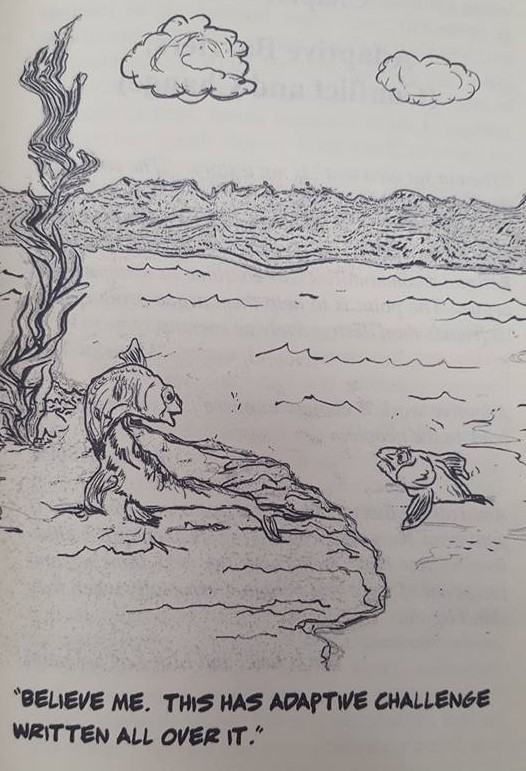
Peter Steinke, the best-selling author and occasional subject of the Just a Little Bit More book blog, is at it again with a new book. Teaching Fish To Walk: Church Systems and Adaptive Challenge is now available at the website of New Vision Press.

teaching-fish-2

Steinke continues to lead the way translating systems theory to congregational functioning. With the current large-scale changes in society and church, Teaching Fish To Walk is timely and instructive. Steinke urges congregations to use change and conflict as opportunities for learning. Many of our churches face the challenge of how to better serve the world and represent the promises of God’s kingdom in the new changing context.

To set the theme for the book, Steinke uses the example of the bichir fish from tropical Africa. This amphibious freshwater fish has both gills and lungs. This species prefers being in water, but when forced to survive on land, it can do so. These fish adapt by drawing their fins closer to their bodies and elevating their heads, which allows their necks more flexibility. Eventually bone and muscle adaptations permit these fish to walk. As Steinke says, “The fish learned to walk, but it took an adaptive challenge for it to happen” (p. 3).

Many congregations founded during the church’s heyday of growth in the mid-twentieth century are now faced with dwindling memberships and questions about future mission. Steinke reaches out to leaders of these congregations and others facing acute adaptive challenges.

This book is not just for clergy but appropriate also for church leaders, many of whom are unfamiliar with systems thinking and terminology. Steinke gives a concise and understandable description of systems thinking in chapter 3, under the section “All of a Piece”:

*Seeing the relationships that exist in discrete parts;

*Knowing that things only exist in relationship to other things;

*Recognizing that the whole cannot be understood by studying independent parts;

*Understanding that nothing is influenced in one direction, as in cause-and-effect thinking;

*Acknowledging that behavior is mutually influential and maintained (p. 33).

Practical descriptions such as this one help church leaders and pastors work together with new thinking and subsequent fresh ideas on the adaptive challenges their congregations face.

Steinke’s viewpoints are not simply rehashes of his previous work – he gives up-to-date insights on the relationship between anxiety and imagination; the differences between adaptive change and technical change, between managing and leading; and, a more expansive and helpful definition of the Greek term metanoia (repentance). Metanoia understood as “large mindedness” enables new thinking and visioning.

The effective synchronizing of psychology, theology, and practical insight has always been the hallmark of Steinke’s work. Teaching Fish To Walk follows in Steinke’s well-established tradition. I highly recommend Teaching Fish To Walk to pastors and congregational leaders who trust that the cycle of death and resurrection applies even to the church in the twenty-first century.


Read my interview with Peter Steinke from January 2016.

This blog and website are representative of the views expressed in my book Just a Little Bit More: The Culture of Excess and the Fate of the Common Good. Distributed by ACTA Publications (Chicago), JaLBM is available on Amazon as a paperback and an e-book. It’s also available on Nook and iBook/iTunes, and at the website of Blue Ocotillo Publishing.

isbn 9780991532827

If you’re a member of a faith community – Christian, Jewish, Muslim, Buddhist, or other – consider a book study series of Just a Little Bit More. The full-length book (257 pgs.) is intended for engaged readers, whereas the Summary Version and Study Guide (52 pgs.) is intended for readers desiring a quick overview of the work. It also contains discussion questions at the end of all eight chapter summaries.

Readers of both books can join together for study, conversation, and subsequent action in support of the common good.

The Spanish version of the Summary Version and Study Guide will be available in October 2016. ¡Que bueno!

¡El librito de JaLBM – llamado Solo un Poco Más saldrá este Octubre de 2016!


Faith, Inequality, and the Pursuit of Common Good

I’m looking forward to the fall season of presentations on “Faith, Inequality, and the Pursuit of Common Good.” I’ll be presenting in Austin and Beeville, Texas. One of the presentations in Austin will be in Spanish (on Thursday, November 17) coinciding with the release of the summary version of Just a Little Bit More in Spanish. Solo un Poco Más, expertly translated by Lilia Martínez, reaches out to Spanish speakers with the goal of explaining the American cultural history of wanting and needing “just a little bit more” – both its positive and negative aspects.

jablm-promo-austin-oct-11

Legend says that John Rockefeller Sr., history’s first billionaire, was asked the question “How much is enough?” His purported answer aptly describes a widely accepted and practiced American way of life: “Just a little bit more.” American ingenuity, drive, and accomplishment – flowing from the spirit of “just a little bit more” – has made the world a better place many times over. When this spirit of attainment goes too far, however, social and economic inequalities exacerbate and common good suffers. The spirit of “just a little bit more” has its rightful place in American and other societies, but it must be harnessed. How can it best serve the common good?

The presentation of “Faith, Inequality, and the Pursuit of Common Good” furthers my work that started with the publication of Just a Little Bit More: The Culture of Excess and the Fate of the Common Good in 2014. The fast-paced interactive presentation spiced with history, sociology, religious wisdom, and modern cultural understandings will introduce you to the Caddy Man and the Hungry Ghost – among others. You’ll be glad you came and I trust you’ll be inspired and encouraged to consider what you might do alongside your neighbor to uplift common good for community, society, and world.

“T. Carlos Anderson is an American treasure. He knows this country’s history well and uses it to promote common good. Time flew by during his presentation as he wove his book’s message with humor and kindness.”

Lanny Wilson, MD, Hindsdale, Illinois

“Anderson’s presentation is lively, open, and engaging. Hopeful and personal, this conversation nudges us away from our habitual competition in the culture of excess and into thoughtful commitment to the common good—into being neighbors.”

Dawn Silvius, pastor, San Antonio, Texas

This blog and website are representative of the views expressed in my book Just a Little Bit More: The Culture of Excess and the Fate of the Common Good. Distributed by ACTA Publications (Chicago), JaLBM is available on Amazon as a paperback and an e-book. It’s also available on Nook and iBook/iTunes, and at the website of Blue Ocotillo Publishing.

isbn 9780991532827

If you’re a member of a faith community – Christian, Jewish, Muslim, Buddhist, or other – consider a book study series of Just a Little Bit More. The full-length book (257 pgs.) is intended for engaged readers, whereas the Summary Version and Study Guide (52 pgs.) is intended for readers desiring a quick overview of the work. It also contains discussion questions at the end of all eight chapter summaries.

Readers of both books can join together for study, conversation, and subsequent action in support of the common good.

The Spanish version of the Summary Version and Study Guide will be available in September 2016. ¡Que bueno!

¡El librito de JaLBM – llamado Solo un Poco Más saldrá este Octubre de 2016!

Black Lives, Black Deaths, and American Social Inequality

Terence Crutcher’s death in Tulsa, Oklahoma is an example of American tragedy repeated ad nauseam. In this troubling event, we see the fears and prejudices of previous generations yet alive in our day, bearing ugly and strange fruit.

I’ve been writing about social and economic inequalities for more than three years. The slow recovery from the Great Recession of 2008 initially served as my inspiration to write. In the post-2008 wreck, pension savings vaporized, numerous jobs were lost, and some housing markets tanked leaving homeowners in the cold. People suffered.

But Wall Street recovered soon enough, and nobody from the big banks went to prison or took responsibility for the havoc brought upon the economy because of overextension and greed in the housing loan market. The very well-to-do didn’t suffer. As a matter of fact, in the eight years since the recession, 1 percenters – the term coined to describe the very well-to-do – have prospered fantastically compared to the rest of us.

What does this have to do with Terrence Crutcher – a forty year-old African-American father of four who attended community college and sang in a local church choir – whose car was either stalled or left in the middle of the road? Four police officers on the ground apprehended Crutcher as he walked from and to his car, and two other officers watched him from the sky in a helicopter. One of the officers on the ground shot Crutcher, and he was left to bleed while lying on the black asphalt of highway 36 in northeast Tulsa. Unattended for two full minutes, he later died. He was unarmed. The police officer who shot him is a white woman. Her husband, also an officer, happened to be in the helicopter hovering overhead. His partner in the helicopter initially described Crutcher as a “bad dude . . . who might be on something.” Even if he was on drugs (police claim there was a vial of angel dust in Crutcher’s car; Crutcher had spent four years in prison on drug charges) or somewhat uncooperative – his death was entirely unnecessary. This disturbing case isn’t one of Crutcher being apprehended for “driving while black,” but “car breaking down while black.” Even in our advanced and oh-so modern twenty-first century society, the great American tenant of presumption of innocence doesn’t apply to all. It especially doesn’t apply to American black men, who are six times more likely to be imprisoned than white American males.

Social inequalities naturally exist and contribute to the healthy functioning of a society. The incentives and rewards to advance one’s standing in a market-based economy properly boost social and economic mobility. But rampant and extreme social inequalities make for an unhealthy society. Extreme and chronic social inequalities are created and maintained by unequal opportunities and disproportionate rewards or punishments for people of differing ethnic, economic, or gender categories. The long list of black men and children recently killed by police officers – Michael Brown, Tamir Rice, Walter Scott, Alton Sterling, Philando Castile, and Tyre King are but a few – speaks of a type of social inequality abhorrent and out of control in the US.

Increasing economic inequality in the US – the rich getting richer, ongoing now for thirty-five years – has contributed significantly to social inequality. As Bill Bishop details in his book The Big Sort: Why the Clustering of Like-Minded America is Tearing Us Apart (Mariner, 2009), Americans have been steadily sorting themselves into more homogenous communities, neighborhoods, and social groups since the early 1980s. Social isolation and seclusion do not make for a stronger and more resilient society.

If you are white like me, I have a few questions: Do you have a personal relationship with anyone who is black? If so, have you discussed this issue – black lives and black deaths – with your black friend or acquaintance?

diversity_and_unity

Social problems have social solutions. What we need is more face to face time between the diverse collection of Americans – and less reinforcement of previously held opinions bolstered by hyper-partisans showcased on outlets like Fox News and MSNBC. What would our society be like if people replaced time spent watching Sean Hannity (Fox News) and Lawrence O’Donnell (MSNBC) with time spent talking and listening to fellow Americans who are in a different category socioeconomically or ethnically?

These conversations, I trust, would bear healthy and beneficial fruit for us today and our descendants in their tomorrows. These interactions can help us get to the place where we place less blame on others and work toward greater shared responsibility with others for the well-being of our society.


This blog and website are representative of the views expressed in my book Just a Little Bit More: The Culture of Excess and the Fate of the Common Good. Distributed by ACTA Publications (Chicago), JaLBM is available on Amazon as a paperback and an e-book. It’s also available on Nook and iBook/iTunes, and at the website of Blue Ocotillo Publishing.

isbn 9780991532827

If you’re a member of a faith community – Christian, Jewish, Muslim, Buddhist, or other – consider a book study series of Just a Little Bit More. The full-length book (257 pgs.) is intended for engaged readers, whereas the Summary Version and Study Guide (52 pgs.) is intended for readers desiring a quick overview of the work. It also contains discussion questions at the end of all eight chapter summaries.

Readers of both books can join together for study, conversation, and subsequent action in support of the common good.

The Spanish version of the Summary Version and Study Guide will be available in September 2016. ¡Que bueno!

¡El librito de JaLBM – llamado Solo un Poco Más saldrá este Octubre de 2016!

The Inequality Trifecta

Now that we’re on the other side of the Bernie Sanders campaign, the claim that American society suffers from rampant inequalities is no longer a shocker. If anything, Senator Sanders’ candidacy proclaimed inequality as public enemy number one. He’s helped us understand that inequality in the US (and elsewhere) consists of three sub-categories: income, wealth, and opportunity.richvspoor-large_600x400

Income inequality is the most accessible of the three, revealed by comparisons in hourly wages, daily wages, and yearly salaries of workers. Income inequality is on the rise in the US, and has been for more than thirty-five years.

To understand wealth inequality, consider that the Dow Jones Industrial Average recently crested 18,000. Climbing since July, the average has now hit an all-time high of more than 18,500. Are you among the 55 percent of American adults who own stocks? Before the 2008 “Great Recession” when the Dow Jones index fluctuated between 12,000 and 13,000, close to 65 percent of Americans owned stocks. Today, the pool of stock owners as a percentage of total population is the smallest it’s been in a generation, concentrating wealth. Increases in stock market indices generally mean those that already have plenty get more.

A number of us (myself included) have retirement pensions and other holdings in the stock market. I fit the majority stockholder profile: white college grad living in a household making more than $75,000 per year. According to the Pew Research Center, 55 percent of whites, 28 percent of blacks, and 17 percent of Hispanics held stocks as of 2013. Financial market holdings, along with business and home ownerships are the main markers of accumulated wealth. The racial wealth gap has increased since 2008 in the US – whites have thirteen times greater wealth (overall assets minus liabilities) than blacks, and ten times greater than Hispanics.* Double or triple would be a significant difference – thirteen and ten times greater reveals a rigged system, historically and currently so.

Economist, financier, and author Mohamed El-Erian best explains opportunity inequality in his book The Only Game in Town: Central Banks, Instability, and Avoiding the Next Collapse (Penguin Random House, 2016): “The worsening of income and wealth inequality has been so pronounced within countries that it now also undermines opportunities” (p. 84). In other words, as inequality continues to increase in the sub-categories of income and wealth, opportunities decrease. This explains why the great American tradition of economic and social mobility is morphing, especially during the past thirty-five years, into economic and social immobility. El-Erian, an American with extensive work experience worldwide, warns that the important role of inequality serving to incentivize and reward hard work and entrepreneurship now takes a back seat to excessive inequalities that harm society in many ways. We’re becoming stuck, and it’s not a good place in which to get stuck.

El-Erian further details inequality’s tightening grip. Wall Street has recovered from 2008’s Great Recession. Corporate profits, as a share of GDP, have reached record highs in the post-Great Recession era. Job creation has improved, but wages remain flat. El-Erian says while the rich continue to get richer, “conventional cyclical redistribution policies have been noticeably absent. With active budget policy making heavily constrained by political polarization, there has been a reduced emphasis on transfer payments and other support for the poor” (p. 87).

“Redistribution” – El-Erian knows that the use of the word is dangerous in today’s era of inequality. Since the first era of rampant inequality – the Gilded Age of the late nineteenth century – redistribution, however, has been an important tool to help make an unequal society a better society. Social Security, Medicare and Medicaid, Title 1 of the Education and Secondary Education Act, and Supplemental Nutrition Assistance Program (food stamps) are some examples of redistribution and transfer payments that specifically benefit the elderly and children in America. Without these programs, American society would be decidedly worse off.

What kind of society do we want to live in? What kind of society do we want our grandchildren to live in? I’m all for continuing to advocate for a society that is egalitarian, civil, and full of opportunity with just rewards.

And for those of us concerned that public administration is by design corrupt and inefficient? Yes, those in government need to be held accountable so that the above mentioned programs and other transfer programs are designed smartly and implemented efficiently. Hopefully, just as smartly and efficiently as have been the decisions and policies we’ve seen in the last thirty-five years to siphon income and wealth upward helping to create the trifecta of inequality that now threatens to destabilize our society.

*For you curious types (like me), as of 2013, Asian-Americans have wealth stores that are 70 percent of the level of whites.


This blog and website are representative of the views expressed in my book Just a Little Bit More: The Culture of Excess and the Fate of the Common Good. Distributed by ACTA Publications (Chicago), JaLBM is available on Amazon as a paperback and an e-book. It’s also available on Nook and iBook/iTunes, and at the website of Blue Ocotillo Publishing.

isbn 9780991532827

If you’re a member of a faith community – Christian, Jewish, Muslim, Buddhist, or other – consider a book study series of Just a Little Bit More. The full-length book (257 pgs.) is intended for engaged readers, whereas the Summary Version and Study Guide (52 pgs.) is intended for readers desiring a quick overview of the work. It also contains discussion questions at the end of all eight chapter summaries.

Readers of both books can join together for study, conversation, and subsequent action in support of the common good.

The Spanish version of the Summary Version and Study Guide will be available in September 2016. ¡Que bueno!

¡El librito de JaLBM – llamado Solo un Poco Más saldrá este Septiembre de 2016!


The Donald for Class President – or Not

A friend teaches US history at a local middle school (6th-8th grades). He is of retirement age, but he told me he wants to teach one more year in order to process the 2016 presidential election with his students. “It’s just too interesting to pass up,” he said with a smile.

I agreed with his assessment of the upcoming election and ventured the opinion that “Trump is like a seventh-grader running for class president.” His response: “Exactly!” My teacher friend knows the territory quite well.

Young%20Donald%20Trump

Don’t get me wrong – I have respect for many of Mr. Trump’s supporters and know a few who will vote for him in November. As is well-documented, Mr. Trump and Senator Sanders both tapped into the malaise of many lower- and middle-class Americans. Trump is no isolated, rich aristocrat. He’s in touch with what a number of Americans feel in their gut: things aren’t as they should or could be.

Whereas Sanders took the high road – not denigrating those he blamed for the malaise (“1 percenters”) or demonizing opponents – it didn’t win him a party nomination. Trump, on the other hand, ran his primary campaign as would a seventh-grade bully. Stereotyping in large strokes, name-calling, and fear-mongering with bravado flair – these helped him win a nomination. The tone of his presidential campaign continues on the same trajectory. Being the bully (or the most anti-politically correct candidate), however, won’t win him November’s big prize.

Attacks on Mexicans, Americans of Mexican descent, and Muslims in America; the condoning of violence at campaign events, and the enticing of violent reaction (if he doesn’t win the election) aren’t very presidential in manner or form. Personal attacks and threats of violence are reactionary devices that come straight out of a seventh-grade bully’s playbook, and in the end, they won’t help The Donald get to the Oval Office.

In my book Just a Little Bit More, I describe the current era of excess that began in 1980. Extremism, one of the era’s hallmarks, manifests itself politically (gridlock), financially (increased inequality), and socially (anxiety). Only during an era of excess could someone like Mr. Trump actually pass as a legitimate candidate for president. In an era of greater egalitarianism, candidate Trump’s overstatements and sweeping stereotypes would not have garnered him or his campaign any traction with voters. Additionally, his braggadocio concerning his financial bottom line (“I’m the most successful person to ever run for the presidency”) would have disqualified him because during eras of egalitarianism fewer people consider great wealth to be a societal virtue. Historically, Trump is one of the least philanthropic of wealthy Americans. Son Eric outdistances his father substantially as a philanthropist.

Bullying gets results in the short-term and thrives in an environment where it is hidden or underexposed. But once a sufficient number of people organize and leverage their power to expose the bully and the bullying, the game is over. As Trump’s message and antics go nationwide, they are exposed as simplistic, sensational, and lacking of substance. His poll numbers trend down, evidence that he now alienates more voters than he attracts.

Seventh grade, as we all know, doesn’t last forever; and neither does a bully’s day in the sun. Things in our country could and should be better, as Mr. Trump claims. But that better day, if it comes, will not be forged through bullying, violence, or rage. We’ve learned these important truths in our history classes; it’s not time to abandon these valuable and hard-earned lessons now.


This blog and website are representative of the views expressed in my book Just a Little Bit More: The Culture of Excess and the Fate of the Common Good. Distributed by ACTA Publications (Chicago), JaLBM is available on Amazon as a paperback and an e-book. It’s also available on Nook and iBook/iTunes, and at the website of Blue Ocotillo Publishing.

isbn 9780991532827

If you’re a member of a faith community – Christian, Jewish, Muslim, Buddhist, or other – consider a book study series of Just a Little Bit More. The full-length book (257 pgs.) is intended for engaged readers, whereas the Summary Version and Study Guide (52 pgs.) is intended for readers desiring a quick overview of the work. It also contains discussion questions at the end of all eight chapter summaries.

Readers of both books can join together for study, conversation, and subsequent action in support of the common good.

The Spanish version of the Summary Version and Study Guide will be available in September 2016. ¡Que bueno!

¡El librito de JaLBM – llamado Solo un Poco Más saldrá este Septiembre de 2016!

Listening to Other Voices

If only Jesus of Nazareth had a Twitter or Facebook account, he would have had so many more followers! I jest, of course; self-promotion, while not a modern invention, has reached a fevered pitch in the social media saturated twenty-first century.jesus twitter

Jesus did call upon many to follow him, but on occasion he also practiced something with which the human family has always struggled: listening to other voices.

Mark’s gospel – chapter 7 – tells of Jesus travelling to the foreign city of Tyre, four to five days walking distance to the north and west of Jerusalem. Presumably, Jesus travels to reach out to Jews living there. A woman, decidedly not Jewish, with a sick daughter engages Jesus. Desperate to the point of trespassing convention – women were not to address men in public – she wants Jesus to heal her daughter. He puts her off by saying that he has only come to serve and seek Israelites: “It is not fair to take the children’s food and throw it to the dogs.” Not only was this an insensitive comment, it was arguably a racial insult.

The Syrophoenician woman, however, doesn’t flinch. “Even the dogs under the table eat the children’s crumbs.” Jesus, as if slapped in the face, acquiesces. He tells the woman to return to her daughter; she does and finds her daughter restored to health.

We assume that Jesus had everything figured out at the commencement of his public ministry, and that consequently he needed no further social or theological development. Listening to the voice of this foreign woman, however, Jesus had to reshape – in an instant – some of his understandings. She wasn’t a dog but a full member of the human family; and, God’s mission extended even to her.

Jesus was a committed social egalitarian before this encounter with the unnamed foreign woman; he became a stronger one after the encounter. A social egalitarian is a person who understands all others – those similar and those different – as equals in God’s eyes. Because of this conviction, Jesus spoke and interacted with all sorts of people: religious leaders, the well-to-do and powerful, the sick and excluded, common folks, women, children, and, yes, foreigners. Rarely did he exclude others.

Those who follow Jesus today – not on Twitter or Facebook – do best to heed his example of social egalitarianism, listening to the other and regarding the other as equal in God’s purview. It’s intriguing that in the twenty-first century world with myriad media for communication and connection, we still don’t know one another all that well within the human family. We yet rely on stereotypes and innuendo in our attempts to understand the neighbor who is different. These weak attempts at understanding contribute to many of the problems – from the inability of Congress to enact immigration reform to police brutality and the targeting of police – besetting our society.

We hear it said today that black lives matter. Absolutely they do, just as the lives of widows, orphans, the poor, and foreigners matter according to the divine language of the Hebrew and Christian Testaments. A good question for my fellow white readers who are Christian: Would you have the same type of worldview and outlook you currently claim if you had been born black or Hispanic or Jewish or Muslim?

A worthy goal in today’s modern age is to have a worldview and outlook that incorporates the wisdom of other voices. Authenticity requires being true to one’s own experiences. It also requires the responsibility of listening to others’ experiences. If your experience is the only one that matters, trumping all others, most likely you’re nothing more than a self-promoter.

Much more often than not, spending face and ear time with someone who offers a different perspective than your own makes the world a better place. In today’s America that suffers of too many hot spots of polarization, listening to other voices is difficult but necessary positive social action. Democrats and Republicans, gun owners and non-gun owners, rich and poor, blacks and whites, atheists and religious partisans, folks living in zip code A and folks living in zip code B – what would it be like to talk with and listen to one another rather than talk about others in negative tones and stereotypes?

Social egalitarianism – it sounds like a political party. Rather, it’s a spiritual commitment utilizing the gift of other voices that has the ability to improve our politics and common life. It’s truly what the one human family needs now.


This blog and website are representative of the views expressed in my book Just a Little Bit More: The Culture of Excess and the Fate of the Common Good. Distributed by ACTA Publications (Chicago), JaLBM is available on Amazon as a paperback and an ebook. It’s also available on Nook and iBook/iTunes, and at the website of Blue Ocotillo Publishing.

isbn 9780991532827

If you’re a member of a faith community – Christian, Jewish, Muslim, Buddhist, or other – consider a book study series of Just a Little Bit More. The full-length book (257 pgs.) is intended for engaged readers, whereas the Summary Version and Study Guide (52 pgs.) is intended for readers desiring a quick overview of the work. It also contains discussion questions at the end of all eight chapter summaries.

Readers of both books can join together for study, conversation, and subsequent action in support of the common good.

The Spanish version of the Summary Version and Study Guide will be available in September 2016. ¡Que bueno!

¡El librito de JaLBM – llamado Solo un Poco Más saldrá este Septiembre de 2016!


Gun Nation

America has more guns overall, and more guns per capita, than any other nation. Most estimates claim that Americans own as many guns as there are residents – 320 million. Other nations with higher percentages of gun ownership don’t come close to America’s dominating rate of 100 guns per 100 residents – Serbia rates at 75; Yemen (54) and Switzerland (46) are next closest. Neighbors Canada and Mexico are estimated, respectively, at rates of 30 and 15. US domestic arms sales have been robust since 2008, but concentrated among a smaller group of owners. Fewer American households today have guns (estimates range from 33-40 percent) than was the case in the early 1970s (50-55 percent). Rural life in America has always been associated with gun ownership; increasing urbanization helps explain the decreasing household gun ownership rate.

In my book Just a Little Bit More I detail the rise of the current era of excess that began in 1980 – more profits for the owner class, greater debt for the working class, more polarization, more inequality. The National Rifle Association’s “all or nothing” quest, dating to the mid-1980s – defining any attempt at gun control legislation as an attack on the Second Amendment of the Bill of Rights – fits in the same category of excess. The NRA has a legitimate voice in our open democratic society, and can serve to help the society maintain a proper balance as concerns gun rights and restrictions. For many decades since its inception in the late nineteenth century, the NRA has served that purpose. It’s more than ironic, however, that the NRA’s generation-strong stranglehold on all congressional Republicans and some Democrats enables homegrown hate mongers – Omar Mateen, the latest – to slay fellow Americans with legally purchased assault-style rifles. There are numerous responsible gun owners in America who fully support the Second Amendment and don’t see the need for citizens to own AK-47s or AR-15s in order to protect themselves, their families, and their communities.

More is not always better; the plethora of easily accessible weapons in the US simply means that these types of mass-shooting events will continue to occur. Some of these events will be thwarted, yes, by well-meaning and heroic gun owners. But the long list of mass shootings beginning with Columbine in 1999 won’t be ending any time soon – as long as this society allows for the status quo to continue.

More than 30,000 Americans die yearly by gun violence; each day more than thirty die by homicide and more than fifty by suicide. Gunfire injures an additional 240 Americans per day. A colleague of mine recently commented that “America is a society addicted to violence.” Call of Duty, the best-selling war-based video game, is played by youngsters all across the US. Learning the art of war, unfortunately, is a necessity in our world of disagreements, disputes, and evil intentions. Perpetuating a culture desensitized to violence and killing, however, is not necessary.

Twentieth century Christian theologian Reinhold Niebuhr (credited with writing the Serenity Prayer, used by twelve-step groups) wisely opined concerning human progress: “There is therefore progress in human history; but it is a progress of all human potencies, both for good and evil.”

It’s a good thing when an armed American woman is able to protect herself from sexual and physical violence from a perpetrator. This current progress wasn’t a reality in previous generations. We’ve made progress in another area, lamentably: the ease by which we can kill one another.

CainandAbel

Fratricide is one of the first stories in the Bible – Cain killing his brother Abel. The prominent place given to the story speaks to its universality. Humans will continue to kill one another, acting upon the angst that lurks in our souls. Because of this ever-present angst, human community is a continuing challenge.

Achieving and maintaining balance between self-protection, constitutional rights, and the question of who can possess firearms is the hard work of common good. There are no rights that are unlimited. That’s a modern reality in progressive, democratic societies – unlimited rights exist and existed in autocratic and monarchical societies. While politicians in Washington DC are mostly inactive and stymied on the intertwining issues of gun control and gun rights, progress moves forward in communities across the nation. Recent legislation for tighter gun controls in California, Washington, Oregon, Colorado, New Jersey, Maryland, and New York are giving evidence that the NRA is no longer the sole dominant voice in the gun debate at the public square of Gun Nation.


This blog and website are representative of the views expressed in my book Just a Little Bit More: The Culture of Excess and the Fate of the Common Good. Distributed by ACTA Publications (Chicago), JaLBM is available on Amazon as a paperback and an ebook. It’s also available on Nook and iBooks/iTunes, and at the website of Blue Ocotillo Publishing.

isbn 9780991532827

If you’re a member of a faith community – Christian, Jewish, Muslim, Buddhist, or other – consider a book study series of Just a Little Bit More. The full-length book (257 pgs.) is intended for engaged readers, whereas the Summary Version and Study Guide (52 pgs.) is intended for readers desiring a quick overview of the work. It also contains discussion questions at the end of all eight chapter summaries.

Readers of both books can join together for study, conversation, and subsequent action in support of the common good.

The Spanish version of the Summary Version and Study Guide will be available in September 2016. ¡Que bueno!

¡El librito de JaLBM – llamado Solo un Poco Más saldrá este Septiembre de 2016!