
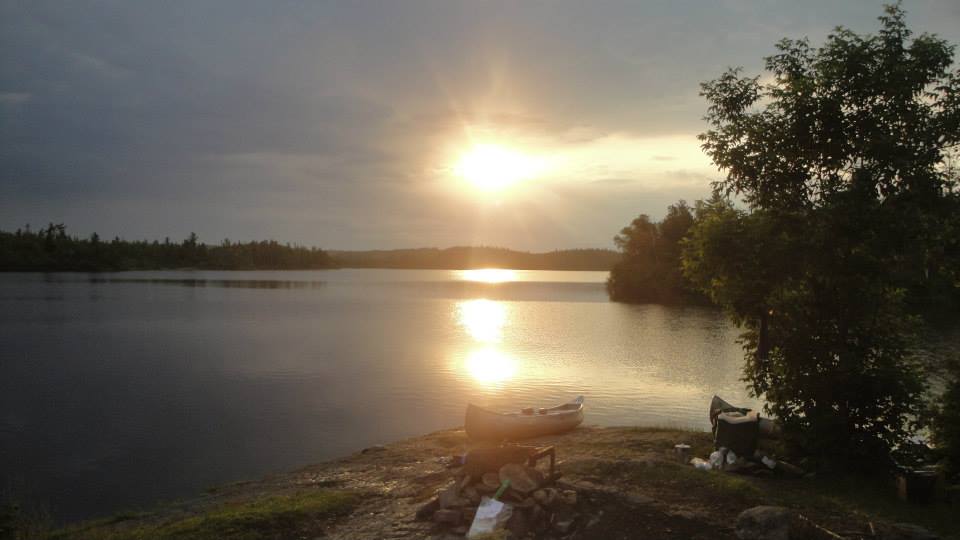
Three generations of my family have been to Minnesota’s Boundary Waters Canoe Area (BWCA), which lies north of Lake Superior and borders Canada within US National Forest territory. The BWCA consists of close to one million acres of lakes, streams, ponds, woods, and portage trails; inhabitants include moose, black bears, loons, eagles, walleye and northern pike. The BWCA’s surface area, incredibly, comprises 20 percent water. No motorboats, no roads, no cars, no cabins, no phones. Your canoe, paddles, map, and compass team up to transport you and your travel companions to and from campsite destinations; your tent, gear, and food – ensconced in backpacks – glide gracefully over the water. These necessities jangle weightily upon your back, however, when you portage them over land. No worries – your canoe comes equipped with shoulder rests. When you turn it upside down and carry it to the end of the portage trail you engage in a workout not replicable on any exercise machine at Gold’s Gym. It’s a great feeling when you throw down your canoe at the end of the trail and simultaneously feel the spray of water upon your legs and hear the boom of the canoe as it bottoms upon flat water.
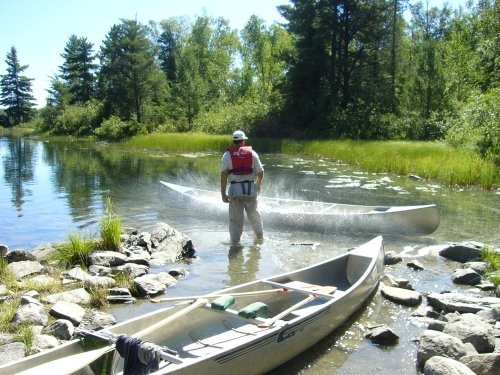
My most recent trip to the BWCA, in 2013, was with a high school youth group from the church I serve in Austin, Texas. It was a great trip full of challenges and rewards. At the end of our trip, we came across a US Forest Service worker. Forest Service employees in the BWCA tend to myriad tasks, including trail maintenance. I asked him how long he had been working for the Forest Service – twenty-five years. I then asked him what were the biggest changes he’d seen in that time – extreme weather.
“The storms in the past years have become stronger and greater in intensity.”
Climate change. It’s happening everywhere. Travel writer Rick Steves sees its effects in Europe. Author Charles Fishman writes about the crippling droughts affecting Australia. Haboobs – an Arabic word we now know because of climate change, meaning intense dust storms – hover from the Middle East and North Africa to Arizona and Texas. Straight-line winds in excess of ninety miles an hour hit the BWCA in July 1999 felling an estimated 25 million trees; one person was killed and sixty were injured. Called a derecho (“straight” in Spanish), it was the largest northernmost storm of its type in recorded history to hit the North American continent.
Climate change is now an accepted reality, yet, people still bicker back and forth as to its cause – or whether it’s simply part of the climate variation that has always existed. Will the effects of historically excessive amounts of carbon dioxide (now at 400 parts per million) in the atmosphere doom the planet?
In Just a Little Bit More, I describe the culture of excess that has been prominent since 1980. Three tenets undergird the culture of excess: bigger and more is always better (from restaurant serving portions to silicone breast implants), economic growth is the panacea for all problems (politicians Republican and Democrat agree), and wealth is the highest societal value. (Is anyone ready for a new Rushmore of Rockefeller, Carnegie, Mellon, and Trump?)
Extreme weather events – and accompanying manifestations, like wildfires – have ravaged the planet for a very long time. Yet, the intriguing connections between recent extreme weather and the current reign of the culture of excess beg investigative thought and reflection.
Economic growth, unequivocally, is the maker and driver of the world we call modern. Before the industrial era (when carbon dioxide levels were at 280 parts per million), poverty and life expectancy rates were – by today’s standards – dismal. The changes and capabilities wrought in the last 250 years simply astound. But how far and how long can economic growth continue as is?
In the bodily progression from childhood to adulthood, limitations eventually halt human physical growth. Human development – in wisdom and maturity – continue on (we trust) as an adult ages. Similarly, I argue that now is the time for greater emphasis on economic development – smart, efficient, and purposeful – as opposed to unabated economic growth.
With religious-type zeal, those who oppose limits on economic growth (see George Will’s recent article on Pope Francis) thunder as if to say whosoever shall stand in the way of the divine right to make as much money as possible be damned! Do not mess with the combination of the three tenets of the culture of excess! Yes, people need jobs – the main mode by which to physically survive on this modern planet. But we must steward the resources of the planet, responsibly and wisely, in the process of working, living, and surviving – together.
When you don’t get enough sleep, your body tells you via symptoms that you need more sleep. If these messages are ignored, breakdown is certain. The recent extreme weather events of heat, cold, floods, snow, drought, and wind could very well be symptoms of a planet that is being transformed by an elevated carbon footprint. As the phrase proclaims – life will go on. But whether or not human life is part of the planet’s future is an open question. Theologian Matthew Fox says that we are the only species on Earth that has the power to control our own destiny; but even so, we’ve yet to decide what to do – whether to live or to die.
The next time you wander out in the darkness – maybe on a canoe trip – and look up and see “the stars pinned on a shimmering curtain of light,” think about Matthew Fox’s statement.*
This blog and website are representative of the views expressed in my book Just a Little Bit More: The Culture of Excess and the Fate of the Common Good. JaLBM, distributed by ACTA Publications (Chicago), is available on Amazon as a paperback and an ebook. It’s also available on Nook and iBooks/iTunes, and at the website of Blue Ocotillo Publishing.
If you’re a member of a faith community – Christian, Jewish, Muslim, Buddhist, or other – consider a book study series of Just a Little Bit More. The full-length book (257 pgs) is intended for engaged readers, whereas the Summary Version and Study Guide (52 pgs) is intended for readers desiring a quick overview of the work. Readers of both books can join together for study, conversation, and subsequent action in support of the common good.
*Quotation from Bruce Cockburn, “Northern Lights,” Dancing in the Dragon’s Jaws (1979, True North).
 The T. Carlos Blog