Water’s Lesson – The Future Favors Development, not Growth

Third in a series of blog posts on water. Click here for first, second.

A Google search on economic growth yields 65 million results – double that of a search on economic development. Whereas politicians and pundits tout economic growth as the panacea of all that ails us, economic development is the way of the future (and present).

What’s the difference between growth and development? It’s not just semantics, but the difference between 10-11 billion people surviving on one planet or having to look for two to three other planets in order to support lifestyles that are hyper-exhaustive of resources and waste sinks. Whereas growth tends to push aside all other considerations for the sake of bigger and more, development is built upon efficiencies and accepts the reality of limits.

Water1As I said in my first blog post on the irreplaceable and life-enabling resource of water, the freshwater supply on Earth is completely stable, having arrived here some 4.4 billion years ago. We have what we have: we can’t order any new supplies of water on Amazon, nor can we expect China to manufacture new supplies. As population continues to increase (currently 7 billion and projected to be 10-11 billion by 2100), the fresh water that exists will have to be shared. Desalination has become a somewhat cheaper process than it used to be, but its overall yield is minimal. Saudi Arabia and Israel – situated in desert climes – benefit from desalination. But for Americans, surrounded by rivers and lakes, desal is not a great solution.

Charles Fishman’s excellent book, The Big Thirst (Free Press, 2011), shows over and again that conservation and decreased use of water IS compatible with economic development. Have you been to Las Vegas lately? The desired destination in the desert gets most of its drinking water from Lake Mead, the big pool of water from the Colorado River that sits behind the Hoover Dam. Vegas gets all of four inches of rain annually. The past twenty-five years, as Lake Mead’s levels have plunged due to drought, Las Vegas has been very intentional about its water consumption. Vegas’ water consumption per capita has decreased more than 30 percent since 1990. Yes, its many golf courses and hotel water fountains betray an extravagant use of water, but Las Vegans have adopted a new mindset: conservation of water is the new normal.

Let’s be honest. Conservation goes against what many Americans have grown accustomed to: wanting what we want (now) without having to accept anything less. It’s all part of the just a little bit more spirit. But, alas, all is not lost. We Americans are an adaptable bunch . . .

According to Fishman, American industry leads the way on smart water usage and conservation. Campbell Soup uses less water today to produce a can of soup than it did five years ago. Coca-Cola, Intel, Monsanto, IBM, and GE have this in common: these corporations realize water availability is limited and are doing (and planning to do) what they can to get by with less water. Their present and future vitality – continued economic development – depends upon water use efficiencies.

Are there any purple water pipes in your neighborhood? Purple pipes signify the presence of reclaimed water or treated wastewater. Some cities in California, Texas, and Florida are saving on potable water via increased use of reclaimed water. Is it really necessary to flush our toilets with potable (drinking) water? In the future when our grandchildren’s generation looks back to review our water habits of today, potable water in toilets will be deemed wasteful (even though appreciated by a number of our dogs). Soon enough watering lawns and plants with drinking water will also be a thing of the past – as will be many of those lawns.

Water is the new oil. The sooner we treat both resources as precious, limited, and belonging to the whole human family – including those coming after us – the better. Economic development, smart and efficient, with a nod to conservation is the only economic activity that will survive as this century goes forward. Our understanding of water is now permanently altered due to climate change-induced drought and population growth. The crucial issue of water use deserves our very best attention and innovative thinking as we go forward.


This blog and website are representative of the views expressed in my book Just a Little Bit More: The Culture of Excess and the Fate of the Common Good. JaLBM is available on Amazon as a paperback and an ebook. It’s also available on Nook and iBooks/iTunes, and at the website of Blue Ocotillo Publishing.

For book clubs, community of faith study groups, and individuals, the Summary Version and Study Guide of JaLBM is now available at the Blue Ocotillo website and on Amazon. It’s a “Reader’s Digest” version (fifty-two pages) of the full-length original with discussion questions at the end of each chapter. Join the conversation about social and economic inequality – without having to be politically hyperpartisan – and let’s figure out how capitalism can do better!
A Toast to Clean Water

(Second in a series – click here for “Water – The Ultimate Fixed Asset.”)

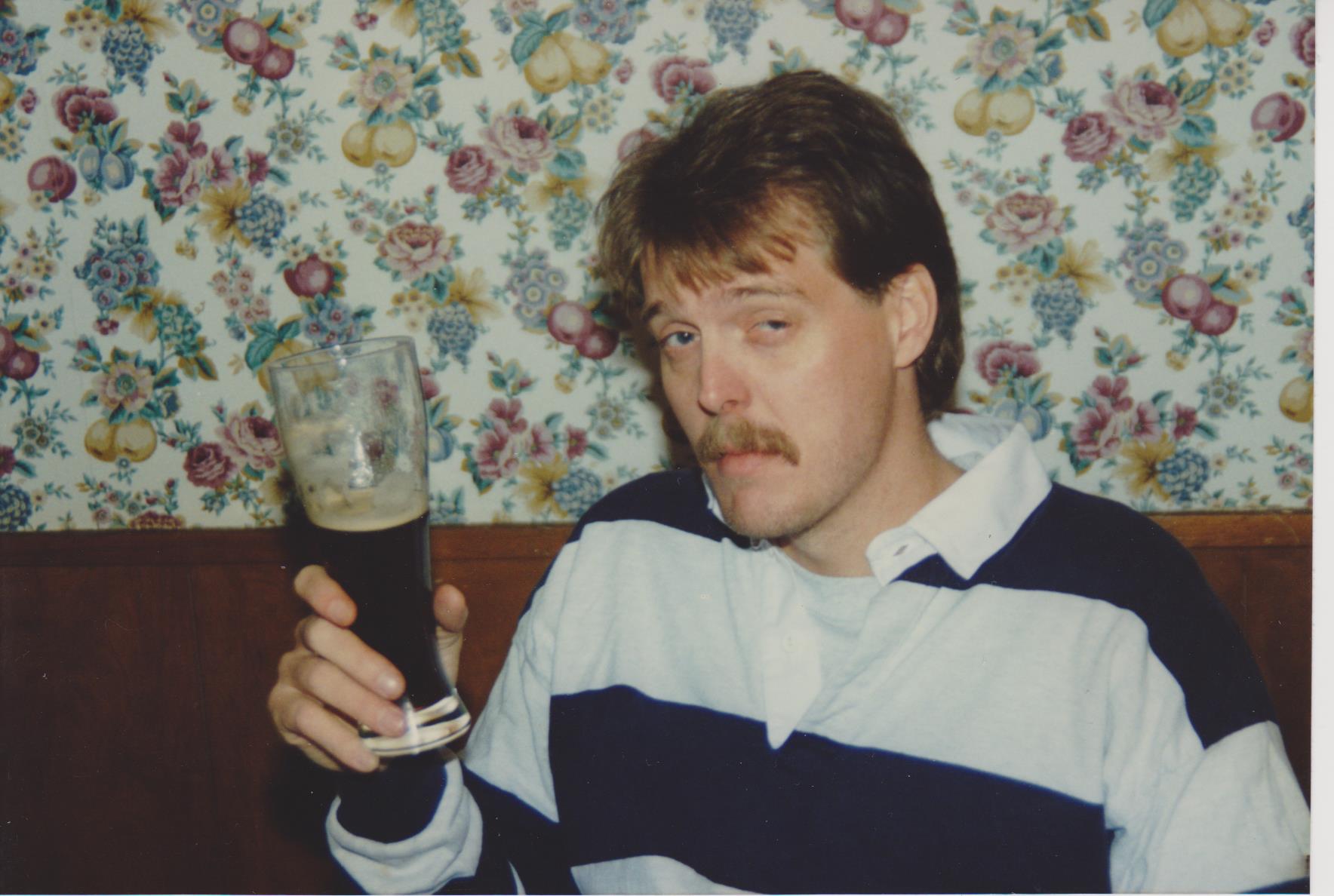
Making homebrew – far and away my favorite hobby of all time.* When my brother Matt shared one of his first batches of homebrew – a smooth weissbier(wheat ale) – I was hooked. I brewed for seven years or so during the 1990s. My favorite concoction was a Cranberry Wheat; I would make it in November as soon as fresh cranberries appeared in the produce section of the grocery store. Charlie Papazian’s 1984 tome, The Complete Joy of Home Brewing, served as my brew bible. I’m not the only one who can say so: Papazian’s book has sold close to 1 million copies. Take that, macro brews Bud/Miller/Coors (known as “yucky beer” in the Anderson household). Long live micro and home brews!

homebrew
Cranberry Wheat – Houston, TX 1996 — Floral Design Wallpaper – looks like circa 1981?!

No offense intended to my friends who make their own wine. Making homebrew and wine are very similar in process – carboys, fermenting bubblers, specific gravity readings. But the end results are markedly different. A home vintner can ferment something decent, but rarely superior to the category of $10-12 bottles at the wine store. (Home vintners can create unique beverages not found anywhere else, however.) Home brewers on the other hand, consistently kick macros’ asses and can make stuff just as good as the American craft and quality import beers offered commercially.

The great reformer of the 16th century church, Martin Luther, famously enjoyed the homebrew made by his wife, Katharina von Bora. At that time, beer was available for sale (the 1516 Reinheitsgebot law dictated that beer be made only from water, barley, hops and yeast), but homebrew rivaled commercial beer production in quantity and quality. Luther lamented times of travel when he found himself in places where good beer was scarce; he pined to return home: “What good wine and beer I have at home, and also a beautiful lady.”

If you’re a homebrewer, undoubtedly you’ve heard the following narrative: beer, its alcohol content killing the impurities in the water, saved our medieval ancestors from peril and disease caused by drinking contaminated water. It sounds nice – especially to a homebrewer – but it’s mostly the stuff of legend. Many have died through the ages from waterborne diseases like cholera and dysentery, but it’s been clean water, not beer or wine, that ultimately allows for our collective gene pool to perpetuate.

Charles Fishman, in his excellent book on present and future predicaments related to water, The Big Thirst (Free Press, 2011), argues that our attitudes and assumptions about water need to change. Close to 1 billion people in the world lack ready access to reliably clean water. Meanwhile in the developed nations of the world, bottled water is one of the biggest growth markets of the last generation. Both the pros and cons of bottled water are well-known: bottled water is perceived to be safer than tap water in municipalities that have not updated aging distribution pipes; bottled water is a healthier option than sugary sodas; yet, the production of billions of plastic water bottles is an inefficient use of resources and a prolific begetter of pollution; and, the cost of bottled water, incredibly, is higher than milk or gasoline.

In my previous blog post on water, I expound on Fishman’s crowning of the twentieth century as the golden age of water, wherein the availability of potable water – “unlimited, free, and safe” – consequently became taken for granted. Fishman calls the business of bottled water “the final flowering” of the golden age of water. Stop by a quick mart store in Anytown, America and gaze through the glass refrigerator doors to see rows of bottled water available from the French Alps, the Italian Alps, Germany, and Fiji. Yes, Fiji, where more than half of residents do not have access to reliably clean drinking water. “A silly triumph for capitalism . . . the market has created very persuasive solutions for water problems that don’t exist, while failing to find any solutions for real water problems” (p. 137).

Fishman reminds his readers that all water problems are local and regional, and their solutions must be local and regional. Even so, with increasing global population (and an unchanging amount of fresh water available), more people worldwide moving into the middle class (and thus using more water), factories spreading to developing nations (using much more water), and the advance of climate change (more regions of the world affected by drought), our attitudes about water need to change significantly. By 2050, it’s possible that 2 billion people worldwide will not have ready access to reliably clean water.

Water issues and problems will predominate into the twenty-first century. The next time you raise a glass – beer, wine, or water – give thanks for what you have and be not afraid to change your attitudes about water. The survival of the human family, no less, depends upon it.


The next blog post continues this series on water and concerns specific changes needed in attitudes about water and related practices.

*Those who know me might think golf is my fave hobby of all time. In my world, golf is best categorized as an obsession – a healthy one, of course.


This blog and website are representative of the views expressed in my book Just a Little Bit More: The Culture of Excess and the Fate of the Common Good. JaLBM is available on Amazon as a paperback and an ebook. It’s also available on Nook and iBooks/iTunes, and at the website of Blue Ocotillo Publishing.

For book clubs, community of faith study groups, and individuals, the Summary Version and Study Guide of JaLBM is now available at the Blue Ocotillo website and on Amazon. It’s a “Reader’s Digest” version (fifty-two pages) of the full-length original with discussion questions at the end of each chapter. Join the conversation about social and economic inequality – without having to be politically hyperpartisan – and let’s figure out how capitalism can do better!

Water – The Ultimate Fixed Asset

The first in a series of three blog posts on water.

Ninety-seven percent of the world’s water supply is salty sea and ocean water. Of the remaining 3 percent that is fresh water, most is frozen (estimates range from 68 to 83 percent). That means over 7 billion people, and myriad plants and animals, share the relative small amount of fresh water that sloshes around. The planet’s water supply – established some 4.4 billion years ago – is absolutely stable. No new water created, none disappearing – the fresh water that exists today supported the lives of multicellular organisms, plants, and dinosaurs long before the arrival of Homo sapiens.

waves-wallpaper-nature-sea-ocean-water-freshness-hd-ocean-water-hd-desktop-wallpaper-Although there would be no life but for water, we absolutely take water for granted. We do the same with the oxygen content of the air we breathe, readily available wherever we might amble upon the green, brown, and blue planet. Water is different, both abundant and scarce, depending upon circumstances and location. We modern-world, well-to-do types simply turn on a faucet and sweet, potable water discharges. I was born in 1961 in Minnesota and I’ve yet to live a single day in the United States when potable water was not available to me on demand.

In the late 1980s, I lived in the South American country of Peru, serving as an intern pastor in a small pueblito called San Antonio de Pomalca. Located in the Sechura desert, the residents of the village retrieved water daily from a well. The folks of San Antonio de Pomalca knew two things about their water supply: it wasn’t unlimited and it needed to be shared.

This type of simple wisdom flies in the face of what has been a driving force in the United States ever since the early 1980s: unlimitedness. Whether water, energy, creativity, resources, or the all-you-can-eat restaurant buffet (an Americanism, different than the Swedish smorgasbord, meaning sandwich table, where variety is valued over endless supply) – we’re encouraged to go for it – don’t hold back. And why not? The spirit of “just a little bit more” is the driving force behind numerous American achievements and accomplishments, beneficial to you, me, and many others throughout the world. But when the spirit of just a little bit more goes too far, blatant inequalities and unjust inequities are often the result.

A good number of Americans born previous to 1961 grew up in domiciles without indoor plumbing or central air conditioning/heating. Maybe you’re one of these folks. You probably don’t take clean, running water for granted. You’re thankful for it because you remember a time when you didn’t have it.

Author Charles Fishman tells us that the twentieth century was the golden age of water. In his book The Big Thirst (Free Press, 2011), he attributes the significant increase in life expectancy in the United States – forty-eight years in 1900 to seventy-five years in 2000 – in large part to enhanced availability of clean water. He says that water became “unlimited, free, and safe” – meaning we didn’t have to worry about water. We could take it for granted. And we do.

The golden age of water, however, is coming to an end. Climate change and related drought, population increase, and heightened competition for water usage are combining to wake us up to the reality of water as a fixed, and not unlimited, asset.

The challenge: can today’s generation of Americans adjust to limitedness? Limitedness calls for conservation, efficiency in usage, and sharing. The values supporting these practices go against the grain of the way many of us are accustomed to living.

I’ll have two or three more blog posts to follow on this very topic. There’s a lot to talk about: desalinization, bottled vs. tap water, market forces on the price of water, gray water in your toilet (yup), among others topics.

By definition a fixed asset is tangible property central to the operation of a business, not traded or converted into cash. Water is central to the business of life – we do best to appreciate it, cherish it, and share it.


This blog and website are representative of the views expressed in my book Just a Little Bit More: The Culture of Excess and the Fate of the Common Good. JaLBM is available on Amazon as a paperback and an ebook. It’s also available on Nook and iBooks/iTunes, and at the website of Blue Ocotillo Publishing.

For book clubs, community of faith study groups, and individuals, the Summary Version and Study Guide of JaLBM is now available at the Blue Ocotillo website and on Amazon. It’s a “Reader’s Digest” version (fifty-two pages) of the full-length original with discussion questions at the end of each chapter. Join the conversation about social and economic inequality – without having to be politically hyperpartisan – and let’s figure out how capitalism can do better!


Can Science Replace Religion?

New Atheism – led by scientists Sam Harris and Richard Dawkins, and others – is deeply critical of religious teaching and practice. Harris says in support of his book The Moral Landscape (Free Press, 2011), “Religious ideas about good and evil tend to focus on how to achieve well-being in the next life, and this makes them terrible guides to securing it in this one.” He and others posit science as a better way to determine worthy human morals and values.

Harris is right to criticize religious understandings that place oversized emphases on an afterlife at the expense of present day concerns – consider the 9/11 terrorists and the supposed promise of virgins awaiting them in paradise, a tragic blend of hate and misogyny inspiring them to act in this world. Harris is also right to look to science to determine better ways for humans to know, think, and interact – making the world a better place now and in the future.

But, before we get too excited about its promoted versatility: science will never solve all of our problems. The human family yet needs good religion. Getting rid of religion, as advocated by Harris and Dawkins, would be akin to throwing out the baby with the bathwater. Additionally, it increases the risk of making science something it is not – a religion.

Consider, for example, forgiveness. Science can teach us about the benefits of forgiveness, but it can’t teach us how to put it into practice. That’s what religion does. Furthermore, religion and science working together help define and categorize different types of forgiveness, a mutual enhancement that makes the world a better place. People who practice forgiveness tend to have lower blood pressure, live with less stress and anxiety, and understand thou shalt not kill as a good guide to navigate relationships with other human beings in this present world. Forgiveness incorporated rejects the option of vengeance. All of these are enhancements to the health and well-being of the whole human family.

The word religion, from the Latin religio, means to fasten, bind, or reconnect. There is no question that religions are human constructions, and consequently not perfect. For Jews, Christians, and Muslims, forgiveness is central to their religious understandings for life in this world. Forgiveness – ritualistically part of all three systems – reconnects adherents with the Divine and binds adherents to one another in this life. Human beings created religions, in part, to help forge community ties. Forgiveness enhances and binds those relational ties, from birth to death.

The story of Joseph, son of Jacob, is shared by the three monotheistic religions. Dreamer of stars and moons, Joseph, the younger offspring and favorite of his father, is sold into slavery by his jealous and envious older brothers. Only later, when the brothers and their families are suffering from hunger and famine, do they unknowingly face their long lost brother Joseph. They are in a most desperate situation, physically and emotionally. Joseph, now powerful and holding in his hands the fate of his brothers and “their little ones,” has the option to choose vengeance upon his brothers for having sold him into slavery so many years earlier. He instead chooses forgiveness – and family reunion.

Of course, religion has been misused through the ages. It has caused great and painful suffering, even to our present day. But it has also taught humans to love one another, to accept one another, and to forgive one another. Religion, like anything else worthy of human attention and endeavor, needs to be continually reformed in order to be better. The old story of Joseph and his brothers has the unique ability to instruct and reform the current and future human family; forgiveness is an essential element for the very survival of humanity.

British writer Bryan Appleyard critiques thinkers who endow science with the ability to give a “final and full account of the world.” Harris and Dawkins have legitimate critiques of religion and some of its practices, but ultimately they advocate science as the one and only true way – essentially, a new religion. This type of thinking is categorically fundamentalist – a type of thinking that usually is not beneficial to the health and well-being of the human family. Atheism is a belief system just as much as any religion can be. True wisdom understands the world to be a big place, large enough for the scientific theories that explain the essence of stars and moons and large enough for the religious systems that bind us together as people who practice virtues like forgiveness.


These blog posts are representative of my work in Just a Little Bit More: The Culture of Excess and the Fate of the Common Good. The book is available through the website of Blue Ocotillo Publishing, www.blueocotillo.com, and Amazon. Blue Ocotillo Publishing – paperback – $14.95 + tax (for Texas residents) + shipping. Ebook format available on Amazon, iBooks, and Nook.

Monday Matters Book Club Studies “Just a Little Bit More”

The Monday Matters book club, based at Triumphant Love Lutheran Church in Austin, Texas, has been gathering for discussion and shared insight more than twenty years. The group originally met in the house of Ted and Velma Ziehe; the first book studied was Marcus Borg’s Meeting Jesus Again for the First Time, its debut conveniently coinciding with the group’s formation in 1994. The initial group, consisting of Lutherans, Presbyterians, and Baptists, liked Borg’s depth of critical scholarship within a faith perspective. Borg’s journey from a naïve, unquestioning faith to one of maturity and authenticity was a positive struggle shared by many in the group. The group decided to keep meeting. The lure of Velma’s cookies and the conversation promised by the study of other good books guaranteed the group’s viability for many more years.

Five years ago, the group started to meet at Triumphant Love. Engineers, pastors, teachers, nurses, and entrepreneurs comprise the group. While neither diverse ethnically nor socioeconomically, the group colors the political map blue, red, and purple. It’s good for Democrats, Republicans and independents to be in conversation with one another in a religious setting: all are reminded that theology is to inform politics, and not the other way around. We might not see eye to eye politically, but we can be in conversation with one another on how best to love and serve our neighbor in God’s name – together.

monday matters
Monday Matters book club – Triumphant Love Lutheran, Austin, TX

Thanks to Norb Firnhaber and Leroy Haverlah who suggested that the group study Just a Little Bit More. Group convener Doug Nelson graciously told me more about the group and helped distribute copies of JaLBM. I introduced JaLBM themes to the group on February 16 – including the dominant religion in America as represented by the Caddy Man (you need to get to know him if you don’t already) – and they took it from there. They convened five sessions to discuss chapters one through eight and invited me back for a closing session on April 6. It was good to meet new folks and see others that I already knew – Ralph and Ellie Erchinger, Dorothy Kraemer, Jim and Kris Carlson – and to be in meaningful conversation with them. Doug Nelson says JaLBM brought out “the most vibrant discussions” the group has had for some time.

If you have a group at church, synagogue, or temple that appreciates meaningful discussion on the important social and economic issues of the day – without falling into well-worn blue and red ruts – take on a study of JaLBM. The book challenges readers with a perspective that cuts against the grain of today’s accepted conventional wisdom of money as highest good. As Peter Steinke says in the book’s foreword, JaLBM benefits its readers by showing “how we have shaped the system we are a part of and what can lead to a new way of doing economics that embraces the common good.”

The summary version of JaLBM with study guide questions is now available at the Blue Ocotillo Publishing website. The study guide version summarizes JaLBM‘s eight chapters and poses questions for discussion at the end of each chapter. Whether reading the full length book or the summary version, all present in a group setting can enter into meaningful discussion and conversation, just like the Monday Matters group at Triumphant Love did for seven sessions.

For those groups in Austin and its vicinity, I am available for presentations to lead JaLBM discussions on the topics of egalitarianism, social mobility, economic democracy, and common good – all from a faith perspective. I’m confident the discussions will be worthwhile and influential.

———————————————————————————————————–
“Anderson’s book is an extensive chronicling of the people, movements, and streams of thought that have led us on the quest to want just a little bit more. In the role of a theologically aware social critic, he reminds me of Niebuhr. He is deeply embedded in the Christian tradition, but has listened carefully to many other voices and thus speaks a reasonable, balanced, and authoritative public word. Anderson shows us the way back toward a commitment to egalitarianism that has become lost over the last century.”
Dr. Phil Ruge-Jones, Professor of Theology and Philosophy, Texas Lutheran University


Just a Little Bit More is available through the website of Blue Ocotillo Publishing, www.blueocotillo.com, and Amazon. Blue Ocotillo Publishing – paperback – $14.95 + tax (for Texas residents) + shipping. Ebook format available on Amazon, iBooks, and Nook. JaLBM Summary Version and Study Guide is available at the Blue Ocotillo Publishing website.


Sorry, I Don’t Know Anyone Who is Poor . . .

Do you have a friendship with anyone who is poor?

Since writing and continuing my work with Just a Little Bit More, I’ve had a lot of conversations with others in my own socio-economic status range – upper-middle – about those in our society who live in poverty. Currently, the US poverty rate is around 16%. (I’m aware that there are some who bicker about the rate – how it’s determined and calculated. I’m using the government poverty threshold rate – for 2014, income of $23,850 for a family of four – which helps lend consistency over a fifty-plus year period, going back to 1959 when the US government published the first national poverty rate – 22.4%.) A lot of folks in the upper classes talk about the poor in our society, but the majority of those who speak don’t know – not by acquaintance, and certainly not by friendship – anyone who is poor.

Author Bill Bishop tells us why this is so in his book The Big Sort: Why the Clustering of Like-Minded America Is Tearing Us Apart (Houghton Mifflin, 2008). He argues that even as America becomes more diverse in overall demographics, we increasingly live in neighborhoods – and socialize – with people who think, vote, and sort their values just like we do. Remember the days when a mechanic and a doctor could be next door neighbors? The America of yesteryear was segregated racially; the dominant segregation in today’s America is socio-economic and often political – reflecting, in part, the polarization that dominates our strained social interactions. Bishop claims only 25 % of American counties in the 1976 presidential election were deemed landslide (more than a 20 point margin of victory); in the 2004 presidential election over 50% of American counties were landslide.

Sorry, I don’t know anyone who is poor, but I certainly have an opinion about the poor.

So true. I’ve learned by listening to middle/upper-middle/upper class folks (white, mostly – all my Latino and African-American friends and acquaintances do know people who are poor) to know what they say about those living in poverty, because I’ve been asking this question consistently for a couple of years when conversing about social inequality: Do you know anyone who is poor? The answer typically breaks down into four opinions/viewpoints: 1) personal knowledge (or an anecdote heard) of a bona fide slacker who doesn’t work and sponges off the government; 2) the story (the one answering the question) of his/her rise from poverty back in the 1940s or ’50s (the implication being that social mobility is alive and well in America); 3) the claim that poor people lack discipline and are lazy – again, the implication being that social mobility is alive and well in America; and, 4) the reality that people living in poverty in the United States have it so much better off than poor people in other parts of the world.

Yes, there are bona fide adult slackers who sponge off the government – without question. It’s tempting to think, however, if you don’t know anyone who is poor – the law of generalization – that all people living in poverty consequently fit this same pattern. Those of us who know people living in poverty realize that such a generalization is nowhere close to the truth. A small minority of adults sponge off the government; consider that half of those living in poverty in the United States – some 22.5 million – are children or elderly. The United States has an abysmal 23.1% child poverty rate. According to a 2012 UNICEF report of the thirty-five richest countries in the world, the United States ranks 34th in childhood poverty. Thanks to Romania’s rate of 25.5%, we avoid the cellar in childhood poverty rankings.

As for social (or economic) mobility – work hard, save money and you’ll succeed by moving up – it works well for middle and upper class, educated Americans (with the usual caveats for ethnicity, gender, and sexual orientation). But that same rate of social mobility doesn’t apply to those who are born into poverty, especially among ethnic minorities. The former group – higher classed and educated – is privileged, systemically. Today it’s best to be born rich in America: it’s three times more likely as compared to a generation or two ago that your father’s income will determine your own income. Upward social mobility, overall, is not what it used to be in America.

And, yes, those who are poor in American have it much better off than those who are poor in Africa, India, Russia, and China. My mother tried to get me to eat my boiled asparagus by referencing the starving hordes in Africa (or was it China?), but it was largely unsuccessful. I had no idea or vision of what life was like in Africa. That type of comparison thinking was too abstract for my juvenile mind to process, especially when it was fully engaged in potential strategies to avoid the mushy asparagus that sullied my plate. Similarly, personal income differences within countries matter much more than income differences between countries.  Economic differences can and do serve to motivate the less fortunate to aspire to greater heights, and poor people living in America can count on a better social safety net than poor people, for example, in Belarus. But, prominent economic deprivation in relation to the rest of society is what can warp a young mind and spirit, because the differences are blatant, noticeable, and real. And if the opportunities to advance are few and far between, then many of the social variables affected by poverty (incarceration, teenage pregnancy, and school drop-out rates) are simply and sadly reinforced.

Do you know anyone – a friend or someone who is more than a passing acquaintance – who is living in poverty?

Linda Tirado is someone who has lived most of her adult years in poverty. Her book Hand to Mouth: Living in Bootstrap America (G. P. Putnam’s Sons, 2014) tells it like it is. She got lucky; a blog post of hers that described living in poverty went viral and she ended up with a book deal. As she rightly claims, it’s more like she hit the lottery than worked her way up via a vibrant economic mobility. Her book is a top-seller and she tells a tale that is compelling, insightful, and real for many Americans. There are those, of course, who attempt to dismiss her telling of the tale of living in poverty in today’s America as overdone and exaggerated. I’ve read her book and done my own bit of investigating. Whereas she can tend toward over-generalizing (I’m guilty of the same charge at times), how often does a minority or shunned voice get the stage? She liberally uses profanity, but her voice is genuine. She speaks for a number of Americans who are rarely heard.

From the last chapter in her book, “An Open Letter to Rich People,” Tirado states “I hope at this point you are feeling like maybe you hadn’t thought this whole [socio-economic] stratification thing through all the way. You guys don’t really ever talk to us and have no idea what our daily lives are like.” When we don’t know anyone in a certain people group, it’s easy to stereotype and even demonize them. The majority of people living in poverty are not undisciplined, lazy, or necessarily deserving of their current fate. How might we all work together to remake our society into one where egalitarianism is valued more so than the propagation of entrenched privilege for the most fortunate among us? Tirado asks would you “want to live in the nation you’ve created; if you were born tomorrow into the lower classes, would you be quite so sure that America is the land of opportunity?”

Some of us in the upper classes are effectively cocooned off from those who live in poverty. We don’t know personally anyone who is poor; our interaction with people living in poverty is limited to random interchanges of commerce that bring us together. We who are well-off purchase or receive services from the working poor whose jobs pay the minimum wage of $7.25/hour or slightly more. As if it’s a religion, we teach to our kids and grandkids the unifying belief: If you’re poor, you’ve done something to cause it to happen, and, consequently, you are at fault. When we trust this premise to be true every single time – without exceptions – we create a society with an intentional lack of compassion. What social critic R. H. Tawney described generations ago is still true today: “A society which reverences the attainment of riches as the supreme felicity will naturally be disposed to regard the poor as damned in the next world, if only to justify making their life a hell in this one.” (From his classic of 1926, Religion and the Rise of Capitalism.)

What would it be like if there was more interaction between the socio-economic classes, as equals on a person-to-person level? Take it from Tirado: “There are poor and working-class people everywhere, guys. You can just have a conversation with one, like a real human being. Give it a try. You’ll like it. We’re entertaining. We have to be; we’re stuck entertaining each other because cable is ridiculously expensive.”


This blog post and others on this website are representative of my views and writing in Just a Little Bit More: The Culture of Excess and the Fate of the Common Good, available at http://www.blueocotillo.com, Amazon, or any other bookselling venue.

Pick it up with Linda Tirado’s Hand to Mouth – highly recommended!

Migration Between the Haves and the Have Nots

So . . . now that the 2014 mid-term elections are over, what is to be done about immigration policy in the US?

Branko Milanovich’s treatise on inequality, The Haves and the Have Nots, stands out because of its decidedly non-polemical tone. What a breath of fresh air to read a book that doesn’t have an agenda, other than to inform about its subject – in this case, economic inequality and its social consequences. Robert Reich also writes on the topic of inequality, but from a decidedly left-of-center viewpoint. I appreciate Reich’s work, but he’s mostly “preaching to the choir.” I imagine most folks who don’t agree with his politics ignore his work. Milanovich, on the other hand, shares insights useful for political partisans on either side of the middle divide. Milanovich’s views on immigration are especially clear-sighted and discerning.

Milanovic hails from Serbia; he now lives and works in the US. He’s an economist who has worked for the World Bank; he has taught at the University of Maryland and Johns Hopkins University. I appreciate and like his “outsider” viewpoint; he’s lived in different parts of the world and sees a larger picture of it. His World Bank experience (as an economic researcher) impresses the reader without losing the reader in overly complicated arguments or formulas.

Milanovich covers numerous important issues related to inequality: social mobility, globalization, income distribution between countries and world regions. And speaking of the word inequality: as a researcher looking for study funding sources, Milanovich has discovered (pgs. 84-85) that it’s acceptable to research the elimination of poverty, especially when charity is a potential solution; but much less acceptable to research the causes of inequality, because of the implication that the power structures in place (that produce inequalities) need fixing.

As I said, his views on migration are especially enlightening. As we know, globalization makes the world smaller in a number of ways, including the awareness of living conditions across the globe. Migration is stimulated when the materially poor see (mostly via TV) how the materially well-off live. Since the 1980s, median income differences between individuals in the richest and poorest countries has increased; and, as we also know, large-scale migration is not legal or politically acceptable in the richer countries. But, Milanovich cautions, as long as these economic and social differences exist, migration will be a reality. “In the long run the antimigration battle cannot be won – if globalization continues” (p. 163). Political rally cries to “seal the border,” while expedient (for some) to win an election, don’t get at root causes. As an example, migration to the US from Mexico has slowed considerably since the 2007-08 economic swoon. Because of the recession and consequent slow economic recovery, the incentive to migrate has dissipated for many Mexicans. (The migration of Salvadorians, Hondurans, and Guatemalans – many of these children – is an altogether different story and situation.)

Milanovich argues for an approach that is as much against the grain as it is commonsensical: “Either poor people’s incomes have to be raised in the countries where they currently live, or they will come, in ever-greater numbers, to the rich world” (p. 164). We typically don’t think in this direction – we typically think we (or me) first and let others fend for themselves. But as globalization advances, the peoples of the world are more interconnected than ever before. Milanovich says that today the terms local poverty and global inequality are interchangeable. This wasn’t the case fifty or sixty years ago, before the current era of excess (beginning in 1980) became entrenched. Milanovich further cautions: “High levels of inequality make global chaos more likely” (p. 162).

So, will we have new legislation concerning immigration policy in the US? We’ll probably have to wait for awhile . . . in the meantime I recommend reading Milanovich’s book and considering some statistics, arguments, and insights that you won’t find in many other places. The cause for better immigration policy, among other things, will be lifted up.


These thoughts can be read in greater detail and development in my book Just a Little Bit More: The Culture of Excess and the Fate of the Common Good, available on Amazon and at the Blue Ocotillo Publishing website.

Branko Milanovich, The Haves and the Have-Nots: A Brief and Idiosyncratic History of Global Inequality, Basic Books (2011).

Piketty’s Capital in the 21st Century

Summers are meant for reading longish, thick works of non-fiction – correct? Alright, I know I’m so wrong with that take, but if you are an unabashed non-fiction junkie like me, you know there’s simply not enough time for experimenting with mediocre fiction. I remember reading Buckley’s Thank You For Smoking when it came out in the ’90s; a truly hilarious and well-written read that lasted . . . five days. I have read other good fiction since then, but – I got to speak the truth – I’m in the game for the longer haul. Reading great narrative history (Lansing’s Endurance and Branch’s Parting the Waters, as examples) and good social commentary is what we n-f zealots do all year long. Ain’t it a blast! Here’s the latest review of a non-fiction must read (or, at least, of which one must read a few good reviews).

Thomas Piketty is a French economist; his 2013 book Capital in the 21st Century (English translation, Belknap Press, 2014) is a best-seller in the States and Europe. He teaches graduate level economics in France, specializing in economic inequality. He taught for a short while at MIT in the early 1990s and then returned to Paris to continue his teaching career. I knew enough about Capital before reading it to understand that Piketty and I speak similarly of capitalism’s susceptibility to political intrigue and its (potential) consequent propensity to siphon wealth upward, favoring the wealthy classes. For awhile I was thinking that my book, Just a Little Bit More, could be billed as the local, indie, American (and shorter) version of Capital. But then I read Dr. Piketty’s tome – so much for the local indie angle. Just a Little Bit More covers a lot of territory, but it doesn’t do r > g, or other economic equations. Capital, for the most part, is economics through and through.

Piketty states early on that “the history of the distribution of wealth has always been deeply political, and it cannot be reduced to purely economic mechanisms.”* According to Piketty’s work with extensive data, the rate on the return of capital (r) typically exceeds the growth rate of the economy (g), thus r > g. Historically, the interest garnered by accumulated wealth outpaces the gains of economic growth by about 5% to 1.5%. Are you still with me?

Things are the way they are – the rich getting richer in the US, especially in the last thirty-five years – not because it’s naturally intended by capitalism, but because it’s been manufactured. Piketty’s r > g has been buttressed by policy. Income and capital gains tax cuts for the wealthiest among us, along with reduced rates for inheritance taxes, have all contributed to the widening gap between America’s richest and poorest. The United States was founded to be an egalitarian country where primogeniture was not practiced as it was in Europe. Primogeniture – family inheritance passed onto the first born male – enabled Europe’s staid aristocracy to maintain its power and place. The two great democratic revolutions (American and French) wanted to give meritocracy a chance; you move yourself upward economically not by inheritance or family connection, but by hard work, ability, and effort. The good ol’ American Dream: one has to work to attain it.

There’s been a slight uproar this past week (third week of July, 2014) as it’s been revealed that the late actor Philip Seymour Hoffman didn’t want his children to be “trust fund kids.” His estate, valued at $35 million, will go (after a significant tax bit since he was not married) to his partner, the surviving parent of their young three children. As if a cruel fate (I jest), their children will need to forge their way forward more reliant upon their relationship with their mother than with a choice inheritance. The new American Dream: just give it to me. Hoffman was apparently adamant of his conviction; his accountant was not able to convince him otherwise.  The following Piketty comment supports Hoffman’s suspicion of oversized inheritance: “Every generation must in some sense construct itself.”~

Piketty, benefitting from the vantage point of an outsider, recognizes an important attribute of American taxation and its history that many Americans overlook: progressive taxation serves the purpose of reducing inequality. And a society that is more so (than less) economically egalitarian has fewer social problems. (If you missed Wilkinson and Pickett’s The Spirit Level: Why Greater Equality Makes Societies Stronger, put it on your reading list now – Bloomsbury, 2009.) Piketty reminds his readers that the great country that led the way in democracy and egalitarianism – America – was also one of the last Western nations to abolish slavery. US society maintains a certain schizophrenic attitude about equality and inequality – we tolerate and accept both simultaneously. “This complex and contradictory relation to inequality largely persists in the United States to this day: on the one hand this is a country of egalitarian promise, a land of opportunity for millions of immigrants of modest background; on the other hand it is a land of extremely brutal inequality, especially in relation to race, whose effects are still quite visible.”**

Inequalities based on individual talent and effort, Piketty asserts, are quite acceptable in democratic societies. But when the deck is stacked, so to speak, democracy is threatened. Whereas today in the Scandinavian countries, along with France, Germany, England, and Italy, the richest 10 percent own between 50 and 60 percent of national wealth – in the United States, the richest 10 percent claim 72 percent of America’s wealth, with the bottom half (the majority of these being women) holding just 2 percent. These figures for the European nations and the United States are similar to what they were at the end of the Gilded Age, shortly before the intervention of World War I.~~ Piketty also argues that the Great Depression was a similar type of intervention to counter the rising inequality of the Roaring ’20s. What is to intervene now and combat, as it were, this current era’s rising tide of inequality? The 2007-08 recession hurt most everyone’s bottom line, but the inequality gap is unaffected; it’s as wide now as it was before the recession.

Boldly, Piketty calls for an international tax on accumulated wealth. Obviously, as Piketty himself concedes, such a measure is highly unlikely to be implemented any time soon. Nonetheless, let’s have a conversation about it. There has been plenty of conversation about the “size of government” and the need to reign in the excessive growth of the public sector. (I agree; please read chapter 6, “Excess,” in Just a Little Bit More.) Inefficiency, redundancy, and waste – none of these are helping the cause of societal common good. But let us also converse and discuss – with some depth of argument – the plight of citizens living in and among social and economic inequality. Piketty says that inequality in America could reach record levels by 2030 if contributing factors (which include the meteoric rise of top salaries) continue unabated. “The egalitarian pioneer ideal has faded into oblivion, and the New World may be on the verge of becoming the Old World Europe of the 21st century’s globalized economy.”*** A highly inegalitarian society requires more attention (social programs) in order to maintain social and political order. A more balanced and egalitarian society requires less public attention to mend its ills and deficiencies. This angle of the debate on social inequality and social programs needs greater voice. Piketty reminds: “The primary purpose of the capital tax is not to finance the social state but to regulate capitalism.”~~~ In other words, to keep capitalism in check.

As a person of faith and a public religious leader, I understand Piketty’s warning about the perils of continued and increasing economic inequality as crucial and urgent. What kind of society do we want to live in and consequently pass on to those who follow us? One where the uncritical pursuit of more and more is encouraged as a way forward regardless of the increasing gap between the richest and poorest? Revolutions – many violent – have risen from such chasms. I will continue to work that we (and those who come after us) might live in a society where the value of egalitarianism is upheld for its own good and for the beneficial consequences it brings.


Just a Little Bit More: The Culture of Excess and the Fate of the Common Good (2014) is available at the Blue Ocotillo Publishing website.


* Location 454 (Ebook markings – the first one I’ve read!)

~ Location 1493

** Location 2770

~~ Locations 4409, 4429, 4509 – Piketty claims that the 72 percent figure most likely is underestimated – meaning it should be higher.

*** Locations 4556, 9009

~~~ Location 9073


Interested in more summer reading? I also recommend Lawrence Summers’s “The Inequality Puzzle: Piketty Book Review,” available online and in the Spring 2014 edition of Democracy: A Journal of Ideas. A rec and a pun together – how good is that!

Yergin’s The Quest

I promised to keep you posted . . . and this one is worth the wait.

Daniel Yergin’s The Quest: Energy, Security, and the Remaking of the Modern World (Penguin, 2011) covers the myriad angles of energy production and consumption – oil and gas, coal, hydro, nuclear, solar, wind, and biomass – and most of their related economic and political ramifications. Yergin’s previous effort, The Prize (Simon & Schuster, 1991), is an epic recounting of the oil industry from its conception to its modern-day manifestation. The Prize is one of the best books I’ve read; it’s simply a must read for anyone wanting to understand the workings of our modern energy-dependent world and its future direction.

Perhaps The Prize was too good; the initial two sections of The Quest – essentially an update on the oil industry from where The Prize left off – were a bit slow. All the good oil industry narratives (Rockefeller, Gulbenkian, Pickens) were already covered in The Prize; an exception, however, is Venezuela and Hugo Chavez’s machinations at power via oil. This new story kept my interest and reminded me of Yergin’s ability to tell a good tale while simultaneously expounding history.

Things pick up considerably in section three (and beyond) as Yergin switches gears and covers the energy industry outside of oil and gas. The topics of electricity generation, coal, carbon release and climate change, nuclear power, renewable energies, energy conservation and efficiency make The Quest more than a worthy read. It’s at these points that the books expansive reach most impresses. Additionally, Yergin’s tendency to not cut corners in the telling of the tale gives the reader a sense of satisfaction, as the time investment (more than 300,000 words, 725 pages) is significant. Yergin took five years to write The Quest, and with the help of his research assistants, he consistently delivers. He answers the questions that occur to you as you think through the reading, and discover. Yergin deeply informs (as an example: US nuclear energy production has remained steady at 20% of total energy produced ever since the Three Mile Island disaster of 1979, despite the addition of no new reactors), and presents sensitive issues without too much hedging one way or the other. His treatment of carbon release (section four) is especially balanced and engaging, as he goes back to 19th century protagonists Tyndall and Arrhenius in order to tell the larger story of climate change.

While I won’t rate The Quest as one of the best books I’ve read, I’ll classify it as outstanding in its scope and compelling in its telling of the energy sector’s complexity. There is no modern world without the exploitation of energy stores; being conversant with Yergin helps one to be plugged into that which powers all (or at least, most) things modern.


My book, Just a Little Bit More: The Culture of Excess and the Fate of the Common Good, can be seen as a complex distillation of many books – Yergin’s The Prize being one – contributing their particular insights to the overall message. It is available at the Blue Ocotillo Publishing website.


Brand This

I’m not the first to complain about the overuse and adulation of the words brand and branding. Naomi Klein effectively sounded the alarm in No Logo: Taking Aim at the Brand Bullies. Written fifteen years ago, No Logo indicted consumer culture that elevates image over represented product. Hers is still a valid critique today; to it I will add just a twist of updating: branding in the 21st century includes not only products, businesses, and corporations, but people. You are your brand.

Tom Peters, business management consultant and author, is one of the persons most responsible for the above statement that equates humanity and commerce.  Like Klein, he also published a book in 1999, The Brand You 50. Despite the book’s cheerleading demeanor and its overuse of italics, bold, ALL CAPS, (and parenthetical side comments), it has a loyal following. The main point of the book – the importance of showcasing one’s unique skills, in business settings and in life – is unassailable. Distinction, as exemplified by the term Me, Inc. (used by Peters extensively in the book), makes the brand.

A few years before Peter’s book came out, I participated in a “thinking expedition” for innovators. Led by Rolf Smith, a recently retired USAF colonel, this conference gathered executives and leaders from companies such as Proctor & Gamble and Exxon, among others. I was Rolf’s pastor at the time, and he was kind enough to sponsor me as a participant. I was first exposed to the term Me, Inc. at the conference, and consequently encouraged to broaden my vocational identity through a Me, Inc. mapping exercise. (Rolf Smith – not Tom Peters – created the Me, Inc. concept.) As I look back on it, the expedition played a small but vital part to inspire me to write Just a Little Bit More.

It’s a good thing to take personal inventory – to see how one measures up and to contemplate future possibilities based upon one’s skill set and capabilities. That is precisely what happened for me when I did the beneficial Me, Inc. mapping project in 1996; Rolf never encouraged us to think of ourselves as brands.

Harvard political philosopher Michael Sandel (What Money Can’t Buy) correctly warns us that market values have been on the rise for the last thirty-five years. He reminds us that there are some things that are better off not having price tags attached to them: giving blood, helping older ladies across the street, encouraging underachieving elementary school kids to read (and paying them to do so). The intrusion of market values storms forward as people are increasingly encouraged to put price tags on all things, even to the point of considering themselves as brands. How far will we allow it to advance? Not everything is to be bought and sold, and not all things (especially people) are to be branded and commercialized.

Brand this: I have unique distinction for who I am as a person, completely unrelated to brand and branding. I am not my brand, and I won’t be branded any time soon. Brand that.


Rolf Smith wrote The Seven Levels of Change in 1997. It’s now in its third edition. Highly recommended.

Just a Little Bit More: The Culture of Excess and the Fate of the Common Good, is available in paperback at the Blue Ocotillo Publishing website. Ebook to be released later this summer!