Economic Growth as Salvation

For those of us concerned about socioeconomic trends and their consequences, Robert Gordon’s The Rise and Fall of American Growth is one of the most important books we’ll see in 2016. This blog post is the fifth (and final) in a series that touches upon the issues the book covers: inequality, economic growth, and poverty, among others. Click on links for first, second, third, and fourth posts in series.


Wouldn’t it be great if the American economy regained the robust growth that it once had? And wouldn’t it be grand if that economic growth could, to quote Donald Trump, “make America great again”?

According to economist Robert Gordon, it’s not going to happen. Gordon, in The Rise and Fall of American Growth, has one major message that he wants to get across: The great inventions and innovations of the late nineteenth and early twentieth centuries that created the incredible economic growth that in turn drove the standard of living higher in the United States was “a revolution that could only happen once.”

The phenomenal economic growth experienced in this country from 1920-1970 was a perfect storm event that won’t be repeated. Neither a Trump nor Clinton presidency has the power to make an economic golden age return.

According to Gordon, here are the reasons why the economic revolution could only happen once:

*Relatively cheap and available energy stores. Oil became the fossil fuel of choice at the beginning of the twentieth century, fueling incredible economic growth. Today, 75 percent of world energy consumption is yet from fossil fuels. Gasoline is cheap currently, but it’s not as cheap as it used to be, and crude oil extraction is much more difficult than ever before.

*The advantages of America, post-World War I and II. The transfer of gold reserves from Europe to the US and the general lack of territorial devastation in the US helped create conditions for an economic boom.

*Worker productivity skyrockets. New Deal pro-labor regulations (the crucial standardization of the eight-hour workday along with increases in wages), the advent of air-conditioning and improved heating in workplaces, and “continuous learning by doing” forced upon the manufacturing sector during World War II all contributed positively toward productivity. As an example, Henry Ford’s mammoth B-24 bomber plant outside of Ypsilanti, Michigan initially produced seventy-five bombers per month in February 1943. By August 1944, the plant achieved its peak rate of production of 432 bombers per month.

*The plethora of subinventions made possible by electricity and the internal combustible engine. Air-conditioning has already been mentioned; additionally the following made for increased economic growth: public transportation, elevators, and all types of electric and machine tools.

*Widespread use of the assembly line in manufacturing. The nascent American automobile industry adapted the disassembly line from nineteenth century meat packers, and Henry Ford perfected the assembly line for production of his Model T in 1913. Modern commercial manufacturing was born.

*Standardization of manufacturing parts. Already begun in the nineteenth century with gun manufacturing, the standardization of parts allowed for interchangeability and afforded easier assembly and repair of machines. The standardization of seemingly mundane nuts, bolts, and screws in the 1920s was an enormous improvement for industrial efficiency.

*Education boom creates better workers. In 1900, only 10 percent of American youth finished high school. By 1940, the graduation rate rose above 50 percent of the first time ever. Today’s rate of 75 percent has held steady since the early 1970s. The post-WW II GI Bill helped swell American college and university rolls, further creating a more capable and highly skilled workforce.

*Construction of the national highway system. Started in earnest under President Eisenhower in the 1950s, and mostly completed by 1972, the US interstate highway system afforded more versatile and efficient transport for American businesses and consumers.

These revolutionary innovations and improvements, according to Gordon, could only happen once. Current and future innovations and improvements are not ruled out; they simply don’t and won’t have the impact on the rate of economic growth as did the revolutionary ones. The rate of economic growth in the US since 1980 is about 1.5 percent. During the 1960s and ’70s, the tail end of the boom, it averaged 3 percent. It’s time we replaced the term economic growth with the more appropriate term economic development, and its accompanying emphasis of quality over quantity.

Monarchs were the guardians of salvation – a strictly earthly variety for a chosen few – in ancient days. The church and its priests succeeded monarchs as the purveyors of salvation – mostly heavenly – during medieval ages. Since the Industrial Revolution, economic growth has brought, and delivered, salvation back to earth. Economic growth has provided food, clothing, housing, goods, and purposeful employment to millions, liberating many of these from poverty. It also has created a small class of economic elites whose financial holdings are historically gargantuan.

But how much is enough? The days of exponential economic growth are over. If we’d truly like to make America great again, future greatness will be determined more so by economic development that favors many, rather than a status-quo economic system (going on thirty-five years) that favors the elite.


This blog and website are representative of the views expressed in my book Just a Little Bit More: The Culture of Excess and the Fate of the Common Good. Distributed by ACTA Publications (Chicago), JaLBM is available on Amazon as a paperback and an ebook. It’s also available on Nook and iBooks/iTunes, and at the website of Blue Ocotillo Publishing.

isbn 9780991532827

If you’re a member of a faith community – Christian, Jewish, Muslim, Buddhist, or other – consider a book study series of Just a Little Bit More. The full-length book (257 pgs.) is intended for engaged readers, whereas the Summary Version and Study Guide (52 pgs.) is intended for readers desiring a quick overview of the work. It also contains discussion questions at the end of all eight chapter summaries.

Readers of both books can join together for study, conversation, and subsequent action in support of the common good.

The Spanish version of the Summary Version and Study Guide will be available in September 2016. ¡Que Bueno!

¡El librito de JaLBM – llamado Solo un Poco Más saldrá este Septiembre de 2016!

Why DOMA is Unconstitutional or America’s Grand Heritage of Egalitarianism

For those of us concerned about socioeconomic trends and their consequences, Robert Gordon’s The Rise and Fall of American Growth is one of the most important books we’ll see in 2016. This blog post is the third in a series that touches upon the issues the book covers: inequality, economic growth, and poverty, among others. Click on links for first and second posts in the series.


Robert Gordon’s The Rise and Fall of American Growth (Princeton University Press), an economic history of the United States, highlights important moments of American egalitarianism. Yes, good ol’ American egalitarianism!

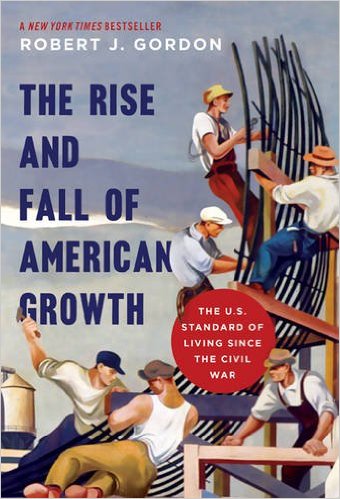
gordon book

In the current age of excess that exuberates in chest-thumping hyper-partisanship and the attitude of winner-take-all, the meaning and sense of egalitarianism seems forgotten. A biblical concept, egalitarianism is the cry of the Israelites wanting freedom from Pharaoh and slavery; we hear echoes of it when the apostle Paul, calling for unity in the nascent Christian community of Galatia, challenges the Galatians’ understanding of entrenched identities, “There is neither Jew nor Greek, slave nor free, male nor female . . .” The word itself comes from the French egal – meaning “equal”but it refers to much more than equal parts or measurements. Egalitarianism emerges and comes to light from a situation of dominance-subordination, or inequality. Egalitarianism is opportunity and access for rich and poor alike. Egalitarianism is blind to the advantages typically derived from social status, pedigree, and wealth.

“What Happened to Egalitarianism?” is the title of the third chapter of my book Just a Little Bit More. I reference anthropologist Christopher Boehm, who studies primates and their social relationships. Boehm looks for interplay between the competing spirits of egalitarianism and winner-take-all in our evolutionary relatives as he investigates the origins of morality in the human family. He speaks of the principle of “reverse dominance hierarchy” as a form of egalitarianism; he witnessed weaker members in a group joining forces to combat the dominance of alpha males.* I call this not survival of the fittest, but survival of the united. Egalitarianism is a sociopolitical phenomenon. A group or community engaged in the struggle for self-determination within a larger community or with a competing community seeks or maintains a sense of equality. The achievements of the civil rights era in the United States are a prime example of the workings of egalitarianism, as is the process that led to the 2015 Supreme Court ruling that the US Defense of Marriage Act (DOMA) is unconstitutional.

Gordon knows that America has a grand heritage of egalitarianism, starting with the Boston Tea Party and the revolutionary plea “No taxation without representation.” When Thomas Jefferson asserted in the Declaration of Independence that “all men are created equal,” the divine right of kings (sorry, George III) took a decisive egalitarian kick to the groin from which it has not recovered.** The competitive spirit of winner-take-all is legitimate and necessary, and has benefitted American ingenuity, inventiveness, and innovation. The winner-take-all ploy becomes troublesome, however, when there is no mitigating force to keep its excesses in check. Egalitarianism serves as the mitigating force of winner-take-all (and vice versa, for that matter), ensuring that the values of equality and greater access for the many win out over unmerited privilege for the few.

Here are some other gems in the history of American egalitarianism, according to Gordon:

The Price Tag: John Wannamaker opened the nation’s first department store, Grand Depot, in Philadelphia in 1876. Whereas bartering and haggling dominated the ways of buying and selling prior to this time, Wannamaker believed all people were “equal before price.” He eliminated price breaks and discounts for the connected, favored, and powerful. A religious man, he believed that all as equals before the Creator meant “one price for all.” He was the inventor of the price tag, an egalitarian innovation that revoluti0nized the consumer age.

The Networking of  Utilities – Electricity, Heating, Telephone, and Sewer: It wasn’t until the mid-1930s that more than half of Americans lived in cities. A majority of these urban dwellings were constructed after the turn of the century, enabling the inclusion of indoor plumbing, electricity, heat, and telephone. As Gordon says, “Networking implies equality. Everyone, rich and poor, is plugged into the same electric, water, sewer, gas, and telephone network. The poor may only be able to afford to hook up years after the rich, but eventually they receive the same access” (p. 95). Because of American society’s relative youth, the networking revolution of utilities spread much more quickly than it did in older European societies. (The current tragedy of lead-laden water in Flint, Michigan is a shameful example of inequality in this land where we refer to these utilities as “basic.”)

Radio: Pittsburgh’s first department store, Joseph Horne’s, began to sell amateur wireless sets – radios – for 10 dollars in the fall of 1920. On November 2, 1920, KDKA in Pittsburgh made the first radio broadcast in American history by transmitting election results as Warren Harding defeated James Cox to become the nation’s twenty-ninth president. Twenty years later, 80 percent of American households had radios in their domiciles. (For sake of comparison, only 75 percent of American households today have Internet access.) Gordon says the invention and rapid diffusion of radio was an example of “striking egalitarianism . . . enjoyed equally by the richest baron or poorest street cleaner” (p. 193).

Both forces – cooperative egalitarianism and competitive winner-take-all – are legitimate and inherently American; our society shines best when neither force dominates, but when they hold each other’s excesses in check. Too much egalitarianism stifles drive and creativity; too much winner-take-all produces inequality and accompanying ill effects. In Just a Little Bit More, I argue that our much cherished democracy needs egalitarianism in order to function at its best. American egalitarianism has helped make possible the following: emancipation from slavery, women’s suffrage, the many acheivements of the civil rights era, same sex marriage, and other accomplishments. Egalitarianism is a main driver of social progress in American and beyond. May we continue to lift it up and advocate it.


*Christopher Boehm, Hierarchy in the Forest: The Evolution of Egalitarian Behavior, Harvard University Press (1999), pgs. 1-3.

**More than two centuries after Jefferson’s famous formulation, we’re still working on fully living out its implied intention.


This blog and website are representative of the views expressed in my book Just a Little Bit More: The Culture of Excess and the Fate of the Common Good. Distributed by ACTA Publications (Chicago), JaLBM is available on Amazon as a paperback and an ebook. It’s also available on Nook and iBooks/iTunes, and at the website of Blue Ocotillo Publishing.

isbn 9780991532827

If you’re a member of a faith community – Christian, Jewish, Muslim, Buddhist, or other – consider a book study series of Just a Little Bit More. The full-length book (257 pgs.) is intended for engaged readers, whereas the Summary Version and Study Guide (52 pgs.) is intended for readers desiring a quick overview of the work. It also contains discussion questions at the end of all eight chapter summaries.

Readers of both books can join together for study, conversation, and subsequent action in support of the common good.

The Spanish version of the Summary Version and Study Guide will be available in September 2016. ¡Que Bueno!

¡El librito de JaLBM – llamado Solo un Poco Más saldrá este Septiembre de 2016!

Diabetes Through the Roof in the US and Developed World

For those of us concerned about socioeconomic trends and their consequences, Robert Gordon’s The Rise and Fall of American Growth is one of the most important books we’ll see in 2016. This blog post is the second in a series that touches upon the issues the book covers: inequality, economic growth, and poverty, among others. Click here for the first post.


My book Just a Little Bit More chronicles the rise of excess and inequality in American society, generally since the Gilded Age (1870-1900) and specifically since the beginning of the 1980s. The sixth chapter, “Excess,” is the longest chapter in the book and covers an array of topics from political polarization and the domination of materialistic values in the marketplace to the oversized inefficiencies of the health care system and the pharmaceutical industry’s commitment to marketing over research and development. I also covered recent changes in the American diet.

When I was doing research on the American diet, I wanted to see hard numbers on the increase of type 2 diabetes since 1980.* Type 2 diabetes is mostly adult-onset, oftentimes related to poor diet and lack of exercise, attributable also to genetic predisposition. I was surprised, however, when I didn’t readily find numbers detailing the increase. Eventually, using data from the Robert Wood Johnson Foundation and the Centers for Disease Control and Prevention, I was able to determine that the number of Americans with diabetes from 1980 to 2010 had increased by 275 percent. Gazoids. To say the least – an increase of 275 percent since 1980 is an astounding figure. We’ve heard about the childhood obesity epidemic for quite a while; the numbers for type 2 diabetes consequently could get worse in the future. But even so, there doesn’t seem to be that much of an outcry or societal alarm. I imagine the pharmaceutical companies don’t mind the quietness . . .

Change is in the air – perhaps. Earlier this month (April 2016) the World Health Organization released a report detailing a doubling of the prevalence of diabetes globally from 1980 to 2014 (an estimated 422 million people, 8.5 percent of adults worldwide today are diabetic, up from 4.7 percent in 1980). The “fast food” diet is a culprit in the increase, and so is plain ol’ excess.

Robert Gordon, the author of The Rise and Fall of American Growth, explains that caloric availability and consumption in the United States, steady from 1800 to 1980 at just below 3000 calories/day, is now on the rise. Whereas a healthy diet consists of 1900-3200 calories/day depending upon age and gender, daily caloric consumption and availability has risen since 1980 and now ranges from 3500-4000 calories/day (pgs. 63-4). We and others around the world are simply consuming more calories per person than previous generations. The worldwide rise in diabetes is not only affecting rich, developed nations but also middle- and lower-income nations like Polynesia and Micronesia. American Samoa, at 30 percent of its population, has the highest rate of adult diabetics in the world. The lowest rate of diabetes is found in northwest Europe at 5 percent. The United States has a rate of just under 10 percent.

This doesn’t mean that every person diagnosed with type 2 diabetes is an overeating slacker. Some are simply genetically predisposed more than others to contract diabetes. We also know that poverty is a culprit in the increase of diabetes. Less expensive foods (chips, cookies, crackers), laden with sugar and/or fat, are good at filling stomachs but substandard at providing necessary nutrition. A first-time reversal in human history beginning in the 1980s, the poor are obese and the rich are thin. In the United States (adult populations), 17 percent of Latinos, 16 percent of Native Americans, and 13 percent of African Americans are diabetic. The rate for whites is 7 percent.

Our various religious traditions teach that limits are a natural part of the created order. Since the Gilded Age, an influential part of American society has championed the idea that limits are unnecessary, because more is always better. The surge in diabetes over the past thirty years tells an important tale: our religious traditions, formed centuries ago, yet speak truth today. Some of our modern societal narratives – more is always better, as an example – are simply falsehoods.


*Type 1 diabetes, formerly called juvenile diabetes, is differentiated from type 2 diabetes, biologically and in terms of its causality. See this link from the American Diabetes Association for a detailed explanation on the difference.


This blog and website are representative of the views expressed in my book Just a Little Bit More: The Culture of Excess and the Fate of the Common Good. Distributed by ACTA Publications (Chicago), JaLBM is available on Amazon as a paperback and an ebook. It’s also available on Nook and iBooks/iTunes, and at the website of Blue Ocotillo Publishing.

isbn 9780991532827

If you’re a member of a faith community – Christian, Jewish, Muslim, Buddhist, or other – consider a book study series of Just a Little Bit More. The full-length book (257 pgs.) is intended for engaged readers, whereas the Summary Version and Study Guide (52 pgs.) is intended for readers desiring a quick overview of the work. It also contains discussion questions at the end of all eight chapter summaries.

Readers of both books can join together for study, conversation, and subsequent action in support of the common good.

The Spanish version of the Summary Version and Study Guide will be available in September 2016. ¡Que Bueno!

¡El librito de JaLBM – llamado Solo un Poco Más saldrá este Septiembre de 2016!

The Rise and Fall of American Growth

For those of us concerned about socioeconomic trends and their consequences, The Rise and Fall of American Growth is one of the most important books we’ll see in 2016. This blog post is the first in a series that will touch on the issues the book covers: inequality, economic growth, and poverty, among others.


Northwestern University economics professor Robert Gordon’s new book argues that the heyday of American economic growth is past and gone. The Rise and Fall of American Growth (Princeton University Press, 2016) opens with a jolt as Gordon summarizes his argument in the first five pages of the introduction, best represented by this line from page 1: “The economic revolution of 1870 to 1970 was unique in human history, unrepeatable because so many of its achievements could only happen once.” Gordon call this one-hundred year period – the Second Industrial Revolution its starting point – the “special century.” The light bulb and the harnessing of electricity, indoor plumbing, the telephone, the automobile and the assembly line, the airplane, and the plethora of appliances (washers, dryers and others) combined to give this period a rate of economic growth previously unseen in the history of the world. And, Gordon argues in the subsequent 783 pages of his tome, the economic growth of the special century will not be seen again in terms of scale and influence upon quality of life. And let us not forget that the incredible economic growth of this special century was primarily fueled by relatively cheap and readily available crude oil.

gordon bookGordon gives the reader historical context for his argument, stating that “there was virtually no economic growth for millennia until 1770, only slow growth in the transition century before 1870, remarkably rapid growth in the century ending 1970, and slower growth since then” (p. 2). China and India have experienced rapid economic growth in the last two decades, but as Gordon outlines, their rates of growth will reach their inevitable limits and begin to slow down, just as we’ve seen in the United States. As a matter of fact, the rates of economic growth in China for 2014 and 2015 (by GDP) are the two slowest of the past twenty-five years.

Yes, our smart phones can take amazing photos and help us navigate our way to a great Thai restaurant when visiting a new city, but a larger context needs to be understood. Gordon says the economic growth since the 1970s comes from a narrower sphere of human activity – entertainment, information, and communications. The advances in these three arenas in the past few years are incredible and greatly appreciated, but they pale in comparison to the advancements of the special century. Back in the day new sewing machines and first-time plumbing in households significantly increased living standards, creating values and efficiencies theretofore unknown. In our day, ditching our flip phones for smart phones is a desired advancement, but it doesn’t register as a major increase in quality of life. emoticon

We can agree with Gordon’s assessment that economic growth since 1970 has been both “dazzling and disappointing.” Smart phones, iPods, and 55 inch flat screen HD TVs rock our worlds, but current innovation and economic activity do not measure up comparably to what was accomplished in generations past. Globalization’s pull of manufacturing jobs away from the US and its accompanying suppression of wages in the US (and equalization of wages worldwide) makes for a forecast unheard of since the close of the nineteenth century: a majority of the youngest Americans now entering the work market will not better their parents in earnings and living standards.

Gordon warns that the headwinds of inequality, blowing steadily since the 1980s, have also significantly impeded the American vessel of progress. An oversized portion of the proceeds of recent American growth – unlike the case in recent past generations – has been distributed to the upper echelon. Gordon states unequivocally that any consideration of US economic growth in the future must deal with the issue and problem of inequality.

According to Gordon, “economic growth is not a steady process that creates economic advance at a regular pace, century after century” (p. 2). With no guarantee that economic markers simply improve for subsequent generations ipso facto, we understand there to be a lot of work to do maintain an egalitarian society. Part of this understanding includes the following realizations: the economic pie is not infinite, but limited; economic returns need to be considered as to their bearing upon social outcomes; and, that neither energy reserves nor waste sinks are unlimited.

I’ll have more posts to come on Gordon’s excellent and timely work.


This blog and website are representative of the views expressed in my book Just a Little Bit More: The Culture of Excess and the Fate of the Common Good. Distributed by ACTA Publications (Chicago), JaLBM is available on Amazon as a paperback and an ebook. It’s also available on Nook and iBooks/iTunes, and at the website of Blue Ocotillo Publishing.

isbn 9780991532827

If you’re a member of a faith community – Christian, Jewish, Muslim, Buddhist, or other – consider a book study series of Just a Little Bit More. The full-length book (257 pgs.) is intended for engaged readers, whereas the Summary Version and Study Guide (52 pgs.) is intended for readers desiring a quick overview of the work. It also contains discussion questions at the end of all eight chapter summaries.

Readers of both books can join together for study, conversation, and subsequent action in support of the common good.

The Spanish version of the Summary Version and Study Guide will be available in September 2016. ¡Que Bueno!

¡El librito de JaLBM – llamado Solo un Poco Más saldrá este Septiembre de 2016!


“Faith and Inequality” Presentations

In a world of fluff (supermarket tabloids) and misplaced immaturity (presidential candidates commenting on the size of certain anatomical features of an opponent), it’s good to have other options of information gathering and personal interchange. I’m grateful to have the opportunity to converse with others on important social issues such as childhood poverty, the causes of inequality, and the pros and cons of economic growth. Building on these themes and others explored throughout Just a Little Bit More: The Culture of Excess and the Fate of the Common Good, I’ll be making presentations at points near and far in the next number of weeks. Enlightening and purposeful conversations will continue in support of common good construction.

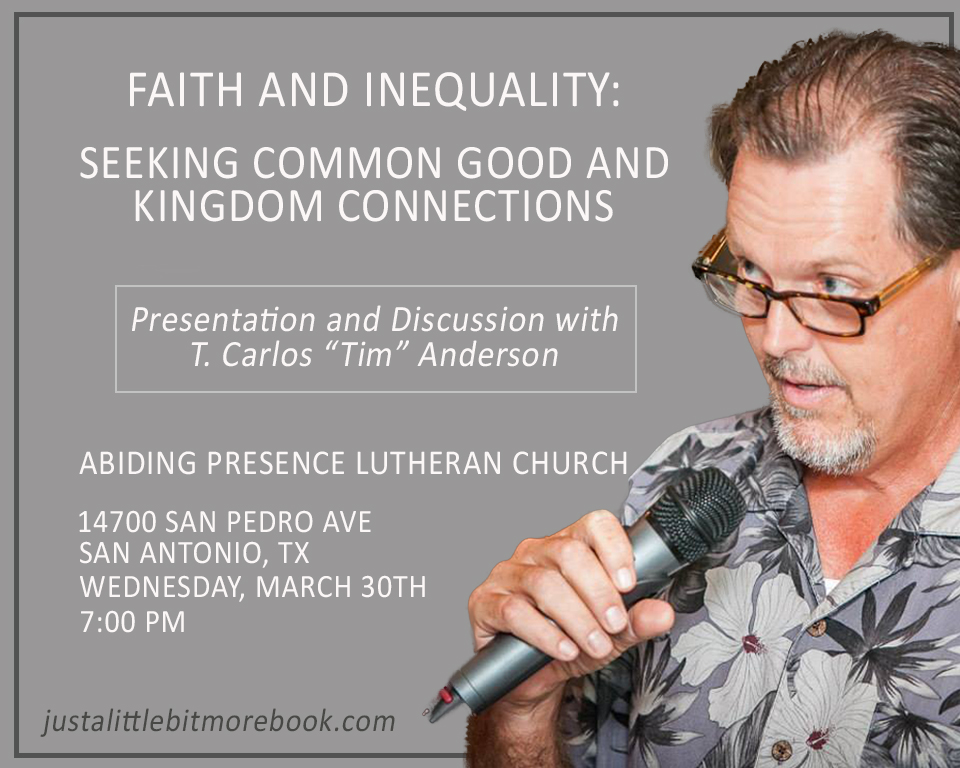
“Faith and Inequality: Seeking Common Good and Kingdom Connections” will be presented in San Antonio and Fort Worth, Texas; Fairfax, Virginia; and Gettysburg, Pennsylvania. Thanks to the church-related groups that have extended invitations to present and to many who have joined in conversation via book study groups on JaLBM themes. The “Faith and Inequality” offering covers a diverse set of related topics – faith development, American social and economic histories, poverty, the pursuit of common good, among others – in seventy-five minutes (or so!) of presentation and discussion. Join us!

Abiding Presence Lutheran Church, San Antonio, Texas  –  Wednesday, March 30, 7 pmJABLM Promo San Antonio V1

Christ Evangelical Lutheran Church, Fairfax, Virginia  –  Tuesday, April 5, 7 pm

Gettysburg Seminary, Gettysburg, Pennsylvania  –  Thursday, April 7, 7 pm

Faith Lutheran Church, Fort Worth, Texas  –  Wednesday, April 20, 7 pm

Judaism, Buddhism, Christianity, Islam, and many indigenous traditions agree: management of the natural human propensity toward greed is a main task of religious activity. Failure of a group or society to keep its appetite for greed in check contributes to its demise. Intriguingly, our various religious traditions formulated these ideas long before the proliferation of capital. While the Industrial Revolution has arguably been a great blessing to the human family, greed management is more crucial now than ever before. We live in an era that makes the case that more is always and exponentially better. I argue, to the contrary, that our traditions have a strong and united message against the spirit of more as always better.

While I’m grateful to Lutheran groups extending me (a Lutheran pastor) an invitation to speak, I’m more than ready to venture beyond. Other Christian denominations and other congregations within the broader faith community have plenty to contribute to this important conversation. The “Faith and Inequality” conversation is intended for all persons of faith, uniting various and diverse voices together in pursuit of common good in our midst.

For Christians, the possible connection between common good and what we understand as “kingdom of God” merits exploration. The Social Gospel movement at the turn of the 20th century – born during Gilded Age inequities – offers guidance. The 21st century needs to make its own response to social and economic inequalities. Join me and many others as we respond to significant inequalities social and economic with energy, smarts, and compassion.


Special thanks to the congregation I serve, St. John’s/San Juan Lutheran Church, Austin, TX for the opportunity to go to Washington, DC where I’ll participate in continuing education events. I’ve never been to the nation’s capital and am looking forward to networking with leaders in the movement for social and economic justice.

And thanks to my publicist extraordinaire daughter, Alexandra Anderson, for her work on the above promo image!


I’m planning to do similar “Faith and Inequality” presentations this fall in Austin and Houston – and open to invitations elsewhere!


This blog and website are representative of the views expressed in my book Just a Little Bit More: The Culture of Excess and the Fate of the Common Good. Distributed by ACTA Publications (Chicago), JaLBM is available on Amazon as a paperback and an ebook. It’s also available on Nook and iBooks/iTunes, and at the website of Blue Ocotillo Publishing.

isbn 9780991532827

If you’re a member of a faith community – Christian, Jewish, Muslim, Buddhist, or other – consider a book study series of Just a Little Bit More. The full-length book (257 pgs.) is intended for engaged readers, whereas the Summary Version and Study Guide (52 pgs.) is intended for readers desiring a quick overview of the work. It also contains discussion questions at the end of all eight chapter summaries.

Readers of both books can join together for study, conversation, and subsequent action in support of the common good.

The Spanish version of the Summary Version and Study Guide will be available in September 2016. ¡Que Bueno!

¡El librito de JaLBM – llamado Solo un Poco Más saldrá este Septiembre de 2016!


What Phil Gramm and Mr. Krabs Have in Common

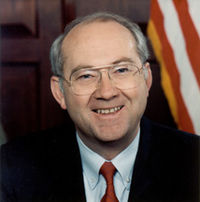
PhilGrammKRABS_EA_copy

The following post is adapted from the book, Just a Little Bit More: The Culture of Excess and the Fate of the Common Good.


Congressional Republicans and Democrats differ in a number of ways, but they are essentially united when it comes to uncritical acceptance of the ways of Wall Street. Whereas roughly 1 percent of Americans are millionaires (as of 2010), 50 percent of US representatives and senators are categorized as such. Phil Gramm, who retired from the Senate in 2002, was a card-carrying member of the millionaires’ club while serving on Capitol Hill. He most memorably was on record naming Wall Street “a holy place.” To be wealthy is not an indictment; but to imagine one’s wealth does not affect the way one votes, especially concerning issues involving personal financial interests, is naïve. As an old Russian proverb states, “When money talks, the truth is silent.”

My son and I went to see the SpongeBob SquarePants Movie when it came out in 2004. He was twelve years old; the movie had something for both generations, as the theater was evenly populated by kids and their parents. SpongeBob is the main character in one of the most popular animated cartoons of the first decade of the 2000s. The series features a number of lead characters (all sea creatures); a handful of Internet bloggers revel in the alleged representation of the seven deadly sins in seven recurring characters of the show. Restaurant owner Mr. Krabs (who is, yes, a crab) is especially fond of money, both its procurement and its retention. In the movie, Mr. Krabs decides to open a second restaurant adjacent to his original one. At its grand opening, he confesses his love for money with an interviewer, as he is asked what inspired him to duplicate his efforts. He answers the question instinctively with one word: “Money.”

Sometimes it’s a jolt that comes from a change of scenery – in this case a cartoon – that helps one to hear the truth loud and clear. The implied mocking of Mr. Krabs’s greed drew one of the largest laughs in the theater that day; even children are able to recognize that the inordinate love of money skews a person’s – or a crab’s – perspective.

Phil Gramm cosponsored the 1999 repeal (proudly signed into law by President Clinton) of the landmark Depression-era Glass-Steagall Act that had separated the activities of commercial banks and security firms. The repeal is now widely considered to be a primary culprit in the 2007-08 economic swoon. Gramm never anticipated the economic demise that he helped create. Let’s be clear: There’s nothing wrong with opening a second business or wanting to construct an environment where jobs and capital proliferate. But to be shrewd to the ways of greed is an elusive wisdom.

Gramm was blinded by his love for money – that which he has in common with Mr. Krabs.


This blog and website are representative of the views expressed in my book Just a Little Bit More: The Culture of Excess and the Fate of the Common Good. Distributed by ACTA Publications (Chicago), JaLBM is available on Amazon as a paperback and an ebook. It’s also available on Nook and iBooks/iTunes, and at the website of Blue Ocotillo Publishing.

isbn 9780991532827

If you’re a member of a faith community – Christian, Jewish, Muslim, Buddhist, or other – consider a book study series of Just a Little Bit More. The full-length book (257 pgs.) is intended for engaged readers, whereas the Summary Version and Study Guide (52 pgs.) is intended for readers desiring a quick overview of the work. It also contains discussion questions at the end of all eight chapter summaries.

Readers of both books can join together for study, conversation, and subsequent action in support of the common good.

The Spanish version of the Summary Version and Study Guide will be available in September 2016. ¡Que Bueno!

¡El librito de JaLBM – llamado Solo un Poco Más saldrá este Septiembre de 2016!

Borderlands

Thanks to Nathan Wicks for the guest blog post poem below. He participated in a 2016 January-term class, “Borderlands”, co-sponsored by the Lutheran Seminary of the Southwest and the Seminary of the Southwest. A group of twenty students – hailing from Texas, Alabama, Iowa, and various points in-between – interacted with Latino folks and the various flavors of Latino culture flourishing from Central Texas down to the Rio Grande Valley. The two seminaries share resources, space, and student experiences in Austin, Texas.


“At some point, on our way to a new consciousness, we will have to leave the opposite bank, the split between the two mortal combatants somehow healed so that we are on both shores at once and, at once, see through serpent and eagle eyes.” – From: Borderlands/La Frontera: La Nueva Mestiza by Gloria Anzaldúa (Aunt Lute, 1987).


BORDERLANDS

The “American Dream” is a history of lines
And who has the power to draw them.
The earth is just the earth, the lines are ours,
And the reason, be it theft or money or slavery or death,
Can be justified and erased in the history books in one generation.
“Our Land” is the history of facilitating
The travel of money from place to place.
“Our Land” is not defined by these lines, or this land,
But sold for cheap in the definition of “us”.
The “American Dream” is a dream of us, the U.S.,
And it looks like the detritus of plastic wrappers and shopping bags
Blowing across the landscape, washed into rivers,
A dream stuffed into our souls to muffle the terror growing in our hearts.
The land cries out, and the rivers swell, enraged at the injustice.
They are calling for judgement,
But it is for those upstream who never feel the punishment,
The ones already bearing the heaviest of burdens,
The real hope and disappointment
Of the “American Dream,” feel the pain.
They suffer for us, yet we walk in a fever dream,
Sleepless, unable to awaken and see ourselves downstream, face to face.

And of course America is something else entirely,
A land stays put wherever lines may be drawn,
An U.S. dream of identity doesn’t change the face of the land,
And we didn’t cross the border, the border crossed us.
A dream is not a denial or escape from reality,
It is the place communicating to its people,
It is the Spirit speaking plainly about the Kingdom.
And those who are seeking first the Kingdom,
What will be given to them?

We came here to look at a river.
We, narcissistic, delusionally dreaming,
Came to see ourselves in this river,
And all we see are shadows.
But why am I struck blind at the sight?
When the invisible is seen there is a glaring darkness,
A shaded shape glimpsed in outline in front of a bright light.
What does your reflection look like, Narcissus?
Is it what you expected?
As your eyes adjust you will look up and see,
It is far more beautiful and full of life than
You ever thought you could be again.

Yes, this American Dream is still a shallow grave,
This is still no Promised Land.
It is an escape from violence through violence into violence.
But in which dream is the Spirit growing?
Thorny, gnarled unfurling, vibrant color in the desert places,
The richest Earth in the “American Dream,”
A threshold of epiphanies, a thin place in between places.
And what are they dreaming about here, in the Borderlands?
Is someone standing here
Broadcasting the corn far across the land,
The seeds of another Kingdom?

And here we are, gathered at the river,
Seeing this place where everyday life goes on
While something is seeking a mending of the breach,
This open wound borne in the bodies of many who have crossed it,
Baptized into something else entirely.
There are people who come together here
And cast a very different line
Across, towards each other.
It is not as grandiose as that other line,
But it is more real; nearly invisible,
Tiny, but tangible and full of hope,
And they are hungry and trying to catch some fish.
I see them reaching towards each other,
Throwing out little lines of longing,
Yearnings for wholeness, prayers of a normal life,
Seeking nourishment for their human need,
Sustenance from the life of this river
As people have done for centuries,
A life to which this river has drawn people
As a point of communion.
They are fed.
Their bodies bear this mark of knowing,
The dream of a New Creation.
The body of Christ is alive and well here,
The Spirit is flourishing on the food of this Tierra.


nathan wicks

Nathan Wicks (pictured) is a student at Wartburg Seminary in Dubuque, Iowa. Nathan, a former farmer deeply concerned about ecological issues, wrote this poem after making the 1,400 mile trek from Dubuque, Iowa to the Texas Rio Grande Valley.


This blog and website are representative of the views expressed in my book Just a Little Bit More: The Culture of Excess and the Fate of the Common Good. Distributed by ACTA Publications (Chicago), JaLBM is available on Amazon as a paperback and an ebook. It’s also available on Nook and iBooks/iTunes, and at the website of Blue Ocotillo Publishing.

isbn 9780991532827

If you’re a member of a faith community – Christian, Jewish, Muslim, Buddhist, or other – consider a book study series of Just a Little Bit More. The full-length book (257 pgs.) is intended for engaged readers, whereas the Summary Version and Study Guide (52 pgs.) is intended for readers desiring a quick overview of the work. It also contains discussion questions at the end of all eight chapter summaries.

Readers of both books can join together for study, conversation, and subsequent action in support of the common good.

The Spanish version of the Summary Version and Study Guide will be available in September 2016. ¡Que Bueno!

¡El librito de JaLBM – llamado Solo un Poco Más saldrá este Septiembre de 2016!


In Lieu of Flowers . . .

inlieuofflowersI recently received a text message from my mom informing me that the mother of one of my high school classmates had passed away. My mom still lives in the locale where I went to high school back in the last quarter of the former century; I most recently lived there twenty-five years ago. As we texted back and forth, my mom further informed me that the deceased woman’s obituary had an interesting closing request: In lieu of flowers, please don’t vote for Hillary Clinton.

How’s that for a new twist on the obit pages? A quick search on the world-wide wonder reveals that, in obits across the country during this political cycle, numerous similar requests reach out to voters from the great beyond, or, at least, from the grave. And in an accurate reflection of unfavorable rating polls, Donald Trump and Ms. Clinton lead the way with negative mentions on the bereavement pages.

hilldonald

Negative requests are a sign of the times, skewed hyper-partisan. Before this era of hyper-partisanship, a rare obit might have kindly solicited a request for a positive vote for a particular candidate. In lieu of flowers, be so kind to consider a vote for candidate X in memory of the deceased. Even so, previous to this current era, such a request would have betrayed a slight breach of etiquette.

Newt Gingrich can be praised or blamed – depending on your point of view – for the current wave of hyper-partisanship. Elected Minority Whip of the House of Representatives in 1989, Gingrich became Speaker of the House as Republicans swept into power in 1994. Named Time‘s Man of the Year in 1995, Gingrich was lionized for his strategy to take the House after forty years of Democratic rule. Gingrich’s strategy wasn’t new, but it was effective: destroy the institution to save it – throw the majority bums out. Under his leadership, House Republicans refused to cooperate with Democrats and publicly portrayed them as the party most benefitting from entrenched corruption. The strategy worked so well, in fact, that the Democrats adopted it and succeeded in bringing ethics violations against Speaker Gingrich in 1998, eventually forcing his resignation from office the following year.

Hyper-partisanship is yet the political modus operandi of the day, and it has spilled over into American society as acceptable behavior. Economic segregation in America has increased; and, in some quarters, the demonization of others who are “different” is on the rise. It makes me wonder: Could the spirit of American hyper-partisanship be strong enough to survive into the great beyond, colonizing a few cloistered places for hyper-partisans? God only knows if there will be gated communities in the afterlife . . .

vernonjohns
Pastor Vernon Johns (1892-1965)

Vernon Johns was Martin Luther King Jr.’s predecessor at Dexter Avenue Baptist in Montgomery, Alabama – the church that proudly stands one block away from the Alabama State Capitol. Johns, provocative and creative, was a firebrand for equality.

One weekday morning in 1949, Brother Johns, as was his custom, arranged the letters on the front sidewalk sign announcing his coming Sunday sermon topic for passersby. What a shock to the good people of Montgomery, abiding by the laws of racial separation, to see the preacher’s sermon title spelled out: Segregation after Death. The Montgomery police chief noticed the sign and demanded that Johns come to the police station to explain himself. Luke 16:19-31 – Jesus’ parable of the beggar Lazarus and the rich man Dives – provided Johns with his textual basis. Johns explained to the chief and his lieutenants that Dives, a staunch practitioner of segregation (economic and otherwise) during his earthly life, was cursed by it in the afterlife. The reversal of fortune – Dives suffering in Hades, and Lazarus being comforted by Father Abraham in Paradise – was not enough for Dives to see that he shared common humanity with Lazarus. The chief and his men, according to Johns’ retelling of the encounter, were moved with empathy. He was not required to alter or take down the sign with his bold sermon title.

Johns’ brilliant interpretation of Jesus’ parable for Montgomery’s specific context focused Luke’s message not on the afterlife, but on how human brothers and sisters, sharing common humanity, treat one another in this life.

That said, brothers and sisters: Vote your conscience, love your neighbor, and begin to shed any negative hyper-partisanship* that unnecessarily discolors your relationships with others in the human family. You can’t take it with you when you go, you know.


*I suppose there is an occasional time and place for hyper-partisan strategy. But may it be rare, and not commonplace.

If you’re interested in further reading on the life of Vernon Johns, see Taylor Branch’s incomparable Parting the Waters: America in the King Years 1954-1963; Simon & Schuster (1989) pages 7-25.


This blog and website are representative of the views expressed in my book Just a Little Bit More: The Culture of Excess and the Fate of the Common Good. JaLBM, distributed by ACTA Publications (Chicago), is available on Amazon as a paperback and an ebook. It’s also available on Nook and iBooks/iTunes, and at the website of Blue Ocotillo Publishing.

isbn 9780991532827

If you’re a member of a faith community – Christian, Jewish, Muslim, Buddhist, or other – consider a book study series of Just a Little Bit More. The full-length book (257 pgs.) is intended for engaged readers, whereas the Summary Version and Study Guide (52 pgs.) is intended for readers desiring a quick overview of the work. It also contains discussion questions at the end of all eight chapter summaries.

Readers of both books can join together for study, conversation, and subsequent action in support of the common good.


The Spanish version of the Summary Version and Study Guide will be available in September 2016. ¡Que Bueno!

¡El librito de JaLBM – llamado Solo un Poco Más saldrá este Septiembre de 2016!


The Joy of Reading (Good Stuff)

During a recent radio interview, I heard someone bemoan all the reading of insignificant detritus he’s done on the Internet, while the good books on his To Read list gather dust: “It’s like I’m on the millionth page of the worst book ever – but I can’t stop reading it.” We’ve all wasted precious time; it’s not the worst sin in the world. But when you find yourself surfing the net and reading about what O.J. Simpson had for breakfast in his prison cell, or about a sighting of Kim Kardashian breast-feeding her baby in public – then you know that some better part of the world is passing you by.

When you start to tally up all the time that gets away, the math is instructive. If you took twenty minutes each day to read good stuff (see below), you’d end up with 120 hours per year. Depending on reading speed and book size, that’s between six to twenty-five books a year. That’s time well spent – directly beneficial to you and indirectly beneficial to those whose paths you cross.

Reading a book is akin to having a conversation with another human being: a deep, meaningful, thought-out exchange that as readers we are able to conduct on our own time. Perhaps a bit grandiose to say, but having a varied and wide reading list is akin to having a conversation with the world. This conversation makes us more aware of our place in the world, and (hopefully) better citizens of it.

20160207_052809
The home bookshelves – a blessed mess, yes.

Good Stuff: While I do read fiction, I’m admittedly over-balanced on the non-fiction side. Taylor Branch’s Parting the Waters, Dee Brown’s Bury My Heart at Wounded Knee, Paul Johnson’s Modern Times, Richard Rhodes’s The Making of the Atomic Bomb, and Daniel Yergin’s The Prize are but a few of the captivating books I delved into over the years. There are many other books I would add to my A-list: Edmund Morris’s Dutch, Bill Bryson’s A Short History of Nearly Everything, and Jared Diamond’s Guns, Germs, and Steel are but a few others.

While my three kids were in college, they received from their old man a hand-picked bundle of books from the good stuff list. Lucky them! I realized they weren’t going to read these books while in college – they had other books to read and happenings to attend. Yet, like a seed planted in good soil, I trust that this gesture someday will bear beneficial fruit.

Occasionally, Facebook friends will call out for “Top 10” or “Best Ever” reading lists. As we all know, there’s a lot of good stuff out there. It’s eye-opening to see what others are reading; it enlarges the conversation. It’s a blessing to have time to read.

There’s a great difference between information and knowledge. The Internet provides plenty of the former, whereas good books help engender the latter.

I’ll continue to blog on the net, with the purpose of supporting common good development, pointing out the good books along the way that help us get there.

Read on, my friends.


This blog and website are representative of the views expressed in my book Just a Little Bit More: The Culture of Excess and the Fate of the Common Good. JaLBM, distributed by ACTA Publications (Chicago), is available on Amazon as a paperback and an ebook. It’s also available on Nook and iBooks/iTunes, and at the website of Blue Ocotillo Publishing.

isbn 9780991532827

If you’re a member of a faith community – Christian, Jewish, Muslim, Buddhist, or other – consider a book study series of Just a Little Bit More. The full-length book (257 pgs.) is intended for engaged readers, whereas the Summary Version and Study Guide (52 pgs.) is intended for readers desiring a quick overview of the work. It also contains discussion questions at the end of all eight chapter summaries.

Readers of both books can join together for study, conversation, and subsequent action in support of the common good.


Let me mention one more great book: Robert Sapolsky’s classic from 1994, Why Zebras Don’t Get Ulcers. Ahem!