Open-Carry, (Big) Cars, and a Theology of Power

The Texas legislature is in session, and the consideration to legalize the open-carry of handguns is a top agenda item. Intriguingly, Texas is out of step with most of the nation when it comes to permitting open-carry of handguns. It is one of only six states that currently doesn’t permit it (open-carry of shot guns and rifles, long associated with hunting, is permissible in Texas). Open-carry means a weapon is visibly holstered to a waist belt or harnessed on a shoulder strap. Proponents consider the holstered gun of a law-abiding citizen a deterrent to potential criminals, who, in contrast, typically conceal their weapons. This part of the argument makes good sense; yet, there is one factor on this issue, rarely mentioned, that I’m concerned about in today’s environment of increasing economic and social inequality: the human propensity to misuse power.

I recently saw a Toyota truck commercial – linked here – that invited you, the potential buyer, to view the showcased truck as “your castle on wheels.” Let’s face it: some people drive as if they would be kings and queens in four-wheel machines with public highways their own personal fiefdoms. No sharing of space, get the hell outta my way, screw you if you think I’m letting you in, you’re not driving fast enough for me so I’m going to ride your ass until you move, etc., etc., etc. Do people treat others like this when jointly walking toward a similar destination? Hardly. Something happens – linked to human nature – when we get behind the wheel, enclose ourselves behind glass and steel, and rev the engine. Like Obadiah Stane as Iron Monger, we become supersized.

et.0423.sneaks.484 –– Obadiah Stane (Jeff Bridges) surveys the Iron Monger armor in the 2008 movie "Iron Man". Paramount Pictures and Marvel Entertainment Present A Marvel Studios Production. ***2008 SUMMER SNEAKS movie.
Jeff Bridges as Obadiah Stane in Iron Man

The twentieth century Christian theologian Reinhold Niebuhr (credited with writing the Serenity Prayer, used by twelve-step groups) wisely opined concerning human progress: “There is therefore progress in human history; but it is a progress of all human potencies, both for good and evil.” Our use of power in the last three centuries – for better and for worse – amazes. Incredible inventions and discoveries making human existence less brutish and more enjoyable; incredible inventions and discoveries able to kill grand quantities of humans (and other forms of life) within seconds. The more power we have, individually and collectively, the more so living life on this planet becomes complex. Religious traditions, from the Jewish commandment “Walk humbly with your God” to the Buddhist teaching “Respect all forms of life,” encourage us not to become supersized in our estimations of self.

The majority of drivers and gun owners are responsible in their respective actions. Yet, as our relationships become thinner and more homogenous in a society of increasing inequality, our fears of one another and our impatience with one another negatively impact our actions. Motor vehicle death per capita in America is down (thanks in part to airbags and safety regulations), but it remains the leading cause of death for Americans under thirty. Ninety Americans die in motor vehicle accidents – entirely preventable – every day. More than 30,000 Americans die yearly from gun violence; more than thirty a day die by homicide and more than fifty a day die by suicide. African-Americans John Crawford and (twelve-year-old) Tamir Rice were shot to death by white police officers, rigorously trained in gun use and safety, because they were thought to be “perpetrators.” As a result, violence directed toward police officers is unfortunately on the rise. The misuse of power in all directions can tragically lead to the loss of innocent life.

We yet live in a society where the fear of the other predominates; many whites fear blacks and browns. In response to fear, human nature dictates that we protect ourselves. With a twenty-year downward trend in violent crime and homicide in America, however, the move toward nationwide open-carry begs the question: Do we as a society and as individuals know the limits of physical power? Supersizing ourselves – with guns or cars – takes away energy and resources from something else potentially much more beneficial to a shared societal common good. What if we put supersized energy and time into the depth and scope of our relationships one with another – especially with those we don’t know? Rich and poor, whites and persons of color, young and old, civilians and police, conservatives and liberals – renewed relationships in public space are more powerful than we realize and help prevent our misuses of power.

niebuhr
Reinhold Niebuhr (1892-1971)


God, grant us the serenity to accept the things we cannot change, the courage to change the things we can, and the wisdom to know the difference.


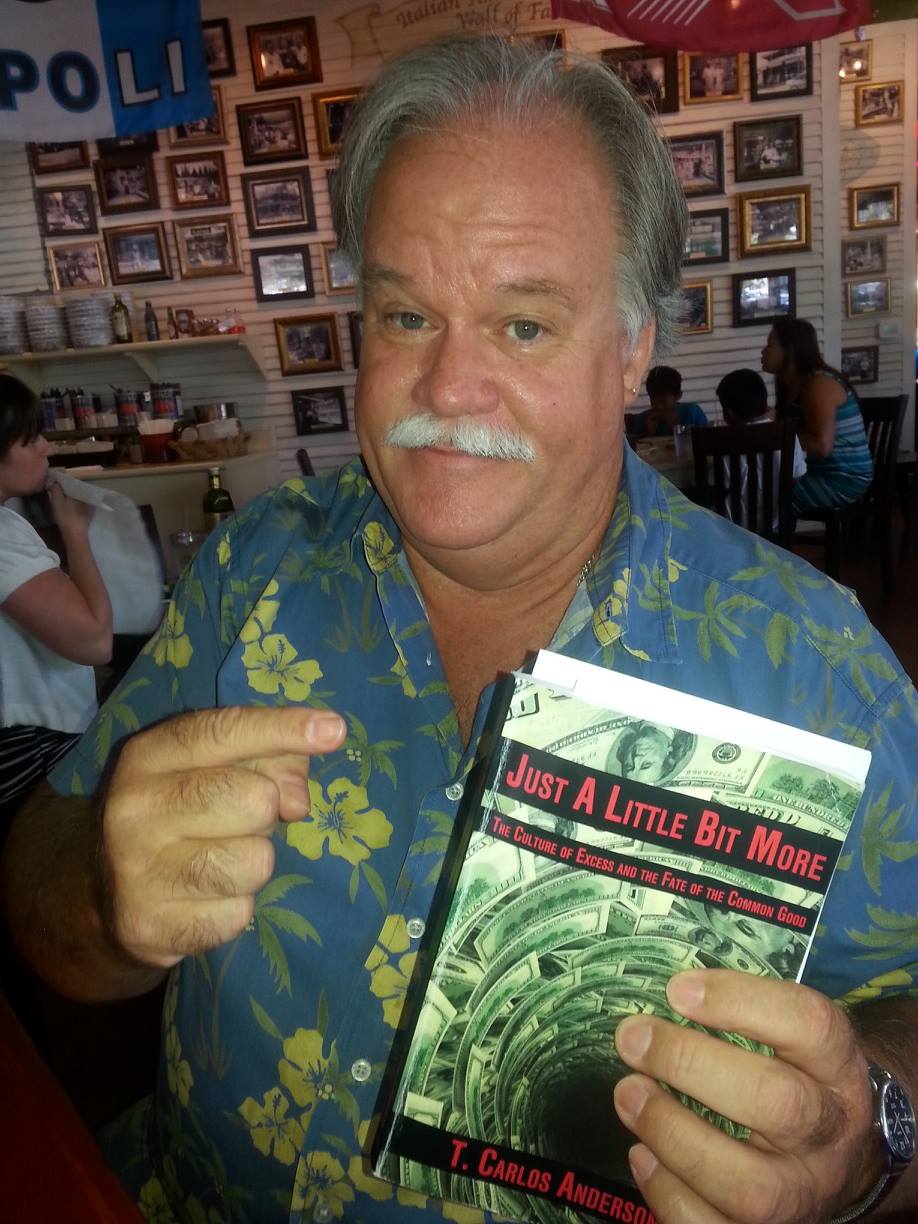
The views expressed in this blog are reflective of my work in the 2014 book, Just a Little Bit More:
The Culture of Excess and the Fate of the Common Good.  

Click here to purchase Just a Little Bit More: The Culture of Excess and the Fate of the Common Good. Paperback, $14.95. You will be redirected to the Blue Ocotillo Publishing website.

Click here if you prefer to purchase JaLBM from Amazon. Ebook available on Amazon, iBooks, and Nook.

Click here for Summary Version and Study Guide from the Blue Ocotillo Publishing website, ideal for book clubs and community of faith study groups.
JaLBM Summary Version/Study Guide Now Available!

Brad Highum, a pastor at Abiding Love Lutheran Church in Austin, has been a great supporter of Just a Little Bit More from its very inception.* Back in 2011, we lunched over gyro wraps at the Phoenicia Bakery on South Lamar in Austin. We sat on the picnic table outside in the hot fall wind (Phoenicia, abundantly stocked with Greek and Arab staples, doesn’t have indoor seating) and went back and forth about the 2007-08 economic swoon and the related topics of social immobility, rising inequality, and childhood poverty. Brad’s enthusiasm let me know that my thinking was on the right track.

JaLBM came out in May 2014. My own congregation, St. John’s/San Juan, and Brad’s were the first congregations to participate in a book study of JaLBM. We conducted the studies concurrently with the purpose of compiling feedback and notes that would contribute toward a study guide for other faith communities.

Halfway through the study, one of Brad’s congregants walked into the Sunday morning adult forum at Abiding Love and gave Brad a knowing look. “Pastor Brad,” he offered, “this book is not a light read.”

Brad responded with a wink and a smile: “It’s not a light topic.”

Checking in at 110,000 words and covering the aforementioned topics related to social inequality, JaLBM is not a light-hearted summer beach read. (My brother Mike, however, did read JaLBM in three days at a Bible camp on Minnesota’s Lake Carlos – he is the current JaLBM speed-reading champ).

JaLBM Summary Version and Study Guide Now Available

For those of you waiting for an easier to read version of JaLBM, wait no longer. Just fifty pages and boasting a larger font, the 10,000 word JaLBM Summary Version and Study Guide condenses the full-length book into a Reader’s Digest version, with discussion questions at the end of each of the eight chapters.

A study of JaLBM with others in a church, synagogue, temple, men’s group, women’s group, or book club setting affords rewarding discussion. JaLBM encourages interchange on the big topics related to social inequality without participants having to fall into well-worn political ruts. Readers of the full-length version and the summary version of JaLBM can be on the same page when it comes to discussion and analysis of the work, leading to activity on behalf of the common good.

The summary version is also intended for high school and college student groups. It’s available now at the Blue Ocotillo Publishing website and soon on Amazon. Thanks to the good folks at Abiding Love and St. John’s for their work in helping to prepare the study guide questions.

Greg Pierce, publisher at ACTA Publications in Chicago, advised me last summer to produce a summary version of JaLBM. ACTA produces community organizing and theology books, with a number of these in pamphlet or summary form. ACTA distributes JaLBM nationally. Greg has had over thirty years experience in the publishing field. He told me that he has consistently seen priests and pastors – when visiting the book table at a convention or conference – overlook whole length books in favor of summary version pamphlets. Greg says it has something to do with their workload!

brother brad
Brother Brad Highum

No matter your work load, there’s a JaLBM version for you. I invite you to take a good look at it and enter into the ongoing discussion to combat social inequality and uplift the common good.


Click here to purchase Just a Little Bit More: The Culture of Excess and the Fate of the Common Good. Paperback, $14.95. You will be redirected to the Blue Ocotillo Publishing website.

Click here if you prefer to purchase JaLBM from Amazon. Ebook available on Amazon, iBooks, and Nook.

Click here for Summary Version and Study Guide from the Blue Ocotillo Publishing website.


*Brad’s colleague pastor at Abiding Love, Lynnae Sorensen, has been a steady supporter of JaLBM as well.


Ferguson, MO and Isaiah 64:1-2

Thanks to Rozella White, Evangelical Lutheran Church in America (ELCA) Director for Young Adult Ministry, for her November 24th FB post on the ELCA Clergy page calling forth commentary and protest concerning the Michael Brown/Darren Wilson grand jury decision. I wrote the following in preparation to preach (in English and Spanish) on Sunday, November 30, 2014 at St. John’s/San Juan Lutheran in Austin, Texas. What follows is not a word-for-word transcript of my preaching that day (preaching is, or at least should be, a “live event”), but the basis of my thinking for what went into the message that became vocalized.

Almost 30 years ago, I lived for two years in South America. Not only did I learn Spanish and get a thorough introduction to generalized Latino culture, I also learned what was to be one of my main vocational callings: to be a missionary to white folks. Missionary, of course, is an old-fashioned word. It’s meaning, however, is still pertinent in the 21st century world. It’s my mission to bring an important message to people with whom I share common experience and understanding. It’s not that I’m superior to those receiving the message or endowed with special talents; initially and significantly transformed by what I saw and experienced in Perú, that transformation continues as I’ve worked in dual language ministry for close to 25 years in Texas.

2019 will mark the bleak 400th anniversary of the beginnings of slavery in the territory of what is now the United States. Slavery came to an official end in 1865, but its effects still linger. Unarmed Africans/blacks have suffered – including death – under the power and hegemony of whites in these lands since 1619 when the first African slaves came to colonial Jamestown. Michael Brown’s case is sadly a continuing thread in a long narrative. Where I live – Austin, Texas – Larry Jackson, an unarmed black man, was killed during a struggle with white police officer Charles Kleinert in July of 2013. Kleinert has subsequently been indicted for the death of Jackson; his trial has yet to start. Austin – the city that oozes cool vibe with all of its events and attractions – has had a number of similar incidents in the past decade where unarmed young men of color (yes, some involved in criminal activity) have lost their lives on the other side of a police weapon.

Thankfully we live in an ordered society, buttressed by law. Police forces are a necessary part of that order derived from law. We are grateful for those who serve in law enforcement, yet we also recognize that a society that has a long history of prejudice and racism, such as ours, can produce a jaundiced law and order. An order based in injustice is no order at all for a class of persons deprived of power. The power of the dominant race or class must be kept in check; power without accountability leads to domination. Ferguson, Missouri is a community of some 21,000 souls – almost 70% black and 30% white. Its police force of fifty-three consists of three black officers and fifty white officers. Ferguson is one of many ethnically minority communities in the US policed by majority white forces.

I’ve heard white folks say over the years: “Slavery is a distant memory – can’t they (blacks) get over it already?” “The civil rights era has helped transform American society – enough with the protests and riots.” “Now that we have a black president, it’s an equal playing field for all and the age of affirmative action should be over.”

This society has made great strides, socially, over the centuries. Yet, the further we go forward, new light shines to expose many other issues and concerns that need attention and correction. As theologian Reinhold Niebuhr proclaimed decades ago, there is progress as time marches forward, a progress in both human potencies – evil and good. Many things are much better than they used to be, but not all things. America is not yet a society devoid of prejudice or racism.

Many people – not just whites – are upset that some in Ferguson responded to the no indictment decision of November 24th with protests and riots that included the burning of buildings and destruction of property. More than a generation ago, non-violence prophet Martin Luther King Jr. condemned riots as self-defeating and socially destructive. However, he also understood why an oppressed minority would resort to rioting: he called it the voice of the unheard.

Isaiah 64:1-2, similarly, is the loud and strong call of a minority voice in search of justice. Here’s a concept that is very difficult for many white American Christians to grasp and understand. Bible stories and histories are told in a minority voice – a voice that lacked societal power in the days of the Egyptians, Assyrians, Babylonians, and Romans. The Israelites and the early Christians that speak, respectively, in the Hebrew and Christian testaments did not speak from a place of political, social, or economic power. They spoke from a place of minority status. Isaiah 64 – from the heart of Israel’s Babylonian exile in the 6th century before Christ – is only understood from a minority perspective, a perspective with which many white Americans are unfamiliar.

“Would that you rip open the heavens and come down!” Exile had ripped apart Israel socially and economically. Israel was justifiably mad at Babylon, God, and itself. The raw anger of the prophet’s voice is undeniable. Many of us – regardless of skin color and socio-economic status – have felt this same type of rage and anger as individuals when suffering through one of life’s many tragedies: loss of a loved one, divorce, an injustice. I remember when my three children were quite young, and the personal feeling of parental responsibility that burdened my heart. I can remember feeling potential rage toward God if anything were to happen to one or all of them. Was I justified in pre-loading my anger toward the heavens? Of course not – but sometimes rage is our only recourse when we are confronted with an event that overpowers us (or in my case, the fear of its overpowering potential). Every single one of us, most likely, can personally relate to such a scenario.

The prophetic voice in Isaiah 64, however, was not an individual voice. It was a voice that spoke for the people – for the community. It was a shared experience – the pain, indignation, and humiliation of exile. And here’s where the understanding of Isaiah 64 gets difficult for American whites (defining the term as those who have at least two or three generations of forebears in the country; the circumstances of immigrants – regardless of color – are fraught with obstacles). For more than 400 years, America has been a society where the locus of social power has resided with whites. Barring isolated individual cases, whites as a people have not experienced the social trauma involved with racial bigotry, prejudice, and discrimination. When my son – blonde and blue-eyed – was growing up in Austin, Texas, I didn’t sit him down and tell him the dos and don’ts of dealing with police officers. Maybe I should have done so, but it never occurred to me at the time. Do black and Latino parents – who are my co-workers and neighbors – have the same experience with their sons and daughters? They do not – I have verified it in conversation with them – and out of necessity they have to have the conversation of conduct in the presence of law enforcement with both their daughters and sons.

We who are law-abiding white folks have lived our whole lives under and within a system that, generally speaking, has worked. Go to school, work hard, and stay out of trouble is an effective formula for many. We need to understand, however, the very same formula and system has not worked the same way for many of our minority brothers and sisters. Black men are six times more likely to be jailed than white men. The poverty rate hovers around 25% for blacks (as it does for Latinos) and only 10% for whites. It is time not only to question a system that works for some and not for all, but to change it.

The season of Advent would have it no other way. “Oh, that you would come down and fix our very lives and the structures that govern them, O Lord!” For too long, we in the American church have been complacent with the message of Jesus’s coming among us as one only of personal redemption for personal sin. This is to be expected from a majority voice comfortable with the system as is. We confine Jesus’s work to the personal realm, and rob the larger society in which we live of the message’s greater effect. Jesus was and is a missionary to this world; his message is life-changing not just for individuals, but for people groups and societies. This Advent, let us see with new eyes and hear with new ears – Jesus comes not just to save us from our personal sin, but to take on societal sin and its consequences as well. He comes that joy, peace, and hope be real not just for some, but for all. God’s kingdom will have it no other way. Amen.


These blog posts reflect the views that I share in my book Just a Little Bit More: The Culture of Excess and the Fate of the Common Good, published in May 2014. It’s available at all the usual haunts, including Amazon. I write under the pen name T. Carlos Anderson; click here to read the humorous and entertaining story about the genesis of the unique pen name.

Migration Between the Haves and the Have Nots

So . . . now that the 2014 mid-term elections are over, what is to be done about immigration policy in the US?

Branko Milanovich’s treatise on inequality, The Haves and the Have Nots, stands out because of its decidedly non-polemical tone. What a breath of fresh air to read a book that doesn’t have an agenda, other than to inform about its subject – in this case, economic inequality and its social consequences. Robert Reich also writes on the topic of inequality, but from a decidedly left-of-center viewpoint. I appreciate Reich’s work, but he’s mostly “preaching to the choir.” I imagine most folks who don’t agree with his politics ignore his work. Milanovich, on the other hand, shares insights useful for political partisans on either side of the middle divide. Milanovich’s views on immigration are especially clear-sighted and discerning.

Milanovic hails from Serbia; he now lives and works in the US. He’s an economist who has worked for the World Bank; he has taught at the University of Maryland and Johns Hopkins University. I appreciate and like his “outsider” viewpoint; he’s lived in different parts of the world and sees a larger picture of it. His World Bank experience (as an economic researcher) impresses the reader without losing the reader in overly complicated arguments or formulas.

Milanovich covers numerous important issues related to inequality: social mobility, globalization, income distribution between countries and world regions. And speaking of the word inequality: as a researcher looking for study funding sources, Milanovich has discovered (pgs. 84-85) that it’s acceptable to research the elimination of poverty, especially when charity is a potential solution; but much less acceptable to research the causes of inequality, because of the implication that the power structures in place (that produce inequalities) need fixing.

As I said, his views on migration are especially enlightening. As we know, globalization makes the world smaller in a number of ways, including the awareness of living conditions across the globe. Migration is stimulated when the materially poor see (mostly via TV) how the materially well-off live. Since the 1980s, median income differences between individuals in the richest and poorest countries has increased; and, as we also know, large-scale migration is not legal or politically acceptable in the richer countries. But, Milanovich cautions, as long as these economic and social differences exist, migration will be a reality. “In the long run the antimigration battle cannot be won – if globalization continues” (p. 163). Political rally cries to “seal the border,” while expedient (for some) to win an election, don’t get at root causes. As an example, migration to the US from Mexico has slowed considerably since the 2007-08 economic swoon. Because of the recession and consequent slow economic recovery, the incentive to migrate has dissipated for many Mexicans. (The migration of Salvadorians, Hondurans, and Guatemalans – many of these children – is an altogether different story and situation.)

Milanovich argues for an approach that is as much against the grain as it is commonsensical: “Either poor people’s incomes have to be raised in the countries where they currently live, or they will come, in ever-greater numbers, to the rich world” (p. 164). We typically don’t think in this direction – we typically think we (or me) first and let others fend for themselves. But as globalization advances, the peoples of the world are more interconnected than ever before. Milanovich says that today the terms local poverty and global inequality are interchangeable. This wasn’t the case fifty or sixty years ago, before the current era of excess (beginning in 1980) became entrenched. Milanovich further cautions: “High levels of inequality make global chaos more likely” (p. 162).

So, will we have new legislation concerning immigration policy in the US? We’ll probably have to wait for awhile . . . in the meantime I recommend reading Milanovich’s book and considering some statistics, arguments, and insights that you won’t find in many other places. The cause for better immigration policy, among other things, will be lifted up.


These thoughts can be read in greater detail and development in my book Just a Little Bit More: The Culture of Excess and the Fate of the Common Good, available on Amazon and at the Blue Ocotillo Publishing website.

Branko Milanovich, The Haves and the Have-Nots: A Brief and Idiosyncratic History of Global Inequality, Basic Books (2011).

Ebola in Dallas, Health Care, and an Interconnected and Shrinking World

Liberian national Thomas Eric Duncan travelled to the US on a tourist visa, arriving September 20. He came to visit his companion, Louise Troh, and their son. Many suspect Duncan lied when leaving Monrovia (Liberia’s capital) on September 19, claiming on a governmental health form issued at the airport that he had not had contact with someone stricken with Ebola. Multiple reports claim that a few days earlier in Liberia, Duncan had helped carry a seriously ill pregnant woman to the hospital (Duncan’s nephew, Josephus Weeks, denies these reports.) Whether Duncan suspected the woman of having Ebola or malaria remains undetermined. The woman later died of Ebola. Most likely, Duncan contracted the disease from the woman. Duncan himself died in a Dallas hospital on October 8; he was originally sent home on September 25 from the same hospital with significant pain and a 103* fever. Two days later, September 27, he returned to the hospital via ambulance – this time to stay – eventually diagnosed with the disease that would kill him. Back to the fateful day, September 25, when Duncan originally came to Dallas’s Texas Health Presbyterian Hospital: a man of color with no health insurance sent home, after a few hours at the hospital, to fend for himself. Yes, Duncan was a foreigner, but it wasn’t the first time a patient without insurance was sent away in such a fashion.

T.R. Reid, in his book The Healing of America (Penguin, 2009), says that the US health care system doesn’t work for everybody because the American health care is more so a market than a system. In a market, people with money are able to buy what they want; others are left out. Reid does a superb job of making the case that the principle of health insurance and the pursuit of profit, in today’s world, are inherently conflicted. Many US citizens are unaware that its country is the only one of the developed nations that doesn’t offer universal coverage to its citizens. The U.K., France, Japan, Germany, Canada, and Australia are among those nations that care for all of its citizens, regardless of income and wealth status. What do to about foreigners – in the country legally or not – with no means to pay for treatment, like Duncan, is a crucial question that has implications for every one of us.

Reid documents the US health care system’s unfortunate inefficiencies and wastes in comparison with other countries: we spend the most on health care per capita and per GDP (significantly so), spend more on administration costs, and our fragmented system lacks the decisive incentive to encourage long-term preventative care. Whereas some 700,000 US citizens annually declare bankruptcy due to health care costs, other countries (Britain, France, Germany, Japan) have none who are forced to do so.

For those under the impression that the “free market” is the mechanism to cure all of our ills (pun intended), Reid’s presentation strongly argues to the contrary. Reid encourages (and I agree) that America go forward in health care by doing what it has done many times before: to pragmatically look around (in this case, to other nations) to see what works best and to incorporate those traits and practices to make our own system – which is the best in the world for a minority of us – much better for all Americans. These mentioned nations use market principles within their systems, but in a controlled manner. We can certainly do the same. Reid says fixing our fragmented system is a moral and ethical obligation, and reminds us that we are better off when all of us – not just some – have access to good care.

At first glance, some of us might not feel responsible for the health of a foreigner visiting on a tourist visa, but inaction or neglect can be deadly for the rest of the population. And it’s not only that Ebola or some other deadly disease might proliferate, as horrific as that would be in itself. We are weaker, more fragmented, and more vulnerable to social ills (violence, depression, higher rates of incarceration, teen pregnancy, obesity, shorter life spans) when social inequalities escalate. My book, Just a Little Bit More: The Culture of Excess and the Fate of the Common Good, establishes and develops this argument in detail.

Thank God for brave public servants – from military personnel going to the front lines of the Ebola breakout in Africa to nurses and doctors fighting the disease in our hospitals here. More so than ever – in this age of modern globalization – we are interconnected and have a shared responsibility for the good health and well-being of all.


Just a Little Bit More is available at the Blue Ocotillo Publishing website and through Amazon (paperback and ebook) and other booksellers and retailers.


Civil Religion in an Era of Inequality

I’m a pastor of the Evangelical Lutheran Church in America (ELCA). I was ordained in 1991; my generation of pastoral leaders presides over a precipitous decline in church membership and participation. This is true for all the mainline churches (Lutherans, Methodists, Presbyterians, etc.). Evangelical and non-denominational churches are no longer growing; the Roman Catholic Church in the United States maintains no loss in membership gracias a los Latinos. Times have changed and the institutional church has lost quite a bit of its mojo . . .

Churches in America, yes, once upon a recent time, did have some mojo (status and momentum). The period of the 1950s and early ’60s was the recent heyday of American churches; the civil religion of that day required good citizens to belong to houses of worship. My generation of pastors (mainliners, at least) was educated and trained by seminary professors, most of whose formative years harkened back to the heyday period. Expectations were rightfully lofty; we were to support the church’s dominion even as signs of decline unmistakably surfaced. My generation can be accused of harboring some entitlement mentality; we were expectant of a decent salary, health insurance, and a pension from these established churches. Today, fewer and fewer churches are able to satisfactorily meet all three of these expectations.

It’s a pretty good idea in this current era of diminishment that a minister have a second gig. I know pastoral colleagues who are engaged in the following tasks for pay: music lessons, carpentry, teaching, coaching, writing, managing a call center. Tent-making, descriptive of the Apostle Paul’s second gig and of a pastor working a secular job, has been the norm much more so than not during the Church’s two-thousand year history. All is not lost in this era of precipitous decline. The church has done some of its best work from and within minority status.

———————————————-

Civil religion has deep roots in modern society. Political philosopher Jean-Jacques Rousseau (18th century) wrote of the “sentiments of sociality,” the social glue holding a nation or state together. Sociologist Robert Bellah, in our day, wrote of civil religion as the common values that unify Americans. He called the Revolutionary War, the Civil War, and the Civil Rights movement the defining chapters of the national narrative. Other items deserving mention include the playing of the national anthem at public events, the president closing out national addresses with “God Bless America,” and belief in the concept of American exceptionalism. Civil religion is a two-sided coin, both helping and hindering societal common good.

 ———————————————-

The ELCA publishes its own monthly magazine for its faithful. No surprises with the name of the magazine – it is called The Lutheran. In the July issue, the cover theme was “Economic Inequality.” Four articles by different authors highlighted this timely topic; The new inequality by Jon Pahl, a teaching theologian working in Philadelphia, was especially well done. Pahl argues that two important responses to this “new inequality” (not entirely new, but a repeat of the inequality of the Gilded Age and the 1920s, and newly present since the late 1970s) is the advocacy of community (political) organizing and the implementation and empowerment of social ministries. Whereas Lutheran Christians have in the past and today strongly advocate social ministries, community organizing seems an entirely different issue. Many of us are comfortable with advocating a food pantry ministry to serve the hungry in our community, but how many of us are willing to dig deeper and ask the question – with the goal of answering it – why there are so many people, including children, who are hungry?

We almost got rid of hunger in the United States in the late 1960s, because of a continued emphasis on social policy coming out of the New
Deal era. In the late 1970s, there were only 200 or so food pantries serving the hungry in the United States. The pendulum swung, however, and something changed as the ’70s gave way to the ’80s. Governmental and societal will embraced the emphasis of fiscal policy over social policy and financialization has been dominant ever since. The size of the US financial sector (measured by percent of GDP) doubled from the late 1970s to 2008. Something else has also increased – exponentially so from the 1970s. Today there are more than 40,000 food pantries and soup kitchens that serve the hungry in the United States. Close to 50 million Americans are food insecure, the majority of these women and children. The emphasis on financialization – the process whereby financial markets, financial institutions, and financial elites are given top priority in governmental policy – is a major factor in the creation of the current economic inequality and its fallout.

When the September issue of The Lutheran came out, the letters to the editor section printed four responses to the articles on economic inequality. Two were highly critical of the magazine for running the articles:

“I do not share your cheerleading enthusiasm that paints economic inequality as demonic injustice.”

“I refuse to be used by people who feel entitled to half of everything others have while they do nothing.”

A part of American civil religion – the social glue that holds this society together – in this era of inequality has devolved into a simplistic “maker/taker” tenet that casually accepts the current rampant inequality as normal. Entitlement, taking on second jobs, poverty (inclusive of an abysmal childhood poverty rate of 23% in the United States), and other social consequences of inequality are crucial issues that cannot be dismissed as trivial.  More harmful, even, is the demonizing of others as entirely culpable and the categorization of American citizens into two groups – us and them.

We pay a high price for the ignorance concerning the causes of inequality and their consequences for the whole of society; the common good suffers as a result. Economist Thomas Piketty forecasts historic levels of inequality for the United States by 2030 if we continue on current trajectories. In the meantime, the soon-to-be minority-status church has a job to do: remind the society in which it resides that the justice of heaven is to touch everyday life here on earth. A majority-status church (as in the 1950s) runs the risk of not being able to differentiate itself from the surrounding civil religion (consider the many US flags in sanctuaries across the nation, as an example). The minority-status church is less susceptible to being co-opted by the reigning civil religion. Point in case: the Divine will carried out on earth includes daily bread, not just for some, but for all.


These ideas are adapted from the book Just a Little Bit More: The Culture of Excess and the Fate of the Common Good (Blue Ocotillo Publishing, 2014) available at the Blue Ocotillo Publishing website.


Playing the Game

How much money do you make? Do your possessions measure up to your neighbor’s? What does your car or truck (I live in Texas) say about your social status? The level of importance we lend to the answers of these questions determines the extent to which we are playing the game.

The confluence of commerce, materialism, and consumerism is the game – and in my book, Just a Little Bit More, I call this game the dominant force in American society. It has its good side: playing the game puts food on our tables, clothes on our backs, roofs over our heads, and money in our bank accounts. Not only that, it gives us purposeful activity and work (most of the time) that benefit fellow members of the human family. The playing of the game, however, can go too far. Americans work more hours than we used to, and the heightened pursuit of possessions and goods drives us into greater debt. Instead of the promised joy and fulfillment these possessions seem to promise, we can find ourselves stuck in a cycle of depressing and anxiety-producing consumption. This game will rule those who devote themselves to it.

The Gilded Age (1870 – 1900) was a previous era of societal fixation on material consumption. American economist and sociologist Thorstein Veblen coined the term “conspicuous consumption” in 1899 to describe the spending by the richest Americans to build up their own prestige and image. Whether the Gilded Age or today: Isn’t it interesting that we almost always “compare up”? It can serve as positive motivation to see that your over-achieving neighbor has bettered her standing and that of her family by a combination of hard work and fortuitousness. But, comparing up – evaluating  your status in contrast to your neighbor who has more – can also erode a sense of shared community and eliminate a feeling of gratitude for what one does have.

—————————————————————————————————————————-

Since the 2007-08 economic swoon, to be a part of the richest 1 percent – unless your name is Donald Trump or Tom Perkins – has not been something about which to toot your horn. If you live in a household that has a yearly income of more than $383,000 in the United States, you are a 1 percenter. Most of us (but not all) reading this blog are not 1 percenters. There is nothing inherently wrong with being a 1 percenter. If it gives you a certain sense of relief to not be included in that exclusive grouping, momentarily repossess your unease. US households that take in $140,000 a year are included in top 1 percent of earners globally. Perspective is important; the United States has more 1 percenters than we might think . . .

The United States, because of advanced development and sheer strength of population, has half of the world’s richest 1%. Seventy million people make up 1 percent of overall world population (7 billion), and the United States has some 35 million people (about 11 % of US population) that are part of households that take in more than $140,000 a year. The remainder of the global richest 1 percent primarily come from Britain, Germany, France, and Japan. Conversely, 2.5 billion people (35% of world population) live on less than $2 a day, the majority of these being women and children. An incredible reality – and let’s not bicker about the definition of poverty – that one in every three humans lives with significant material deficiencies.

Thankfully, we don’t have to worry about those who live in poverty. This attitude – screw the poor – is also part of playing the game. All we (who don’t live in poverty) need to do is work and consume and the gate-keeper of the game, the Market, will take care of the rest! We just buy stuff and consume to our hearts’ content and we don’t have to worry about those “below” us. If they want some of what we got, let them get in the game and work for it. True enough for some, but not universally true for all. Adults, whether living on $2 a day or $383,000 a year, are responsible for their own actions and suffer the consequences of bad choices. Yet, it’s a fallacy (and if you identify as religious, it’s idolatrous) to believe that an ever-expanding market system will provide all that we and everyone else will need.

A regular reader of this blog, in agreement with the principles brought forth in Just a Little Bit More, asked me: So, what are we to do? Answer: Inform yourself and stay up to speed on the topic of inequality, be part of the conversation (especially with the younger generation currently being initiated into the lures of materialism), and, take positive action. Perhaps the most important part of taking positive action is to make sure you’re not playing the game. If you’ve got enough to eat, if you own a house that is in good shape, if you are shepherding a vehicle or two (or three) . . .  and you’re still playing the game – then it might be time to reconsider your values and your goals. The game is good up to a point. But beware: the continual striving for more and more, as with an addiction, eventually satisfies less and less. Compare down for a change. You might see a new reality and be inspired to play the game in a different way.


Just a Little Bit More: The Culture of Excess and the Fate of the Common Good is available at the Blue Ocotillo Publishing website.

 Thanks to Pastor David Moore of Austin, Texas for the suggestion, via conversation, of this topic. David, in talking on this topic, prefers to use a basis of individual earners as opposed to households. Using individual earners lowers the threshold considerably for top 1 percent earners globally – down to about $50,ooo a year – as non-workers (children, mostly) in households are disregarded. Pastor David’s Moore’s website: http://www.twocities.org.


Piketty’s Capital in the 21st Century

Summers are meant for reading longish, thick works of non-fiction – correct? Alright, I know I’m so wrong with that take, but if you are an unabashed non-fiction junkie like me, you know there’s simply not enough time for experimenting with mediocre fiction. I remember reading Buckley’s Thank You For Smoking when it came out in the ’90s; a truly hilarious and well-written read that lasted . . . five days. I have read other good fiction since then, but – I got to speak the truth – I’m in the game for the longer haul. Reading great narrative history (Lansing’s Endurance and Branch’s Parting the Waters, as examples) and good social commentary is what we n-f zealots do all year long. Ain’t it a blast! Here’s the latest review of a non-fiction must read (or, at least, of which one must read a few good reviews).

Thomas Piketty is a French economist; his 2013 book Capital in the 21st Century (English translation, Belknap Press, 2014) is a best-seller in the States and Europe. He teaches graduate level economics in France, specializing in economic inequality. He taught for a short while at MIT in the early 1990s and then returned to Paris to continue his teaching career. I knew enough about Capital before reading it to understand that Piketty and I speak similarly of capitalism’s susceptibility to political intrigue and its (potential) consequent propensity to siphon wealth upward, favoring the wealthy classes. For awhile I was thinking that my book, Just a Little Bit More, could be billed as the local, indie, American (and shorter) version of Capital. But then I read Dr. Piketty’s tome – so much for the local indie angle. Just a Little Bit More covers a lot of territory, but it doesn’t do r > g, or other economic equations. Capital, for the most part, is economics through and through.

Piketty states early on that “the history of the distribution of wealth has always been deeply political, and it cannot be reduced to purely economic mechanisms.”* According to Piketty’s work with extensive data, the rate on the return of capital (r) typically exceeds the growth rate of the economy (g), thus r > g. Historically, the interest garnered by accumulated wealth outpaces the gains of economic growth by about 5% to 1.5%. Are you still with me?

Things are the way they are – the rich getting richer in the US, especially in the last thirty-five years – not because it’s naturally intended by capitalism, but because it’s been manufactured. Piketty’s r > g has been buttressed by policy. Income and capital gains tax cuts for the wealthiest among us, along with reduced rates for inheritance taxes, have all contributed to the widening gap between America’s richest and poorest. The United States was founded to be an egalitarian country where primogeniture was not practiced as it was in Europe. Primogeniture – family inheritance passed onto the first born male – enabled Europe’s staid aristocracy to maintain its power and place. The two great democratic revolutions (American and French) wanted to give meritocracy a chance; you move yourself upward economically not by inheritance or family connection, but by hard work, ability, and effort. The good ol’ American Dream: one has to work to attain it.

There’s been a slight uproar this past week (third week of July, 2014) as it’s been revealed that the late actor Philip Seymour Hoffman didn’t want his children to be “trust fund kids.” His estate, valued at $35 million, will go (after a significant tax bit since he was not married) to his partner, the surviving parent of their young three children. As if a cruel fate (I jest), their children will need to forge their way forward more reliant upon their relationship with their mother than with a choice inheritance. The new American Dream: just give it to me. Hoffman was apparently adamant of his conviction; his accountant was not able to convince him otherwise.  The following Piketty comment supports Hoffman’s suspicion of oversized inheritance: “Every generation must in some sense construct itself.”~

Piketty, benefitting from the vantage point of an outsider, recognizes an important attribute of American taxation and its history that many Americans overlook: progressive taxation serves the purpose of reducing inequality. And a society that is more so (than less) economically egalitarian has fewer social problems. (If you missed Wilkinson and Pickett’s The Spirit Level: Why Greater Equality Makes Societies Stronger, put it on your reading list now – Bloomsbury, 2009.) Piketty reminds his readers that the great country that led the way in democracy and egalitarianism – America – was also one of the last Western nations to abolish slavery. US society maintains a certain schizophrenic attitude about equality and inequality – we tolerate and accept both simultaneously. “This complex and contradictory relation to inequality largely persists in the United States to this day: on the one hand this is a country of egalitarian promise, a land of opportunity for millions of immigrants of modest background; on the other hand it is a land of extremely brutal inequality, especially in relation to race, whose effects are still quite visible.”**

Inequalities based on individual talent and effort, Piketty asserts, are quite acceptable in democratic societies. But when the deck is stacked, so to speak, democracy is threatened. Whereas today in the Scandinavian countries, along with France, Germany, England, and Italy, the richest 10 percent own between 50 and 60 percent of national wealth – in the United States, the richest 10 percent claim 72 percent of America’s wealth, with the bottom half (the majority of these being women) holding just 2 percent. These figures for the European nations and the United States are similar to what they were at the end of the Gilded Age, shortly before the intervention of World War I.~~ Piketty also argues that the Great Depression was a similar type of intervention to counter the rising inequality of the Roaring ’20s. What is to intervene now and combat, as it were, this current era’s rising tide of inequality? The 2007-08 recession hurt most everyone’s bottom line, but the inequality gap is unaffected; it’s as wide now as it was before the recession.

Boldly, Piketty calls for an international tax on accumulated wealth. Obviously, as Piketty himself concedes, such a measure is highly unlikely to be implemented any time soon. Nonetheless, let’s have a conversation about it. There has been plenty of conversation about the “size of government” and the need to reign in the excessive growth of the public sector. (I agree; please read chapter 6, “Excess,” in Just a Little Bit More.) Inefficiency, redundancy, and waste – none of these are helping the cause of societal common good. But let us also converse and discuss – with some depth of argument – the plight of citizens living in and among social and economic inequality. Piketty says that inequality in America could reach record levels by 2030 if contributing factors (which include the meteoric rise of top salaries) continue unabated. “The egalitarian pioneer ideal has faded into oblivion, and the New World may be on the verge of becoming the Old World Europe of the 21st century’s globalized economy.”*** A highly inegalitarian society requires more attention (social programs) in order to maintain social and political order. A more balanced and egalitarian society requires less public attention to mend its ills and deficiencies. This angle of the debate on social inequality and social programs needs greater voice. Piketty reminds: “The primary purpose of the capital tax is not to finance the social state but to regulate capitalism.”~~~ In other words, to keep capitalism in check.

As a person of faith and a public religious leader, I understand Piketty’s warning about the perils of continued and increasing economic inequality as crucial and urgent. What kind of society do we want to live in and consequently pass on to those who follow us? One where the uncritical pursuit of more and more is encouraged as a way forward regardless of the increasing gap between the richest and poorest? Revolutions – many violent – have risen from such chasms. I will continue to work that we (and those who come after us) might live in a society where the value of egalitarianism is upheld for its own good and for the beneficial consequences it brings.


Just a Little Bit More: The Culture of Excess and the Fate of the Common Good (2014) is available at the Blue Ocotillo Publishing website.


* Location 454 (Ebook markings – the first one I’ve read!)

~ Location 1493

** Location 2770

~~ Locations 4409, 4429, 4509 – Piketty claims that the 72 percent figure most likely is underestimated – meaning it should be higher.

*** Locations 4556, 9009

~~~ Location 9073


Interested in more summer reading? I also recommend Lawrence Summers’s “The Inequality Puzzle: Piketty Book Review,” available online and in the Spring 2014 edition of Democracy: A Journal of Ideas. A rec and a pun together – how good is that!

Inclusive and Exclusive Capitalism

Even though you weren’t invited, how could you have missed it? The Inclusive Capitalism Conference in London, on May 27, gathered some of the wealthiest folks on the planet. The 250 who were present reportedly hold one-third of controlled assets worldwide – over $30 trillion – almost on par with the richest eighty-five folks in the world who hold the equivalent wealth and capital of the poorest half of the world’s population, some 3.5 billion people. At the London conference, the keynote speaker list included Britain’s Prince Charles, Bill Clinton, Mark Carney (the Canadian-born governor of the Bank of England), and IMF chief Christine Lagarde. The conference was convened in part by financier Lynn Forester de Rothschild, the American-born wife of British subject Evelyn de Rothschild. London’s historic Guildhall served as the venue; porcini risotto graced the plates of the invitees for dinner. “Inclusive Capitalism”? The description “Exclusive Capitalism” might have been just as apropos.

Even so, the conference did propagate some nuggets of wisdom usually not parroted by the ultra-rich whose wealth tends to skew their viewpoints toward realms unrealistic. (Mitt “my wife drives two Cadillacs” Romney, for example, was not on the invite list.) Rising economic inequality was recognized as a destructive reality; Karl Marx’s injunction that capitalism “carries the seeds of its own destruction” was acknowledged as possibly truthful; and, Pope Francis was revered as prophetic in his economic prognostications and not pooh-poohed as an agent of socialism. (Rush Limbaugh, the bard of inequality and a frequent name-caller of Francis, was neither on the invite or extensive speaker list.)

As I document in my book Just a Little Bit More, the current era of excess (beginning in 1980) has brought forth increasing wealth inequality and negative social consequences. This same type of episodic excess was showcased during the Gilded Age and the 1920s. The outcomes weren’t good then and they’re not good today. Is there anyone left today who doesn’t understand that the current era of excess has made the rich richer while keeping the rest of us treading water; and, that too much economic inequality is not good for society? Is this the way things simply are – and there’s nothing we can do about it – in our modern and advanced civilization?

How interesting that the plutocrats – the ruling wealthy, a number of them present at Guildhall – now admit that grand inequalities are destroying a good thing and that certain outcomes of capitalism are dysfunctional. The consensus opinion – that capitalism is at risk – was on full display at the London conference. Wow – it’s been a long time coming, but it looks like a little change is taking hold. For years the one-two punch from the monied interests was 1) blatant denial that the rich were getting richer, and (when challenged on the denial’s claim) 2) the economic system rewards “winners” justly. The status quo is always defended by those who benefit most from it . . . but look, a change is gonna come.

Capitalism’s tendency to siphon wealth upward to an exclusive elite is not a new phenomenon; it’s been a reality since the Gilded Age. When it is kept in check (progressive tax rates, as an example), freedom is maintained for humble and ordinary citizens. Henry Demarest Lloyd was a rich man (by marriage), but progressive in his outlook. More than 100 years ago he proclaimed “liberty produces wealth and wealth destroys liberty.” It’s a statement that still packs a punch today, and it helps keep capitalism inclusive for the majority.


These and similar views are representative of what you’ll find in my book. Go to the Blue Ocotillo Publishing website to purchase a copy of Just a Little Bit More: The Culture of Excess and the Fate of the Common Good.

No Billionaire in Spanish – Part 1

So there I was, preaching away in Spanish – predicando – like I’ve done for so many years. The topic was social inequality based on the words of one of the Hebrew prophets. And then it happened, as it does occasionally; I said something that didn’t quite sound right and now I was getting the look from a few of my parishioners. Pastor: “billonario” no existe en Español. After the service, we talked about what I had said and I was told by my native Spanish speakers – representing Mexico and a number of Central American countries – that even though they understood what I said and meant, a word for billionaire does not exist in Spanish. Carumba – the land of Ferdinand and Isabella which sent Cortés and Pizarro gold-digging to the New World doesn’t have billonario in its lexicon? Pastor, será mejor decir multi-millonario.

Of course, they are right. With a little research, we discover that billionaire is an American phenomenon and word. Based on the French millionnaire, American writers began using billionaire in the late 1800s – an obvious reflection of speaking patterns.* John Rockefeller wouldn’t become the world’s first billionaire until the 1910s, but what other society would or could birth such a term? America was, and still is, the society where the ability to risk and go beyond the boundaries is a great strength (and sometimes a weakness). American ingenuity, inventiveness, and drive have changed the world for the better – over and again. In the process, some have become billionaires; as applied to a person, the new term was within the bounds of American imagination and reach. Rockefeller (and his contemporary Andrew Carnegie) both inherently knew that they were treading upon new ground with their massive accumulations of capital. Their intuition inspired their grand efforts in philanthropy; they somehow knew the incredible quantities in their possession were meant not only for themselves and their families, but for others as well. Both worked hard to give away large portions of their excess, impressively so.

Do you know how much a billion is? Since all of us live in the post-Rockefeller world, we’re very accustomed to the word billionaire. Perhaps we assume it to be the next step beyond millionaire. It’s actually much more than that. A million seconds pass by in eleven and a half days. A billion seconds, on the other hand, pass by in thirty-one and a half years. Could you spend $500 a day ($15,000 monthly) – on food, rent, necessities, and some of the finer things of life? If you had a million dollars to start with, it would take you five and a half years to exhaust it at $500 a day. If you had a billion dollars to start with, you could spend $20,000 a day ($600,000 monthly) for sixty years and not even exhaust one-half of what you started with. A billion is significantly beyond a million; zero is closer to one million than one million is to one billion.

Languages are living systems, adapting and changing constantly. Soon enough, Spanish dictionaries will officially adopt the word billonario. The one-half billion native Spanish speakers in the world (about 100 million more than native English speakers) will be able to speak about and understand social inequality on more specific terms. Tener billones quiere decir tener responsibilidad grande.**


In Part 2 of this post, I’ll look at what more than 100 years of billionaire and its influence has meant for American and world society.


* The word equivalent of billion has been in use by the French and Italians since the 1600s. Originally, billion meant double million (bi); the British used this terminology previously, understanding a billion numerically as 1,000,000,000,000. The American understanding of nine zeros for billion is now commonly accepted worldwide; twelve zeros after the original digit, of course, designates trillion.

** To have billions means having great responsibility.


Just a Little Bit More: The Culture of Excess and the Fate of the Common Good, dealing with social inequality and similar issues, is available at the Blue Ocotillo Publishing website.