Connecting the Dots Between Extreme Weather and Economic Growth

bwca1
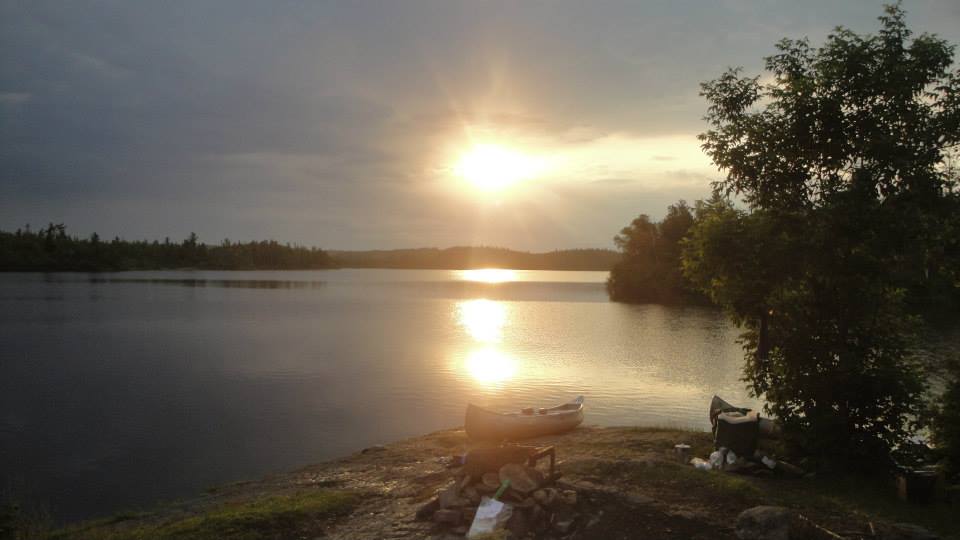
Boundary Waters Trip – 2013

Three generations of my family have been to Minnesota’s Boundary Waters Canoe Area (BWCA), which lies north of Lake Superior and borders Canada within US National Forest territory. The BWCA consists of close to one million acres of lakes, streams, ponds, woods, and portage trails; inhabitants include moose, black bears, loons, eagles, walleye and northern pike. The BWCA’s surface area, incredibly, comprises 20 percent water. No motorboats, no roads, no cars, no cabins, no phones. Your canoe, paddles, map, and compass team up to transport you and your travel companions to and from campsite destinations; your tent, gear, and food – ensconced in backpacks – glide gracefully over the water. These necessities jangle weightily upon your back, however, when you portage them over land. No worries – your canoe comes equipped with shoulder rests. When you turn it upside down and carry it to the end of the portage trail you engage in a workout not replicable on any exercise machine at Gold’s Gym. It’s a great feeling when you throw down your canoe at the end of the trail and simultaneously feel the spray of water upon your legs and hear the boom of the canoe as it bottoms upon flat water.

bwca2
Boundary Waters Trip – 2006

My most recent trip to the BWCA, in 2013, was with a high school youth group from the church I serve in Austin, Texas. It was a great trip full of challenges and rewards. At the end of our trip, we came across a US Forest Service worker. Forest Service employees in the BWCA tend to myriad tasks, including trail maintenance. I asked him how long he had been working for the Forest Service – twenty-five years. I then asked him what were the biggest changes he’d seen in that time – extreme weather.

“The storms in the past years have become stronger and greater in intensity.”

Climate change. It’s happening everywhere. Travel writer Rick Steves sees its effects in Europe. Author Charles Fishman writes about the crippling droughts affecting Australia. Haboobs – an Arabic word we now know because of climate change, meaning intense dust storms – hover from the Middle East and North Africa to Arizona and Texas. Straight-line winds in excess of ninety miles an hour hit the BWCA in July 1999 felling an estimated 25 million trees; one person was killed and sixty were injured. Called a derecho (“straight” in Spanish), it was the largest northernmost storm of its type in recorded history to hit the North American continent.

Climate change is now an accepted reality, yet, people still bicker back and forth as to its cause – or whether it’s simply part of the climate variation that has always existed. Will the effects of historically excessive amounts of carbon dioxide (now at 400 parts per million) in the atmosphere doom the planet?

In Just a Little Bit More, I describe the culture of excess that has been prominent since 1980. Three tenets undergird the culture of excess: bigger and more is always better (from restaurant serving portions to silicone breast implants), economic growth is the panacea for all problems (politicians Republican and Democrat agree), and wealth is the highest societal value. (Is anyone ready for a new Rushmore of Rockefeller, Carnegie, Mellon, and Trump?)

Extreme weather events – and accompanying manifestations, like wildfires – have ravaged the planet for a very long time. Yet, the intriguing connections between recent extreme weather and the current reign of the culture of excess beg investigative thought and reflection.

Economic growth, unequivocally, is the maker and driver of the world we call modern. Before the industrial era (when carbon dioxide levels were at 280 parts per million), poverty and life expectancy rates were – by today’s standards – dismal. The changes and capabilities wrought in the last 250 years simply astound. But how far and how long can economic growth continue as is?

In the bodily progression from childhood to adulthood, limitations eventually halt human physical growth. Human development – in wisdom and maturity – continue on (we trust) as an adult ages. Similarly, I argue that now is the time for greater emphasis on economic development – smart, efficient, and purposeful – as opposed to unabated economic growth.

With religious-type zeal, those who oppose limits on economic growth (see George Will’s recent article on Pope Francis) thunder as if to say whosoever shall stand in the way of the divine right to make as much money as possible be damned! Do not mess with the combination of the three tenets of the culture of excess! Yes, people need jobs – the main mode by which to physically survive on this modern planet. But we must steward the resources of the planet, responsibly and wisely, in the process of working, living, and surviving – together.

When you don’t get enough sleep, your body tells you via symptoms that you need more sleep. If these messages are ignored, breakdown is certain. The recent extreme weather events of heat, cold, floods, snow, drought, and wind could very well be symptoms of a planet that is being transformed by an elevated carbon footprint. As the phrase proclaims – life will go on. But whether or not human life is part of the planet’s future is an open question. Theologian Matthew Fox says that we are the only species on Earth that has the power to control our own destiny; but even so, we’ve yet to decide what to do – whether to live or to die.

The next time you wander out in the darkness – maybe on a canoe trip – and look up and see “the stars pinned on a shimmering curtain of light,” think about Matthew Fox’s statement.*


This blog and website are representative of the views expressed in my book Just a Little Bit More: The Culture of Excess and the Fate of the Common Good. JaLBM, distributed by ACTA Publications (Chicago), is available on Amazon as a paperback and an ebook. It’s also available on Nook and iBooks/iTunes, and at the website of Blue Ocotillo Publishing.

If you’re a member of a faith community – Christian, Jewish, Muslim, Buddhist, or other – consider a book study series of Just a Little Bit More. The full-length book (257 pgs) is intended for engaged readers, whereas the Summary Version and Study Guide (52 pgs) is intended for readers desiring a quick overview of the work. Readers of both books can join together for study, conversation, and subsequent action in support of the common good.

*Quotation from Bruce Cockburn, “Northern Lights,” Dancing in the Dragon’s Jaws (1979, True North).


“Just a Little Bit More” in Chicago

Basketball was my first love. My home church, St. Mark Lutheran in Mt. Prospect, Illinois, had (and still has) an activity center with a full-size hardwood basketball court. As a youngster, I would lay in bed at night dreaming about making it to the fifth grade. Back in that day, there were no basketball teams or leagues for pint-sized superstars-to-be. Fifth grade was the entry point for organized basketball. We played a competitive church league b-ball schedule for four years up until high school; the last two of those years we played on the church team and the junior high school team simultaneously. Those were the days. I’ve often said that I probably would not have become a pastor without that hardwood basketball court at the St. Mark Center. The center was built in 1969. From my vantage point now having served as a pastor for twenty-five years, I’m pretty impressed that the St. Mark church council and building committee in the ’60s had the courage and commitment to build that center – like I said – with a hardwood basketball court as its centerpiece. Today, the center still hosts basketball games and other activities for youth, and serves as a winter overnight sleeping area for homeless people via the PADS (Public Action to Deliver Shelter) program.

st. mark presentation
JaLBM presentation at St. Mark Lutheran, Mt. Prospect, IL, September 14, 2015.

St. Mark also funded my seminary education. In the mid- to late-1980s, seminary tuition ranged from $3000-$4500/year, as education costs were significantly subsidized by the larger church. (Seminary tuition currently runs about $15,000/year.) I’m indebted to St. Mark for its support, and grateful for the people of St. Mark who helped shape my faith and understanding of the world. I wouldn’t be where I am today without them.

Consequently, it was a privilege and honor visit St. Mark and have a conversation on social and economic inequalities, and the common good. Some forty-five people gathered September 14th for presentation and discussion on Just a Little Bit More themes: Rockefeller’s permission, the dominant religion of the land (the confluence of commerce, materialism, and consumerism), and Jesus as a social egalitarian. It was a good session. I’m grateful for the leadership of Nancy Snell, Dr. Lanny Wilson, Dr. Jean Rossi, and my dad—the original “Carlos”—Carl Anderson at St. Mark as they continue further discussions on JaLBM themes in their adult education book study series. Thanks to retiring Pastor Linnea Wilson and St. Mark’s new pastor, Christie Webb, for their support as well.

Messiah Lutheran Church, Wauconda, IL hosted a luncheon Q & A session for me and Just a Little Bit More after I preached at the congregation on September 13th. A number of folks at Messiah have read JaLBM and we engaged in fruitful conversation about the common good and the pursuit of justice in the midst of increasing societal inequality. Special thanks to Pastors Dawn Mass Eck and Ben Dueholm (who has written an excellent article on inequality for The Christian Century, linked here) for facilitating a good weekend for their guest preacher at Messiah. I preached on Hispanic ministry as Messiah embraces a study emphasis this fall, “Church in Changing Neighborhood.” The public school district that serves Wauconda, a northern Chicago suburb, has a student population 26 percent Latino; a generation ago there was minimal Latino presence in Wauconda.

It was gratifying to be at “home” again in the Chicago area, seeing faces old and new, sharing some of my JaLBM work and Hispanic ministry experience.

I don’t play basketball anymore, but I haven’t forgot my hardwood court roots. Thanks, St. Mark!


If you’re a member of a faith community – Christian, Jewish, Muslim, Buddhist, or other – consider a book study series of Just a Little Bit More: The Culture of Excess and the Fate of the Common Good. The full-length book (257 pgs) is intended for engaged readers, whereas the Summary Version and Study Guide (52 pgs) is intended for readers desiring a quick overview of the work. Readers of both books can join together for study, conversation, and subsequent action in support of the common good.

Donald Trump and the Value We Attribute to Wealth

The Donald is on a roll – a white roll, that is. Mexicans and other Latinos are saying “ya basta” – that’s enough.

I pastor a dual-language congregation in Texas. The Donald has given me, for a number of Sundays now, a comical entry into my Spanish sermón. Don’t get me wrong – we don’t focus or even dawdle on partisan politics in Spanish worship at St. John’s/San Juan Lutheran in Austin, but we do talk about what’s happening in society. And The Donald is happening . . .

America is the land of opportunity. And part of that opportunity has been achieved, up to the current day, on the backs of cheap (or enslaved) labor. African slaves and immigrants, Chinese and other Asians, Irish, Italians, Swedes, Germans, Poles, Greeks, Mexicans, Iranians, and many others have put in long days and nights working the land, the factories, the shipyards, the foundries, the slaughterhouses, the ports, the warehouses, the kitchens, the taxis and shuttle buses. America is the land of slaves who came against their own will. America is the land of indigenous natives who were pushed aside – many of these exterminated. America is the land of immigrants, many who came possessing not much more than sheer will. And still, America is the land of opportunity for many – it’s more than a cliché; it’s a vital reality.

America, a great country and society, is far from perfect. We’ve yet to attain “liberty and justice for all.” But as we continue forward on our societal journey, we seem to be making more progress than not.* We value family and friendships, hard work, second chances, accomplishments, and successes.

But here’s where it starts to get complicated. We also revere the attainment of wealth as one of our highest social values. This value has taken Donald Trump to the top of the polls. Yes, he talks tough and is hitting a nerve with a small segment of our society (very white) that wants to fix our immigration issues with deportations and walls. But because he is rich – fabulously so, just listen to him tell you – he has POTUS potential. He claims that he’s “the most successful person to ever run for president.” Mitt Romney’s nomination four years ago, in part, can be attributed to the same evaluation.

Americans equate wealth with success. According to University of Michigan philosophy professor Elizabeth Anderson, this evaluation can be very narrow and limiting – essentially, anti-freedom. I call it un-egalitarian. Check out this brief, yet insightful interview (linked here) by veteran journalist Sam Pizzigati with Dr. Anderson (no relation) on the Inequality.org website e-newsletter Too Much.

Talking about societal values, Anderson says, “I’m wary of any society that reduces success to a single definition. If a society is free, people will pursue different conceptions of the good and define success in different ways. They won’t be unified around a single common definition of success any more than they would be unified around a single religion” (italics mine).

According to Anderson, the primary problem with this single definition of success is that those who are not wealthy are seen to be failures. Secondary problems include overconsumption (by the rich and poor alike, trying to keep up and measure up) and wealth accumulation by questionable means. Value extraction that is harmful to people and communities, and the environment, is permitted because the higher goal of wealth accumulation is served. That’s a problem.

A society that worships wealth accumulation is one in need of a recalibration of its values. Wealth is good, unquestionably; but its unfettered pursuit portends societal decline. A successful society is one that is diversified in its understanding of good and doesn’t allow wealth to siphon upward. Anderson calls inheritance taxes the most just in the world, because they mitigate against the establishment of a permanent upper-class.

Teachers, soldiers, nurses, mechanics, child care workers, cops, community organizers, construction workers, kitchen workers, and caretakers will never be paid extravagant salaries. But their work is vital to the flourishing of societal common good. And their work doesn’t extract, but adds value to communities and societies. Our society would not be successful without them, and the many others who serve the common good in their work.

Candidate Trump can harangue Mexican and other Latino immigrants all he wants. It’s unconvincing, however. Most all of the Mexican and Latino immigrants (and their sons and daughters) that I know in Austin, Houston, and San Antonio – and in other places in this country – are adding value to their communities and to this society.

And, in the end, despite all his wealth, the haranguing will not win Mr. Trump a national election in twenty-first century America.


*Dee Brown’s Bury My Heart at Wounded Knee and Taylor Branch’s Trilogy on the King Years, among other distinguished works of history, help to tell a fuller representative story of American history.


This blog and website are representative of the views expressed in my book Just a Little Bit More: The Culture of Excess and the Fate of the Common Good. JaLBM is available on Amazon as a paperback and an ebook. It’s also available on Nook and iBooks/iTunes, and at the website of Blue Ocotillo Publishing.

For book clubs, community of faith study groups, and individuals, the Summary Version and Study Guide of JaLBM is now available at the Blue Ocotillo website and on Amazon. It’s a “Reader’s Digest” version (fifty-two pages) of the full-length original with discussion questions at the end of each chapter. Join the conversation about social and economic inequality – without having to be politically hyperpartisan – and let’s figure out how capitalism can do better!

The Minority Status DNA of the Church

At the present time, do you think religion as a whole is increasing its influence on American life or losing its influence?                                                                                   – Gallup Poll question

Religion is losing influence in American society, according to 77 percent of those recently polled by Gallup. It’s not the first time Americans have been pessimistic about religion’s influence upon society. Gallup started polling on this question in 1957. At the height the Vietnam War in 1970, 75 percent of those polled answered the above question in the negative. During the 1990s, those answering “religion is losing influence” hovered near 60 percent. It was only after the terrorist attacks of September 11, 2001 that increasing influence numbers outpaced losing influence numbers. That positive bump only lasted two years, however.

Could this losing influence trend reverse itself in the future? Absolutely.

Contrary to what the Gallup poll might suggest, the church in America is not in the process of dying. As of 2014, 70 percent of Americans claim Christian affiliation, a clear majority. Not all of these, however, regularly participate in the life of a gathering faith community. According to the Pew Research Center, Catholics and mainline Protestants are currently losing significant numbers of adherents, while the category grouping “unaffiliated” or “none” (many of these young adults) conversely grows – now at 23 percent, nearly one in four Americans.

As a pastor in a mainline denomination (ELCA) that is suffering numerical decline, I proclaim that the wane of religious influence and participation is not the worst thing that could happen. As I’ll explain, it’s a potentially good situation.

For the first 300 years of its life, the Christian church was a minority status organization. The apostle Paul described the believers in the church of Corinth as not measuring up to elevated human standards of wisdom, influence, or nobility. Even so, this small and obscure organization – the gathering community in Corinth being one example – maintained vitality. Its founding DNA, if you will, was infused with an ability to thrive in difficult circumstances.

early church

Roman Emperor Constantine gave his blessing upon the church in 325 CE, thus enabling it to (eventually) grow into what most American Christians know the church as – a majority status institution. There’s nothing inherently wrong with a majority status institution, but care must be taken that corruptions, entitlements, and ineffectiveness don’t infiltrate the institution and desecrate its mission. The American auto industry of the 1970s and ’80s is a prime example – remember the Plymouth Volare and the AMC Pacer? These inferior models, indirectly, helped make the way for the Honda Accord and Toyota Camry – significantly better automobiles, and from foreign manufacturers.

Like the US auto industry, the American church is not what it used to be. In the 1950s and early ’60s, social pressures dictated that respectable citizens be church members; church attendance numbers crested. The pendulum has now swung decisively in the other direction, as attributed by the growing number of “nones” or religiously unaffiliated, and shrinking church memberships.

It’s quite possible that the church is in the process of becoming leaner and more focused. The pendulum has swung far enough to the other side that churches no longer need to try to measure up to what used to be. Our numbers aren’t what they used to be a generation or two ago? So be it! Biggest is not always best. Infused into our organizational DNA is the ability to thrive as a minority institution.

The 21st century could be a time of clarified mission for a number of our churches. Mission that includes cooperation with peoples of differing faith traditions on topics of common interest: compassionate service to the human family for the advancement of common good; an impassioned voice for justice when the economy unfairly rewards the advantaged at the expense of the disadvantaged; the promotion of peace in the face of war. And all these things done in the name of that which we hold to be holy.

When peoples of differing religions operate together in this fashion, positive religious societal influence will proliferate and the world will be a better place because of it.


This blog and website are representative of the views expressed in my book Just a Little Bit More: The Culture of Excess and the Fate of the Common Good. JaLBM is available on Amazon as a paperback and an ebook. It’s also available on Nook and iBooks/iTunes, and at the website of Blue Ocotillo Publishing.

For book clubs, community of faith study groups, and individuals, the Summary Version and Study Guide of JaLBM is now available at the Blue Ocotillo website and on Amazon. It’s a “Reader’s Digest” version (fifty-two pages) of the full-length original with discussion questions at the end of each chapter. Join the conversation about social and economic inequality – without having to be politically hyperpartisan – and let’s figure out how capitalism can do better!

Water’s Lesson – The Future Favors Development, not Growth

Third in a series of blog posts on water. Click here for first, second.

A Google search on economic growth yields 65 million results – double that of a search on economic development. Whereas politicians and pundits tout economic growth as the panacea of all that ails us, economic development is the way of the future (and present).

What’s the difference between growth and development? It’s not just semantics, but the difference between 10-11 billion people surviving on one planet or having to look for two to three other planets in order to support lifestyles that are hyper-exhaustive of resources and waste sinks. Whereas growth tends to push aside all other considerations for the sake of bigger and more, development is built upon efficiencies and accepts the reality of limits.

Water1As I said in my first blog post on the irreplaceable and life-enabling resource of water, the freshwater supply on Earth is completely stable, having arrived here some 4.4 billion years ago. We have what we have: we can’t order any new supplies of water on Amazon, nor can we expect China to manufacture new supplies. As population continues to increase (currently 7 billion and projected to be 10-11 billion by 2100), the fresh water that exists will have to be shared. Desalination has become a somewhat cheaper process than it used to be, but its overall yield is minimal. Saudi Arabia and Israel – situated in desert climes – benefit from desalination. But for Americans, surrounded by rivers and lakes, desal is not a great solution.

Charles Fishman’s excellent book, The Big Thirst (Free Press, 2011), shows over and again that conservation and decreased use of water IS compatible with economic development. Have you been to Las Vegas lately? The desired destination in the desert gets most of its drinking water from Lake Mead, the big pool of water from the Colorado River that sits behind the Hoover Dam. Vegas gets all of four inches of rain annually. The past twenty-five years, as Lake Mead’s levels have plunged due to drought, Las Vegas has been very intentional about its water consumption. Vegas’ water consumption per capita has decreased more than 30 percent since 1990. Yes, its many golf courses and hotel water fountains betray an extravagant use of water, but Las Vegans have adopted a new mindset: conservation of water is the new normal.

Let’s be honest. Conservation goes against what many Americans have grown accustomed to: wanting what we want (now) without having to accept anything less. It’s all part of the just a little bit more spirit. But, alas, all is not lost. We Americans are an adaptable bunch . . .

According to Fishman, American industry leads the way on smart water usage and conservation. Campbell Soup uses less water today to produce a can of soup than it did five years ago. Coca-Cola, Intel, Monsanto, IBM, and GE have this in common: these corporations realize water availability is limited and are doing (and planning to do) what they can to get by with less water. Their present and future vitality – continued economic development – depends upon water use efficiencies.

Are there any purple water pipes in your neighborhood? Purple pipes signify the presence of reclaimed water or treated wastewater. Some cities in California, Texas, and Florida are saving on potable water via increased use of reclaimed water. Is it really necessary to flush our toilets with potable (drinking) water? In the future when our grandchildren’s generation looks back to review our water habits of today, potable water in toilets will be deemed wasteful (even though appreciated by a number of our dogs). Soon enough watering lawns and plants with drinking water will also be a thing of the past – as will be many of those lawns.

Water is the new oil. The sooner we treat both resources as precious, limited, and belonging to the whole human family – including those coming after us – the better. Economic development, smart and efficient, with a nod to conservation is the only economic activity that will survive as this century goes forward. Our understanding of water is now permanently altered due to climate change-induced drought and population growth. The crucial issue of water use deserves our very best attention and innovative thinking as we go forward.


This blog and website are representative of the views expressed in my book Just a Little Bit More: The Culture of Excess and the Fate of the Common Good. JaLBM is available on Amazon as a paperback and an ebook. It’s also available on Nook and iBooks/iTunes, and at the website of Blue Ocotillo Publishing.

For book clubs, community of faith study groups, and individuals, the Summary Version and Study Guide of JaLBM is now available at the Blue Ocotillo website and on Amazon. It’s a “Reader’s Digest” version (fifty-two pages) of the full-length original with discussion questions at the end of each chapter. Join the conversation about social and economic inequality – without having to be politically hyperpartisan – and let’s figure out how capitalism can do better!

A Toast to Clean Water

(Second in a series – click here for “Water – The Ultimate Fixed Asset.”)

Making homebrew – far and away my favorite hobby of all time.* When my brother Matt shared one of his first batches of homebrew – a smooth weissbier(wheat ale) – I was hooked. I brewed for seven years or so during the 1990s. My favorite concoction was a Cranberry Wheat; I would make it in November as soon as fresh cranberries appeared in the produce section of the grocery store. Charlie Papazian’s 1984 tome, The Complete Joy of Home Brewing, served as my brew bible. I’m not the only one who can say so: Papazian’s book has sold close to 1 million copies. Take that, macro brews Bud/Miller/Coors (known as “yucky beer” in the Anderson household). Long live micro and home brews!

homebrew
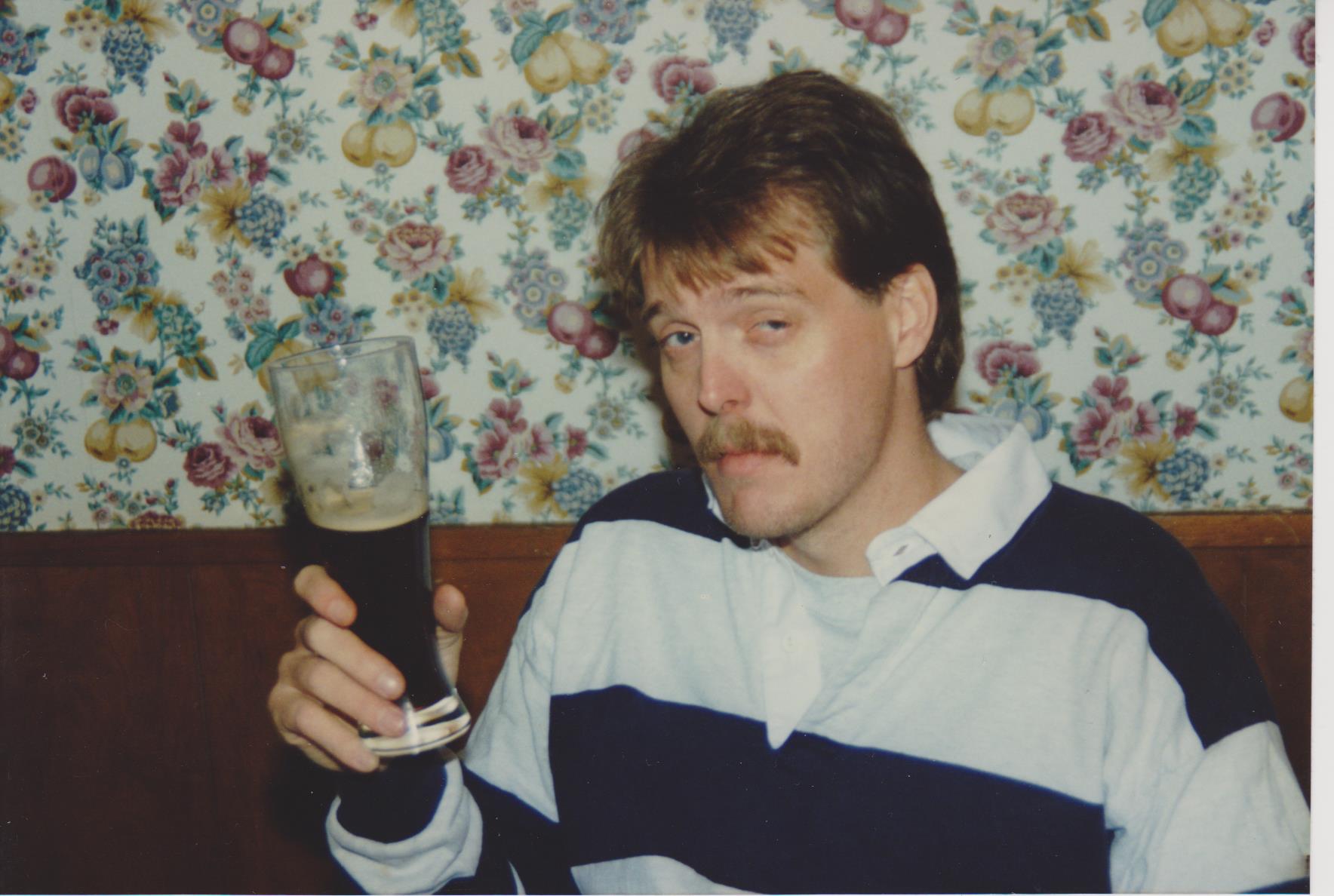
Cranberry Wheat – Houston, TX 1996 — Floral Design Wallpaper – looks like circa 1981?!

No offense intended to my friends who make their own wine. Making homebrew and wine are very similar in process – carboys, fermenting bubblers, specific gravity readings. But the end results are markedly different. A home vintner can ferment something decent, but rarely superior to the category of $10-12 bottles at the wine store. (Home vintners can create unique beverages not found anywhere else, however.) Home brewers on the other hand, consistently kick macros’ asses and can make stuff just as good as the American craft and quality import beers offered commercially.

The great reformer of the 16th century church, Martin Luther, famously enjoyed the homebrew made by his wife, Katharina von Bora. At that time, beer was available for sale (the 1516 Reinheitsgebot law dictated that beer be made only from water, barley, hops and yeast), but homebrew rivaled commercial beer production in quantity and quality. Luther lamented times of travel when he found himself in places where good beer was scarce; he pined to return home: “What good wine and beer I have at home, and also a beautiful lady.”

If you’re a homebrewer, undoubtedly you’ve heard the following narrative: beer, its alcohol content killing the impurities in the water, saved our medieval ancestors from peril and disease caused by drinking contaminated water. It sounds nice – especially to a homebrewer – but it’s mostly the stuff of legend. Many have died through the ages from waterborne diseases like cholera and dysentery, but it’s been clean water, not beer or wine, that ultimately allows for our collective gene pool to perpetuate.

Charles Fishman, in his excellent book on present and future predicaments related to water, The Big Thirst (Free Press, 2011), argues that our attitudes and assumptions about water need to change. Close to 1 billion people in the world lack ready access to reliably clean water. Meanwhile in the developed nations of the world, bottled water is one of the biggest growth markets of the last generation. Both the pros and cons of bottled water are well-known: bottled water is perceived to be safer than tap water in municipalities that have not updated aging distribution pipes; bottled water is a healthier option than sugary sodas; yet, the production of billions of plastic water bottles is an inefficient use of resources and a prolific begetter of pollution; and, the cost of bottled water, incredibly, is higher than milk or gasoline.

In my previous blog post on water, I expound on Fishman’s crowning of the twentieth century as the golden age of water, wherein the availability of potable water – “unlimited, free, and safe” – consequently became taken for granted. Fishman calls the business of bottled water “the final flowering” of the golden age of water. Stop by a quick mart store in Anytown, America and gaze through the glass refrigerator doors to see rows of bottled water available from the French Alps, the Italian Alps, Germany, and Fiji. Yes, Fiji, where more than half of residents do not have access to reliably clean drinking water. “A silly triumph for capitalism . . . the market has created very persuasive solutions for water problems that don’t exist, while failing to find any solutions for real water problems” (p. 137).

Fishman reminds his readers that all water problems are local and regional, and their solutions must be local and regional. Even so, with increasing global population (and an unchanging amount of fresh water available), more people worldwide moving into the middle class (and thus using more water), factories spreading to developing nations (using much more water), and the advance of climate change (more regions of the world affected by drought), our attitudes about water need to change significantly. By 2050, it’s possible that 2 billion people worldwide will not have ready access to reliably clean water.

Water issues and problems will predominate into the twenty-first century. The next time you raise a glass – beer, wine, or water – give thanks for what you have and be not afraid to change your attitudes about water. The survival of the human family, no less, depends upon it.


The next blog post continues this series on water and concerns specific changes needed in attitudes about water and related practices.

*Those who know me might think golf is my fave hobby of all time. In my world, golf is best categorized as an obsession – a healthy one, of course.


This blog and website are representative of the views expressed in my book Just a Little Bit More: The Culture of Excess and the Fate of the Common Good. JaLBM is available on Amazon as a paperback and an ebook. It’s also available on Nook and iBooks/iTunes, and at the website of Blue Ocotillo Publishing.

For book clubs, community of faith study groups, and individuals, the Summary Version and Study Guide of JaLBM is now available at the Blue Ocotillo website and on Amazon. It’s a “Reader’s Digest” version (fifty-two pages) of the full-length original with discussion questions at the end of each chapter. Join the conversation about social and economic inequality – without having to be politically hyperpartisan – and let’s figure out how capitalism can do better!

Water – The Ultimate Fixed Asset

The first in a series of three blog posts on water.

Ninety-seven percent of the world’s water supply is salty sea and ocean water. Of the remaining 3 percent that is fresh water, most is frozen (estimates range from 68 to 83 percent). That means over 7 billion people, and myriad plants and animals, share the relative small amount of fresh water that sloshes around. The planet’s water supply – established some 4.4 billion years ago – is absolutely stable. No new water created, none disappearing – the fresh water that exists today supported the lives of multicellular organisms, plants, and dinosaurs long before the arrival of Homo sapiens.

waves-wallpaper-nature-sea-ocean-water-freshness-hd-ocean-water-hd-desktop-wallpaper-Although there would be no life but for water, we absolutely take water for granted. We do the same with the oxygen content of the air we breathe, readily available wherever we might amble upon the green, brown, and blue planet. Water is different, both abundant and scarce, depending upon circumstances and location. We modern-world, well-to-do types simply turn on a faucet and sweet, potable water discharges. I was born in 1961 in Minnesota and I’ve yet to live a single day in the United States when potable water was not available to me on demand.

In the late 1980s, I lived in the South American country of Peru, serving as an intern pastor in a small pueblito called San Antonio de Pomalca. Located in the Sechura desert, the residents of the village retrieved water daily from a well. The folks of San Antonio de Pomalca knew two things about their water supply: it wasn’t unlimited and it needed to be shared.

This type of simple wisdom flies in the face of what has been a driving force in the United States ever since the early 1980s: unlimitedness. Whether water, energy, creativity, resources, or the all-you-can-eat restaurant buffet (an Americanism, different than the Swedish smorgasbord, meaning sandwich table, where variety is valued over endless supply) – we’re encouraged to go for it – don’t hold back. And why not? The spirit of “just a little bit more” is the driving force behind numerous American achievements and accomplishments, beneficial to you, me, and many others throughout the world. But when the spirit of just a little bit more goes too far, blatant inequalities and unjust inequities are often the result.

A good number of Americans born previous to 1961 grew up in domiciles without indoor plumbing or central air conditioning/heating. Maybe you’re one of these folks. You probably don’t take clean, running water for granted. You’re thankful for it because you remember a time when you didn’t have it.

Author Charles Fishman tells us that the twentieth century was the golden age of water. In his book The Big Thirst (Free Press, 2011), he attributes the significant increase in life expectancy in the United States – forty-eight years in 1900 to seventy-five years in 2000 – in large part to enhanced availability of clean water. He says that water became “unlimited, free, and safe” – meaning we didn’t have to worry about water. We could take it for granted. And we do.

The golden age of water, however, is coming to an end. Climate change and related drought, population increase, and heightened competition for water usage are combining to wake us up to the reality of water as a fixed, and not unlimited, asset.

The challenge: can today’s generation of Americans adjust to limitedness? Limitedness calls for conservation, efficiency in usage, and sharing. The values supporting these practices go against the grain of the way many of us are accustomed to living.

I’ll have two or three more blog posts to follow on this very topic. There’s a lot to talk about: desalinization, bottled vs. tap water, market forces on the price of water, gray water in your toilet (yup), among others topics.

By definition a fixed asset is tangible property central to the operation of a business, not traded or converted into cash. Water is central to the business of life – we do best to appreciate it, cherish it, and share it.


This blog and website are representative of the views expressed in my book Just a Little Bit More: The Culture of Excess and the Fate of the Common Good. JaLBM is available on Amazon as a paperback and an ebook. It’s also available on Nook and iBooks/iTunes, and at the website of Blue Ocotillo Publishing.

For book clubs, community of faith study groups, and individuals, the Summary Version and Study Guide of JaLBM is now available at the Blue Ocotillo website and on Amazon. It’s a “Reader’s Digest” version (fifty-two pages) of the full-length original with discussion questions at the end of each chapter. Join the conversation about social and economic inequality – without having to be politically hyperpartisan – and let’s figure out how capitalism can do better!


Whole Foods Market – Detroit

wfd1

It might seem as if all the news coming out of Detroit lately has been bad . . . blighted and abandoned neighborhoods, the first major American city to declare bankruptcy, crippling unemployment. In 1950,
Detroit was the fourth most populous city in the United States with 1.8 million residents. Its population has been in decline ever since. The 2008-09 economic crash caused Detroit’s unemployment rate to peak at 28 percent, and Detroit’s population plummeted to under 725,000 with two hundred thousand residents leaving the Motor City during the crisis.

You might have heard that Detroit is a “food desert,” meaning that there are no grocery stores selling fresh produce within the city limits. That’s not true. There are a number of loyal grocers within the city limits – the Honey Bee Market, established in 1956, caters to a mostly Latino clientele in southwest Detroit, and University Foods, established in 1979, serves the upper Midtown area. The Eastern Market, located about a mile from Ford Field stadium, is the largest public historic market district in the United States. Especially on Saturdays, thousands of Detroit area residents flock to buy the fresh produce it offers. It also serves as a tailgate destination before Detroit Lions home games in the fall. There are other local grocers and discounters like Save-A-Lot (the precursor to Dollar General as a grocer); but when the Farmer Jack grocery chain closed its single remaining store in 2007, that meant major grocery chains no longer had operations in Detroit. No Albertsons, Kroger, or Safeway stores within Motown’s city limits – not even Walmart, the largest grocer in the United States.

Austin-based Whole Foods, surprisingly, decided to enter Detroit’s city limits, setting up shop on Mack Avenue in lower Midtown in June 2013. Whole Foods sells high quality, organic, and sustainable foods to customers nationwide via employees who are treated well – starting wages are usually around $11/hour, with benefits offered after four to six months on the job. Whole Foods strives to practice environmental stewardship through its relationships with suppliers, and touts commitment to “greater good” as a core value in its aggregate operations. Whole Foods is also one of the most expensive grocery stores in the country.

wfd3
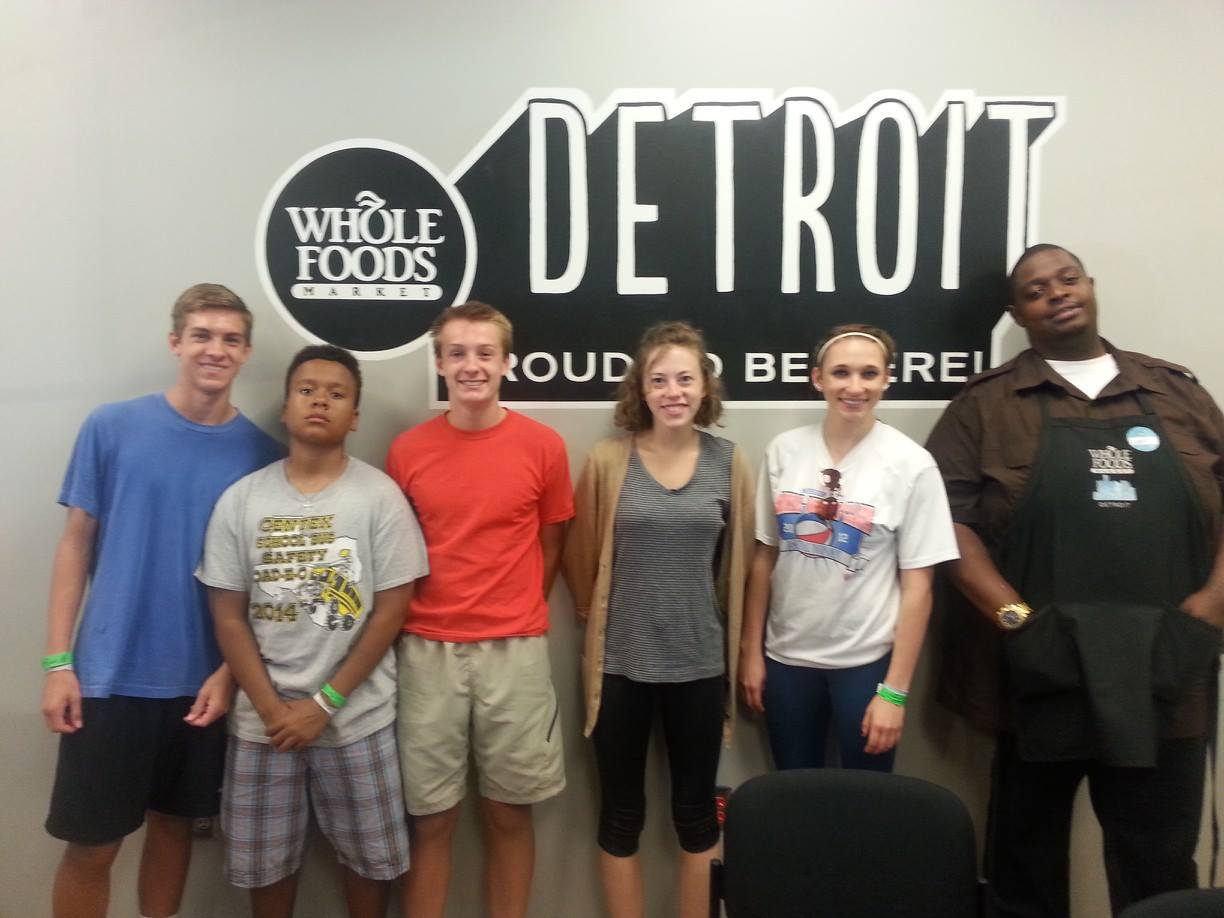
St. John’s/San Juan Lutheran youth with store manager Larry Austin

The ELCA Youth Gathering brought 30,000 Lutheran high schoolers to Detroit in July 2015. I came to the gathering with eight youth and a wonderful adult leader, Chelsi West, representing St. John’s/San Juan Lutheran in Austin. The gathering youth and their leaders performed service projects throughout the city, and filled the Ford Field stadium four nights for music, fellowship, and inspiration from superb speakers. It was a fantastic event, and many Detroiters expressed gratitude for our presence that brought service muscle and economic support to the city and surrounding area.

While in Detroit for the event, our group went for a visit to the Whole Foods store in Detroit’s Midtown. Being from Austin, I wanted to see what “greater good” connections the seemingly incongruous placement of a Whole Foods store in the Motor City were producing. We hoofed up from Ford Field about one mile to lower Midtown on a hot Saturday afternoon. New apartment buildings contrasted with burnt-out and abandoned mansions from days gone by. My Austinite youth, accustomed to a busy downtown corridor, were surprised by the tranquility. We saw few passersby and only a modest amount of cars on the roads.

When we got to Mack Avenue in lower Midtown, we noticed more activity. The Whole Foods Market stood on the corner. At 20,000 square feet, it’s one-fourth the size of Austin’s flagship store. Yet, it’s one of the biggest grocery stores within the Detroit city limits.

Some of the grocery stores in Detroit (such as Save-A-Lot) move big quantities of cheap food with meager selection – highly processed filler and junk food like chips, crackers, and sugary treats. It’s only been in the last few decades that a major shift has occurred in world history – generally speaking, the poor are now obese and the rich are thin. For all of history, it’s been the other way around. Cheap filler food – seemingly the best option for people living in poverty – is a main contributing factor. Detroit has one of the highest obesity rates for American cities (33 percent). Whole Foods has sent one of its staff nutritionists, Dr. Akua Woolbright, to live and work in Detroit; she offers free classes on healthier eating and lifestyle change.

Store manager Larry Austin (pictured above) met with our group and talked to us of the store’s two years of operations in Detroit. Larry exudes an exemplary enthusiasm for his work and for the mission of Whole Foods in Detroit. He’s been with Whole Foods for sixteen years. The five high schoolers who joined me in conversation with Larry caught a small glimpse of Whole Foods co-CEOs John Mackey and Walter Robb’s 21st century business model. Larry told us, with a confident smile, that sales for these first two years have exceeded expectations significantly.

The Detroit store employs 180 people, half of whom actually live within city limits; the majority of these are full-time employees receiving health care benefits.

My book Just a Little Bit More proposes a newer concept – economic democracy – that uplifts the values of limits, balance, and cooperation within the competitive business environment. JaLBM promotes purposeful common good creation; it’s our responsibility to make sure the economic market lives up to that goal. Mackey and Robb concur and it’s a major reason why they put the first chain grocer back into Detroit since 2007. Granted, Whole Foods took advantage of city-offered subsidies that minimized the store rental rate ($6/square foot), but Kroger, Albertsons and Walmart haven’t done so and don’t have plans to set up shop anytime soon within Detroit’s city limits.

As for the prices in the Detroit store – overall, they seemed expensive. I expected to see more difference in terms of prices between Whole Foods in Austin and Detroit (the hot food and salad bar is available at $6.99/lb. instead of the usual $8.99/lb.). But as Mackey, Robb, and store manager Larry Austin will tell you, the store offers a significantly healthier quality of food not available anywhere else in Detroit. And also, if you’re making your own food – and not buying prepared food – you’re saving money. According to Slate writer Tracie McMillan, (her linked article is excellent), Whole Foods Detroit has a mountain of work to do if they expect Detroit’s poorer residents to shop there. McMillan says 38 percent of Detroit residents receive SNAP benefits – food stamps – but only 5-10 percent of sales at Whole Foods Detroit as of now are from residents using SNAP benefits. (Nationally, Whole Foods’ rate of SNAP benefit users is 1-2 percent of overall sales.)

Detroit has over 400 liquor stores, grossly outnumbering the city’s grocery stores. Whole Foods in Detroit is not a perfect match, but I give the corporation major props for choosing the city of Detroit for a much needed shot of fresh produce, healthier food options, and jobs.

The news from Detroit is getting better – unemployment is currently down to 10. 2 percent and further economic recovery seems to be just around the corner. Most importantly, all the Detroiters with whom we interacted – from Larry Austin to folks on the street – were upbeat about their city.

Thanks to the many Detroiters who helped make the ELCA Youth Gathering memorable and uplifting!

#RiseUpELCA


This blog and website are representative of the views expressed in my book Just a Little Bit More: The Culture of Excess and the Fate of the Common Good. JaLBM is available on Amazon as a paperback and an ebook. It’s also available on Nook and iBooks/iTunes, and at the website of Blue Ocotillo Publishing.

For book clubs, community of faith study groups, and individuals, the Summary Version and Study Guide of JaLBM is now available at the Blue Ocotillo website and on Amazon. It’s a “Reader’s Digest” version (fifty-two pages) of the full-length original with discussion questions at the end of each chapter. Join the conversation about social and economic inequality – without having to be politically hyperpartisan – and let’s figure out how capitalism can do better!


Same-Sex Marriage Legalized – Egalitarianism in Action

I’m a pastor of a national church body that is both progressive and traditional. The Evangelical Lutheran Church in America (ELCA) approved, in 2009, a resolution to ordain gay and lesbian ministry candidates. This decision led a number of folks and congregations to leave the ELCA; overall membership has plummeted now to under 4 million members. At its inception in 1988, the ELCA had a membership of more than 5 million souls. The 2009 decision is not the sole factor to explain the church’s decline, but one of many including changing cultural values and increasing number of hours worked by Americans.

SCOTUS
US Supreme Court – 2015

On Sunday, July 5, I preached on the recent US Supreme Court decision (Obergefell v. Hodges) to legalize same-sex marriage. The congregation I serve in Austin, Texas is dual-language, English and Spanish; we gather to worship separately in both respective languages each Sunday within a “one congregation” context. We have members in each worship group who represent either side of the gay marriage issue – traditional and progressive. The text of II Corinthians 12:9 – spiritual power reaching full maturity in weakness – served to remind our traditional-leaning members (most of whom were raised in the previous century and taught that homosexuality was wrong) about the hidden strength of spiritual power: It gives us the wisdom to sort out the things we can change from the things we need to accept. Our Christian tradition beckons us to love our neighbors and interact with them compassionately, even if their life choices and/or politics don’t agree with our own.

The Supreme Court decision, coming days before the 239th anniversary of the nation’s birth, gave me an opportunity to preach also on the egalitarian foundations, still alive and well, of our society. Egalitarianism, as I proclaim it, goes beyond equality to a deeper reality than simply equal quantities, measurements, or values. Egalitarianism emerges and comes to light from a situation of specific inequality—dominance-subordination. Egalitarianism is political in nature: a group or commu­nity engaged in the struggle of self-determination within the larger community or with a competing community seeks, at­tains, and maintains a balance or equity with its competitor.

The word egalitarian was coined during the Gilded Age (1870 – 1900) as the maturing industrial era created economic and social inequalities previously unknown.  While the word egalitarian is a very recent addition to most languages, the concept of egalitarianism is a deeply biblical and ancient one. From God telling Pharaoh through Moses “Let my people go!” to Paul proclaiming to the Galatians that “all of you are one in Christ Jesus” – egalitarianism, be it spiritual or secular, unites and liberates those who are subordinated by unjust domination.

The biblical record serves to buttress egalitarian­ism as a social value in secular society. As a political response to the dominance that a top-down hierarchy or majority can create, egalitarianism has played a major role in American history. Many immigrants came to America from Europe because the promised or imagined opportunity provided relief from social and economic domination. The abolition movement achieved success in the nineteenth century, as did the civil rights movement in the twentieth century, fueled by egalitarianism. Egal­itarianism is one of humanity’s greatest achievements be­cause of the opportunities it affords to those previously kept under thumb. Those seen to be individually weak join forces to stand up to or have equal footing with the strong and powerful. Thomas Jefferson and Benjamin Franklin’s use of the egalitarian line “all men are created equal [sic]” in the Declaration of Independence has served both to restrict the haughty and to liberate the downtrodden. Egalitarianism best serves to eliminate unjust and unmerited privilege that debilitates minority populations. America’s slaves, indigenous, immigrants, minorities, women, children, handicapped, gays and lesbians have all achieved civil rights—sometimes through blood, sweat, and tears—because of egalitarianism.

scotus 1967 warren court
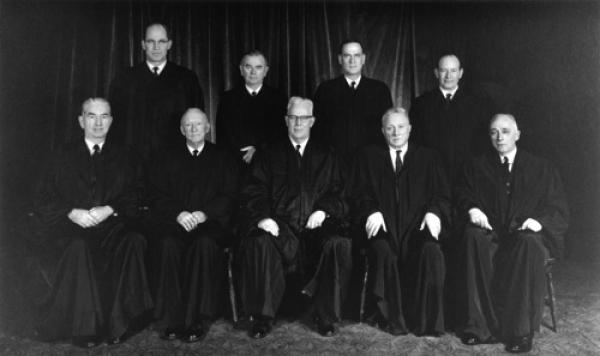
1967 Supreme Court (Thurgood Marshall joined in October after the June 12th Loving decision)

The 2015 Obergefell decision echoes the 1967 Supreme Court decision to legalize interracial marriage in all the land. According to Gallup.com, some 75 percent of Americans in 1967 disapproved of interracial marriage, and fourteen former slaveholding states did not permit it. The Loving v. Virginia decision helped move the nation away from some of its racist past, and toward a future of greater light.

Our Supreme Court justices and their decisions are not infallible, but oftentimes a wisdom derived from the radical phrase “all people are created equal” comes forth from their decisions. Both liberty and egalitarianism are founding and guiding principles of this society; their simultaneous cooperation and competition with one another (balancing out the other’s excesses) help this society live up to its stated convictions.


This blog and website are representative of the views expressed in my book Just a Little Bit More: The Culture of Excess and the Fate of the Common Good. JaLBM is available on Amazon as a paperback and an ebook. It’s also available on Nook and iBooks/iTunes, and at the website of Blue Ocotillo Publishing.

For book clubs, community of faith study groups, and individuals, the Summary Version and Study Guide of JaLBM is now available at the Blue Ocotillo website and on Amazon. It’s a “Reader’s Digest” version (fifty-two pages) of the full-length original with discussion questions at the end of each chapter. Join the conversation about social and economic inequality – without having to be hyperpartisan – and let’s figure out how capitalism can do better!

Vacations are for Slackers . . .

It’s summertime – have you taken a vacation yet? A recent national survey claims that 42 per cent of working Americans didn’t take any vacation days in 2014. Wow – keep that stat in mind the next time you have an interchange with a grumpy employee. Maybe he’s having a bad day in part because he hasn’t had time off from the job for a significant stretch. The United States is the only developed nation in the world that doesn’t lawfully mandate paid vacation days for workers.

Some Americans are workaholics and others actually like their jobs so much they don’t take any vacation days. Workaholics and job-lovers together, however, we can assume to be a minority. Other Americans in low-paying jobs are unable or afraid to take time off (lest they lose their jobs), and other Americans are uncomfortable getting away from the office or workplace lest necessary tasks be forgotten or mismanaged by others. Other Americans, because of our incomplete system of health care coverage, end up using vacation days as sick or family leave days.

Most Americans – whether vacation-takers or not – live in obeisance to the dominant religion of the day: the troika of materialism, commerce, and consumerism. On the surface, it’s a good religion that feeds, shelters, clothes, and employs us. But when the religion goes overboard – too many hours worked is but one example – it breaks bad and damages societal common good.

jalbm neal
The Caddy Man

By the numbers, the three people groups most devoted to working are South Koreans, Americans, and Australians. Only South Koreans take fewer vacation days and holidays than American workers; only Australians work on average more weeks per year than Americans. The Caddy Man, actor Neal McDonough, perfectly describes (albeit unintended) the dominant religion in America. Speaking incredulously of those woosified Europeans: “They take August off – off!”

Once upon a time (in the 1950s), many commentators, confident of increased gains in productivity and innovation, foresaw a shorter workweek and increased leisure time for Americans by the last few decades of the century. Those predictions fell completely flat. Americans worked, on the average, 160 hours more a year in 2000 than in 1970. America, historically associated with the opportunity to work, now seems to be associated with the domination of work (for those who can find it). Consumerism, of course, has brought about work’s ability to rule.

According to Adam Sacks of Oxford Economics – an organization that serves the travel industry – the average working American leaves five vacation days unused per year. Sacks calls it a culture of work martyrdom: those who don’t use all their vacation are more virtuous than those who do take all their vacation days. Vacations are for slackers.

————————————————————————

The star-forming region NGC 3603 - seen here in the latest Hubble Space Telescope image - contains one of the most impressive massive young star clusters in the Milky Way. Bathed in gas and dust the cluster formed in a huge rush of star formation thought to have occurred around a million years ago. The hot blue stars at the core are responsible for carving out a huge cavity in the gas seen to the right of the star cluster in NGC 3603's centre.
Hubble Space Telescope pic

Vacations are also for those seeking renewal and rejuvenation. One of the first stories in Hebrew scriptures tells of the Creator God taking a day off at the conclusion of an extended work project. The moral of the story: creativity and rest go hand-in-hand. We are capable of creating and doing good work on little sleep; but, over the long haul, you and I need rest and downtime in order to be effective in relationships and in work environments.

When will we see a change in the way working America operates? The typical reward for good work is increased pay. While many appreciate (and need) an increase in pay, when will we see a culture shift that rewards employees’ good work with more time off?


This blog and website are representative of the views expressed in my book Just a Little Bit More: The Culture of Excess and the Fate of the Common Good. JaLBM is available on Amazon as a paperback and an ebook. It’s also available on Nook and iBooks/iTunes, and at the website of Blue Ocotillo Publishing.

For book clubs, community of faith study groups, and individuals, the Summary Version and Study Guide of JaLBM is now available at the Blue Ocotillo website and on Amazon. It’s a “Reader’s Digest” version (fifty-two pages) of the full-length original with discussion questions at the end of each chapter. Join the conversation about social and economic inequality – without having to be hyperpartisan – and let’s figure out how capitalism can do better!