Habitat for Humanity in El Salvador

Thanks to colleague Kathy Haueisen for this guest blog post. Blue Ocotillo will be publishing her novel Asunder this spring. Check out other posts from Kathy at her website, “How Wise Then: Ancient Wisdom for Modern Problems.”    
        

            Two days before I was scheduled to fly to El Salvador for my third Thrivent Builds-Habitat for Humanity trip I got an e-mail from our State Department warning me of escalating concerns about safety there for U.S.A. travelers. Were this my first trip I might have cancelled my flight.

            Since this was not my first trip, I deleted the e-mail and continued packing. Both Thrivent (a not-for-profit financial services organization for Christians) and Habitat in El Salvador run excellent programs. The work, though physically challenging, is manageable. We get two breaks and a long lunch plus encouragement to rest when we’re feeling tired.

            Our task was to help dig an eight foot-deep hole and deepen a trench around the house for a new septic system at a Habitat home. We spent much of the week moving dirt out of the way and then moving it back in to fill in around newly laid pipes.

            The week wasn’t all work. Habitat encourages getting to know the Salvadorians we met. For that reason each work site includes an interpreter. This is essential as the building project managers are hired for their construction skills and ability to work with international volunteers, not for their English skills. Some volunteers speak Spanish, but few have an adequate vocabulary to negotiate building instructions.

            One of the Habitat workers was a young man, David. At one point David was pitching dirt out of the pit that was now deeper than he was tall. He could pitch dirt out faster than five volunteers could load it into a wheel barrel and haul it to the empty lot next door.

            One young local woman, Glenda, came by every day to help because she wanted to practice her English. I wanted to practice my Spanish so we spoke to one another in both languages frequently during the week. I was immediately drawn to Glenda as she is the same age as two of my granddaughters.

            Luis Viscarra is the Habitat staff person charged with welcoming each international team at the San Salvador airport. He gives each team a brief history of El Salvador along with practical tips for staying healthy and safe while in country. He starts by explaining that when Spain conquered El Salvador several centuries ago the country was divided up among fourteen colony families. By the time of the 1980s’ Civil War, descendants of these original fourteen families literally owned all of El Salvador. These few were wealthy while the majority of people were living in desperate poverty.

            The Civil war broke out in 1979 when the military-led government, representing the interests of the fourteen families, fought against a coalition of guerrilla groups fighting for a more equitable distribution of the country’s resources.

            Many fled during the twelve-year conflict. Both sides recruited child soldiers. There was extreme violence, including deliberately terrorizing and targeting civilians via death squads. Martyr Oscar Romero, a Catholic priest, campaigned on behalf of the poor. For his efforts he was assassinated in March 1980 as he led worship. We saw photos of him everywhere, including on the stole of Lutheran Bishop Medardo Gomez who presided over worship at Iglesia Luterana Cristo Rey (Christ the King Lutheran Church) in Santa Ana, our first Sunday there.

            The years of extreme violence and the disruption of families as many fled the twelve years of extreme violence have resulted in a generation of young men who have grown up inadequately educated but with much experience of violence. That combined with extreme poverty, has led to the formation of gangs.

            So yes, gangs are a serious problem in some parts of El Salvador. However, Habitat leaders know where they are active and keep the international volunteers far away from those areas.

            Because we were team number 250 through the Thrivent-Habitat of El Salvador partnership, we were given extra special attention. The week started with a worship service at Cristo Rey in Santa Ana. An earthquake destroyed their church building in 2000. For many years the small congregation gathered in an old cinder-bloc building that survived the earthquake. It had originally been a chicken coop.
Cristo Rey.Santa Ana (1)

            When Joe and Bonnie Reilly started taking volunteers to El Salvador as part of Joe’s work with Thrivent, they took teams to worship at Cristo Rey since many of the homes they worked on belonged to members of that congregation.

            A few years ago they sat with their team in folding chairs in the cinder-block building and asked Pastor Carlos what he needed most. His obvious answer was, “A new church.” There were only two problems: the congregation had no funds and little hope of raising them to build a new church; and, Habitat for Humanity builds homes, not churches.

            The best way to handle a problem is to get rid of it. With a lot of prayer and enthusiasm Partners in Faith was formed. Funds were raised. Habitat for Humanity gave permission for teams to slow down on building homes and pick up speed on construction of the much-needed new building. International volunteers and Cristo Rey members worked side by side for several years to build what Bishop Gomez claims is the best Lutheran church in all of El Salvador.

            As we worshipped on the one-year anniversary of the completion and dedication of the church I held back tears, as did many of my fellow team members. Most of us had played some small part in the construction of the new building. In addition to Bishop Gomez, several other honored guests participated, including the president of a Baptist seminary, an Episcopal priest, two USA Lutheran pastors, and a pastor from Guatemala. Sitting next to me in the pews was the German Lutheran church’s ambassador for Central America.

New Cristo Rey.Santa Ana

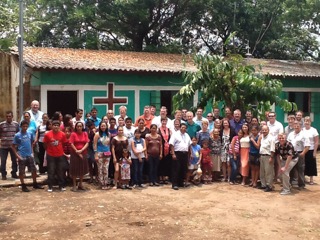
            Our team of twenty-seven worked on three housing projects in the planned community of Getsemaní near the town of Ahachapan, in western El Salvador, near Guatemala. We stayed at a lovely lodge resort in the mountains that featured a large dining room complete with dance floor, a miniature zoo, horse-back riding, a spa and swimming pool, a playground and a couple of game rooms.         

            Luis told us that approximately two-thirds of Salvadorians live in sub-standard housing. Thanks to the twenty-five years of effort on the part of Habitat in El Salvador and the volunteer work of a thousand volunteer teams, that situation is slowly, but surely improving.

            Our media loves to cover violence and corruption. They miss some of the many truly beautiful places we saw on our trip. The people, the food, the hospitality, and the community of volunteers all working on a common mission make traveling to El Salvador well worth the effort it takes to go.

——————————————————————————————-

Kathy Haueisen is an ELCA pastor who lives in Houston, Texas. She has authored two books and served as editor of two others. Asunder is her first novel. Taking an intimate look at the emotions involved in divorce, it will be released April 2016.

            

Poverty, Scarcity, and Your Next Diet

Have you ever failed at dieting? A newer book gives an insightful explanation as to why the diet didn’t work; additionally, the same explanation helps us understand why many get stuck in poverty and what might be done to combat its persistence.

jalbm food

In a previous blog post, I asked: Do you know anyone who is poor? In our increasingly stratified society, most better-off Americans don’t maintain friendships with people living in economic poverty; nonetheless, many have an opinion about their societal brothers and sisters struggling to get by on less. And – let’s be honest – that opinion is generally not favorable.

Scarcity: The New Science of Having Less and How it Defines our Lives, by Harvard economist Sendhil Mullainathan and Princeton psychologist Eldar Shafir, exposes as flawed the opinion that being poor is due mostly to moral failure.

Using the term bandwidth to describe fluid and accessible mental capacity, the authors explain how we process information and make decisions. None of us, they maintain, has unlimited mental capacity. As evidence, think about the last time you saw someone texting while driving. The culpable person was either driving ten miles per hour under the limit or weaving in and out of the lane, like a drunk driver. We can only do so much with what we have, especially as concerns texting and driving. Mullainathan and Shafir say that scarcity of differing types (caused by lack of time, money, or other resources) causes tunneling, a concentrated type of focus. Tunneling helps you send or read a text message while driving, but it hampers your driving performance. None of us is as good at multi-tasking as we think we are. Our available brain capacity, or bandwidth, is taxed when we’re doing more than one thing at the same time.

Temporary scarcity helps the mind focus and causes it, for better or for worse, to tunnel. If you missed breakfast for some reason, there’s a good chance you’ll get some lunch – your mind and stomach united, focused on the task. Chronic scarcity, however, is always disadvantageous. One’s mental bandwidth is heavily taxed when living in a state of chronic want and need. Mullainathan and Shafir maintain that chronic scarcity hampers decision making; living in poverty constitutes an austere tax on the mind.

The co-authors agree with the assessment made by many better-off Americans: specifically, the stereotype of those living in poverty as having a “lower effective capacity” concerning positive decision making for their own health and well-being, and that of their families. But – THIS IS A MAJOR DIFFERENCE – Mullainathan and Shafir attribute the diminished capacity of those living in poverty (compared to those who are well-off) not to sub-par character issues and moral failure. They attribute it to the mental bandwidth tax: “part of their mind is captured by scarcity.” Would you and I make some of the same questionable decisions in similar circumstances that poor people make – like spending too much on basketball sneakers for a kid? It’s easy to say “no.” But, have you or I ever lived in chronic poverty? If we answer the latter question in the negative, we best leave the former questioned unanswered.

We’ve all heard of slackers who do their darndest to game the system; some of these are in our own families. They, however, are the minority. In today’s America, a lot of the folks living in poverty are the elderly and children. Mullainathan and Shafir report that 50 percent of American kids today will at one point or another be on food stamps. It’s a great country, as the saying goes, but it’s also an incredibly unequal country.

In my book Just a Little Bit More, I quote the English historian and economist R. W. Tawney who lived in a time of similar inequality to ours – the 1920s. Tawney spoke of an unequal society that lacked understanding of and compassion for those who lived in poverty: “A society which reverences the attainment of riches as the supreme felicity will naturally be disposed to regard the poor as damned in the next world, if only to justify making their life a hell in this.” Tawney wrote these lines in Religion and the Rise of Capitalism, published in 1926. Some things haven’t changed in close to 100 years.

Mullainathan and Shafir do not shun individual responsibility as they encourage an expanded understanding of poverty and its causes. There is no substitute for hard work and personal responsibility for those desiring to rise above the poverty line. The co-authors do call for something they call fault tolerance – I call it compassion for those living in poverty. Perhaps there is a single mother in your community, working a job that pays $10/hour, juggling childcare and household responsibilities, trying to pick up a class or two at the local community college. What does she need? She needs supportive family, friends, neighbors, and public policy that don’t further tax her mental bandwidth. She needs timely helping hands, an occasional day off, and political representatives and appointees that shape ethical public policy, in part, because they are in touch with her reality.

As for your next diet, Mullainathan and Shafir have a suggestion: Sabbath. The traditional Jewish practice of rejuvenation, tranquility, and rest, Sabbath encourages a break from normal activity. According to the co-authors, food deprivation and trade-offs (adding up allowed calories and carbs, depending on types of food consumed) are activities of self-imposed scarcity that tax one’s mental bandwidth. Psychologically, this type of dieting is exhausting. Consequently, take a day off from your diet when necessary. Don’t blow it or ruin it by consuming all things forbidden! But, be compassionate with yourself – allow for some fault tolerance. Relax and let your mind reboot. The very next day, get back on the diet and have a goal to stay on it for six days or so. Sabbath comes once a week, every seven days.

The long-term goal is new practice. The only diet that works is the one that acts as a bridge to new practice. Good ol’ proper diet and exercise – there’s no substitute for it. Sabbath might help you get there, to the “new you.”


This blog and website are representative of the views expressed in my book Just a Little Bit More: The Culture of Excess and the Fate of the Common Good. JaLBM, distributed by ACTA Publications (Chicago), is available on Amazon as a paperback and an ebook. It’s also available on Nook and iBooks/iTunes, and at the website of Blue Ocotillo Publishing.

isbn 9780991532827

If you’re a member of a faith community – Christian, Jewish, Muslim, Buddhist, or other – consider a book study series of Just a Little Bit More. The full-length book (257 pgs.) is intended for engaged readers, whereas the Summary Version and Study Guide (52 pgs.) is intended for readers desiring a quick overview of the work. It also contains discussion questions at the end of all eight chapter summaries.

Readers of both books can join together for study, conversation, and subsequent action in support of the common good.


Meeting Taylor Branch

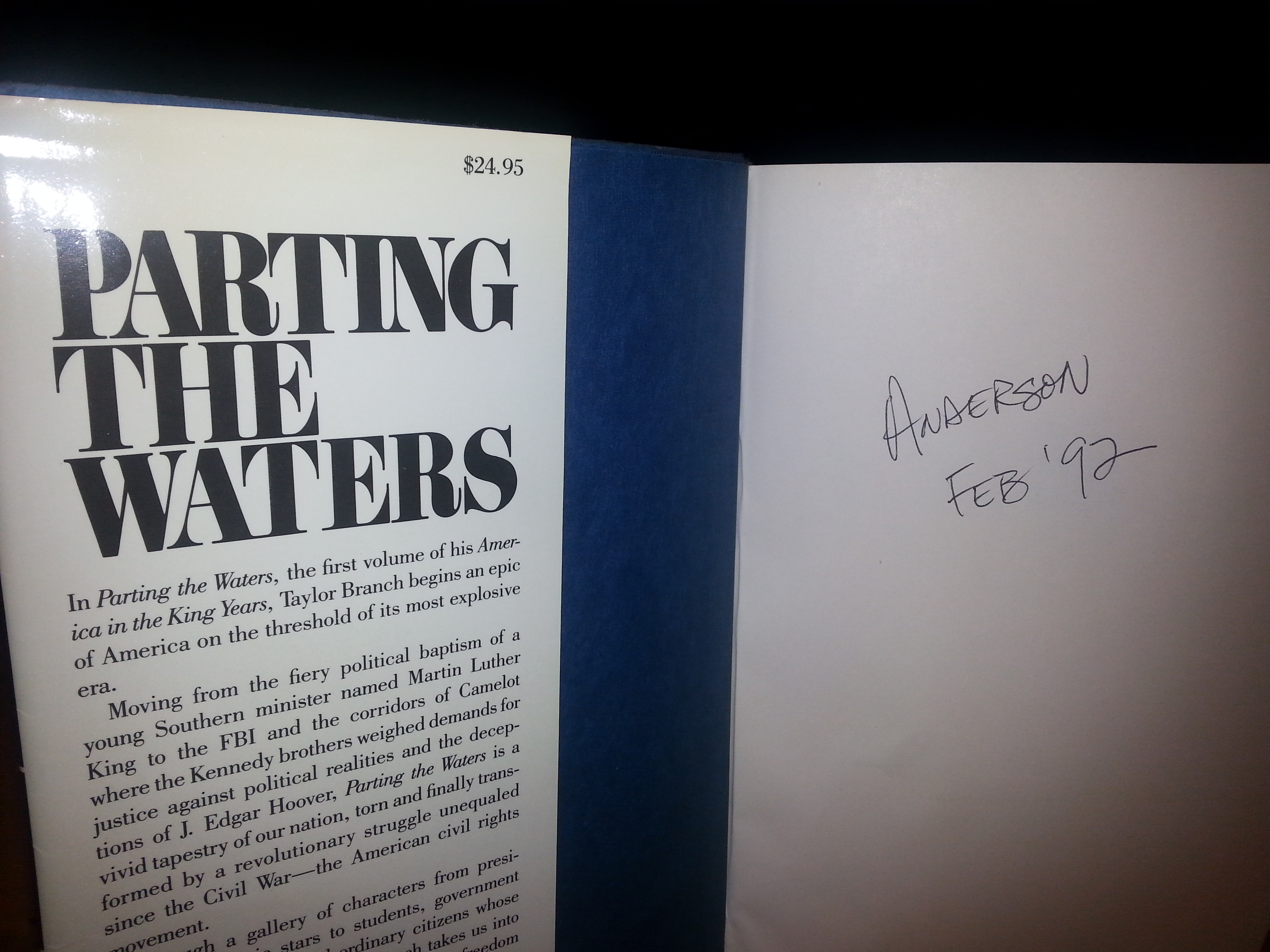
Whenever I buy a book* – new or used – I immediately write my name and the purchase month on the inside cover. I bought Parting the Waters: America in the King Years, 1954-63 when we were living in Houston; I was starting out as a young pastor at Holy Cross Lutheran. I don’t remember exactly how in 1992 I came across Taylor Branch’s exhaustive tome of more than 1,000 pages detailing the crux of the civil rights era. ptwPerhaps I had heard it won the Pulitzer Prize for History, or maybe my ministry colleague Gene Fogt, a bona fide bibliophile, suggested I read it. The book was yet relatively fresh, published in 1988. We were living in Peru in the late ’80s, my seminary internship dictating how I spent the majority of my hours. Seven degrees south of the equator in Chiclayo, Peru, el bendito castellano occupied most of my free brain space, but I was able to do some “catch up” reading on the side – The Brothers Karamozov and Les Miserables, among others. I had always liked to read, but during my adolescent and early adult years, basketball and golf always took precedence over reading. I played some basketball in Peru for a city team, but didn’t touch a golf club for two years. I started to do a lot of reading on internship, and I continued to read extensively as we made it back to the States.

Once I started reading Parting the Waters, my focus did not waver. During the summer of ’92 all my free time dissipated into ardent observation of Martin Luther King, Fred Shuttlesworth, Septima Clark, John Lewis, Robert Moses, and the many other characters that forged the transformative movement. I was mesmerized; the reading filled me in on a part of my life that I had somehow missed. Born in the last week of 1961, growing up in the mostly white northwest suburbs of Chicago – yes, I missed it. When MLK was assassinated on April 4, 1968 in Memphis, I was all of six years of age. I don’t remember my parents saying anything to me about it. I certainly don’t blame them.

Parting the Waters, its Exodus imagery trumpeted, is unequivocally one of the best books I’ve ever read. Not only did it provide crucial historical tb sigdetails of the 20th century’s most formative events, it further shaped my understanding of ministry and vocation. People of faith, working together, can influence and even change society in accordance with a sense of what is understood to be God’s justice and love. The shackles can be broken – imagine that. Yes, the arc of the moral universe is long and it does bend toward justice.

Taylor Branch had more to tell; a second book was titled Pillar of Fire: America in the King Years, 1963-65. I remember waiting and waiting for it to come out. Not until 1998, ten years after the first, did the second volume of the promised trilogy see the light of day. I purchased Pillar immediately upon its release, but didn’t read it until 2001. It was as if I had waited too long for dinner and my hunger had passed. There was other stuff I was reading, our three kids commanded plenty of attention, and I was once again playing an occasional round of golf. Once I started to read Pillar, I remember feeling that Branch was like a juggler trying to keep so many balls in the air simultaneously. There were so many details and threads of the story in the years ’63-’65: Kennedy’s assassination, Vietnam, Malcom X, J. Edgar Hoover, the Klan, King’s Nobel Prize, Selma – just to mention a few. A very busy narrative, its primary focus no longer locked onto King. Pillar was good, but it couldn’t match Parting the Waters. No book ever has.

At Canaan’s Edge: America in the King Years, 1965-68, found Branch back on stride. Published in 2006, the final volume of the trilogy recaptured its focus on King with gripping narrative and historical detail, especially as it highlighted the crucial work of the backbone organizations of the civil rights movement – CORE, SNCC, and King’s own SCLC. I read Canaan in the spring of 2007; as with Parting the Waters, I could hardly put it down.

Another ritual to my book reading habit is to record the date that I finish reading a book on the inside back cover. It was with joy and regret that I wrote 5/18/07 alongside my initials when I finished reading Canaan. Joy for the story told and its teaching message; regret that there was no more to read.

————————————————————————————————————————


tb and tcI met Taylor Branch in April 2015 after a lecture he gave at the University of Texas. The topic of the lecture covered his 2011 piece in The Atlantic, “The Shame of College Sports.” The Frank Deford Lecture on Sports Journalism speaker rearticulated his conviction that students who play sports at major universities (such as the University of Texas) need to be compensated financially. According to Branch, it’s a power issue. At the big-time colleges, administrators and coaches are paid extravagantly, which helps perpetuate a hierarchy where students are essentially powerless. I recommend reading the article if you haven’t – it’s conveniently hyperlinked above.

Branch provided good information for those of us interested in book reading, writing, and publishing. Writing was not his vocational goal after graduating from the University of North Carolina in 1968, but, nonetheless, he started working as a staff journalist for magazine publishers (Esquire and Harper’s) to pay the bills. Before long, he fancied himself a god-honest writer. He wanted to write books. He did some ghostwriting – for Watergate convict John Dean and basketball legend Bill Russell – but labored under the impression that real writers are novelists. In 1981 he produced his novel The Empire Blues. He said, in full self-deprecation mode, that “it sold all of 500 copies.”

He then procured a contract to produce a history of the civil rights movement and its era. The procurement wasn’t easy, and the contract was only for three years. Consequently, Branch did some other writing projects to keep himself and his family fed. Six years of research and writing finally came to fruition when Parting the Waters received stellar reviews and won Branch the 1988 Pulitzer Prize for History. Eighteen more years of research and writing would be required for Branch to finish out the landmark trilogy.

My three aforementioned kids are now adults. In the process of their college educations, I came up with the idea to present them some books, crucially important to me, that I hope would help shape their understanding of the world. Each of them receives the three same books, and then one or two books additionally as befits their particular personality and interests. Parting the Waters is the first book on the list that each of them receives; Dee Brown’s Bury My Heart at Wounded Knee and Bill Bryson’s A Short History of Nearly Everything complete the top three list.

I enjoyed visiting with Taylor Branch after the lecture. He was kind enough to inscribe my original copy of Parting the Waters and to receive a copy of my own Just a Little Bit More, posing for a picture to boot. American in the King Years is one set of many books that have influenced my thinking and inspired me to write JaLBM. Branch is a talented historian and journalist, but he’s gifted as a theologian as well. “King’s life is the best and most important metaphor for American history in the watershed postwar years” (from the preface of Parting the Waters).


Click here to purchase Just a Little Bit More: The Culture of Excess and the Fate of the Common Good. Paperback, $14.95. You will be redirected to the Blue Ocotillo Publishing website.

Click here if you prefer to purchase JaLBM from Amazon. Ebook available on Amazon, iBooks, and Nook.


*I do own a Kindle and enjoy reading ebooks; Thomas Piketty’s Capital in the 21st Century was the first ebook I read on my Kindle. I thought I’d start with something light and short. Ahem. Read my review here.

A sidelight: I also met Frank Deford at the same event, the legendary journalist of Sports Illustrated and NPR fame. The University of Texas holds his archival writings, and presents the Frank Deford Lecture on Sports Journalism annually. I told him I always try to catch his NPR Morning Edition commentary on Wednesdays, which he has been doing since 1980. He has two and a half minutes by which to get his message across. I told him those pieces are like mini-sermons; he thought about that and said, “You’re right.” Keep preaching, Frank!

Pastor Brad Highum on “Just a Little Bit More”

Brad Highum, a pastor at Abiding Love Lutheran Church (ELCA) in Austin, highly recommends you and your congregation do a book study of Just a Little Bit More. As he emphasizes in the video clip below concerning social immobility, rising inequality, and elevated childhood poverty, “We have to know how we got here, in order to begin to address ideas about how we move from this place, how we move forward.”

Pastor Brad has been a passionate supporter of Just a Little Bit More from its very inception. Back in 2011, we lunched over gyro wraps at Phoenicia Bakery on South Lamar Boulevard in Austin. We sat on a picnic table outside in the hot fall wind (Phoenicia, abundantly stocked with Greek and Arab staples, doesn’t have indoor seating) and went back and forth about the 2007-08 economic swoon – and how our faith confronts what it has brought forth. Brad’s enthusiasm let me know that my thinking was on the right track.

The culmination of a three-year process, Just a Little Bit More, was published in May 2014. My own congregation, St. John’s/San Juan Lutheran in Austin, and Brad’s were the first congregations to participate in a book study of JaLBM. We conducted the studies concurrently with the purpose of compiling feedback and notes that would contribute toward a study guide for other faith communities.

I especially appreciate Brad’s comprehension and dissemination of JaLBM‘s message. Our faith does have something to say in mitigation of economic and social inequalities. Brad is absolutely “on point” in this video clip as he encourages others in faith communities to look into a book study of JaLBM.

I first met Brad Highum when he was a student at the Lutheran Seminary Program of the Southwest (LSPS). While studying for ordained ministry (and previous to), he was serving as minister of adult education and programs at Riverbend Church in Austin. Brad is an excellent teacher and preacher. His scripture knowledge and recall are superb; his interpretation is progressive. His fluid articulation pulls in listeners to understand the message being shared.

Pastor Brad and I both conducted seven week studies of JaLBM at our respective congregations. Halfway through the study, one of Brad’s congregants walked into the Sunday morning class at Abiding Love and gave Brad a knowing look. “Pastor Brad,” he offered, “this book is not a light read.”

Brad responded with a wink and a smile: “It’s not a light topic.”

Pastor Brad’s got a quick wit, too.

———————————————————————————————————-

For the congregant at Abiding Love and others who are looking for an easier version of JaLBM to digest, the Summary Version and Study Guide is now available. Amazon and the Blue Ocotillo Publishing website offer it for $6.95 (52 pages); ebook version, $2.99.

isbn 9780991532827As stated above, Brad and the folks at Abiding Love (along with my folks at St. John’s/San Juan) helped shape the discussion questions at the end of all eight summarized chapters. Consequently, readers of the full-length version of JaLBM and the Summary Version and Study Guide can join in the same discussion with the purpose of “understanding how we got here” so that we might better – together – construct societal common good.

Just a Little Bit More: The Culture of Excess and the Fate of the Common Good – full-length version, 277 pages – is available wherever books and ebooks are sold.


The Big Short

“The Big Short,” the film adaptation of Michael Lewis’s book of the same name, explains the 2008 financial crisis by detailing the actions of four groups of investors who foresaw the burst of the housing market bubble. Lewis (Moneyball, The Blind Side, and Boomerang) is in very familiar territory depicting the dark side of Wall Street; his first book, Liar’s Poker, recounted his days as a Wall Street bond market manager in the mid-1980s “when a great nation lost its financial mind.” According to Lewis, not much changed in twenty-five years – save a few names and outlandish increases in the amounts of money bet and squandered on Wall Street.

big shortOur family has been doing a Christmas Day movie for the past few years. Our initial Christmas Day excursion was in 2007 when we took in “Walk Hard: The Dewey Cox Story.” The next year we saw what still rates as one of the best of the Christmas Day pics: “The Curious Case of Benjamin Button.” “Up in the Air” (2009) and “Hugo” (2011) were good, but not memorable. “Anchorman II” (2013) was, predictably, funny in a juvenile type of way. “Les Miserables” (2012) had a great Sacha Baron Cohen as Thénardier, and . . . a whole lotta of singing.

“The Big Short” is well worth seeing. The movie title refers to the practice of short selling a stock or bond – betting that it will tank. The protagonists bet, correctly, that the housing market bubble would burst. The movie’s two hours plus run-time works continually to explain this and other components of the 2008 economic swoon to both those who have and haven’t delved into its causes. The movie’s narrative, including “breaking the fourth wall” explanations from Ryan Gosling’s character, and cameos from chef Anthony Bourdain, actress Margot Robbie, entertainer Selena Gomez, and economist Richard Thaler, help explain complex derivative trading, credit default swaps, collateralized debt obligations, and other roll-off-the-tongue market descriptors.

Neil Irwin, senior economics correspondent for The New York Times, reviews the movie favorably. He is critical, however, of the movie’s notion that no one – save the four groups of protagonists – foresaw the burst of the bubble. Irwin rightly claims that many other people suspected the bubble’s presence as early as 2005; the ferocity of the bubble’s burst is what caught so many by surprise. Subprime mortgage loans’ ability to corrode supposedly walled-off safer securities wiped out dreams on Main Street and Wall Street. American (and worldwide) common good took a beating: jobs and pension funds were lost; properties were squandered; and social and economic inequalities, on the rise for a generation, were exacerbated.

Steve Carell’s character, Mark Baum (Steve Eisman in real life) – haunted and obsessive – doggedly seeks out some sort of justice in the midst of the darkness. He’s a Wall Street player, undoubtedly, but the unmitigated fraud that imbues the financial side of the housing market won’t let him rest. His pursuit of what turns out to be contorted justice gives a glimmer of hope.

As 2016 approaches, we’re still a society that emphasizes fiscal over social policy. A balance between the two categories of policies would be an improvement. The lures of consumerism continue to take precedence over concern for and care of the environment. The realization and acceptance that we can’t continue to burn through unlimited amounts of oil and coal to fuel our desires of economic growth at all costs would be another improvement. And many yet believe that market activity, like a washing machine working a load of soiled clothing, somehow turns our collective greed into good. It doesn’t – and that’s the simple lesson of the 2008 crash well-told by “The Big Short.”

————————————————————————————————————

Understanding the 2008 crash, which had much in common with the economic crash of 1929, is essential knowledge for citizens who care about their families, neighbors, and communities. “The Big Short” – book or movie – is a good place to start. If you would like to understand the larger panoramic view, I humbly suggest you read Just a Little Bit More. Until Brad Pitt contacts me (ha!) to make a movie version of JaLBM (he co-produced “The Big Short”), this linked YouTube short on JaLBM will have to suffice!


This blog and website are representative of the views expressed in my book Just a Little Bit More: The Culture of Excess and the Fate of the Common Good. JaLBM, distributed by ACTA Publications (Chicago), is available on Amazon as a paperback and an ebook. It’s also available on Nook and iBooks/iTunes, and at the website of Blue Ocotillo Publishing.

isbn 9780991532827

If you’re a member of a faith community – Christian, Jewish, Muslim, Buddhist, or other – consider a book study series of Just a Little Bit More. The full-length book (257 pgs.) is intended for engaged readers, whereas the Summary Version and Study Guide (52 pgs.) is intended for readers desiring a quick overview of the work. It also contains discussion questions at the end of all eight chapter summaries.

Readers of both books can join together for study, conversation, and subsequent action in support of the common good.

The Proper Place of Excess

Thanksgiving, once again, is here and gone. I know I had too much to eat and drink. How about you?

Excess is a regular part of the natural order. Our bodies turn excess calories into fat cells – technically, stored energy for later use. Most excess weight, however, is simply lugged around serving unwittingly as a contributing factor to health problems. Alcohol, on the other hand, is eliminated by the body. But a morning-after dehydration headache, caused by excessive drinking, lets you know you overdid it. Long-term excessive drinking, of course, will kill you.

Excess has its consequences.

Excess, nevertheless, plays an important role in the survival process. You and I are here thanks to an excessive amount of spermatozoa, from which emerged one little victor to join forces with an ovum. Survival of the fittest and the fertilized! And not only that, some of the plants which provide food, oxygen, and beauty upon the earth produce seeds for their own reproduction numbering in excess of hundreds and thousands. As a Texas gardener, I plant basil for the summer and cilantro for the winter (for year-round pesto). For seven years running, I haven’t had to purchase seeds to keep my gardens growing. Their seed production is voluminous; I only have to figure out where I left the seeds collected from the previous season!

———————————————————————————————————

Historically, Northern Hemisphere winter has been the season of rest and recuperation. During winter seasons ancestral, many of our forebears rejoiced in the gathered harvest, savored freshly slaughtered meat, and delighted in new beer and wine. Before hunkering down to wait out the winter, trusting their accumulated supplies to hold out – our Northern Hemisphere ancestors celebrated. The winter solstice, December 21, marking the rebirth of the sun, has traditionally been associated with feasts and festivals replete with excesses. Our own secular Christmastime holiday is a direct descendant of these revelries.

Roman Saturnalia and misrule, centered on feasting and gift-giving, also featured societal role reversals where servants and peasants became lords and ladies for a day or short season. The usually steady tables of fortune were turned, if only for a moment. During misrule (common in European societies and colonial America) individuals of low socioeconomic status demanded that their wealthier neighbors and patrons treat them – the servants and peons of society – as if they were the wealthy and deserving. Servants pounded on the doors of their superiors demanding fresh meat and fresh brew. For the most part, these and far more unsavory indulgences were tolerated during misrule. You might have heard or read about the Puritans of Massachusetts infamously outlawing Christmas in the late 1600s. It wasn’t the legendary anniversary of the Savior’s birth with which they had trouble, but the simultaneous misrule celebrations that exalted excesses, some acceptable and others decidedly distasteful.

Later, in the 1800s, misrule evolved into a new type of social inversion that has persisted to our own day, justly captured in the well-known Mel Tormé lyric: Christmas was made for children. In the mid-1800s, before compulsory schooling, children were understood to be miniature adults who occupied the bottom rung of social hierarchy along with peasants and servants. Modern secular Christmas – a family celebration – was created at this time with children becoming the focus of charity and goodwill. Misrule became domesticated, but its excesses were not lost in the transition.

Many of our familial antecedents received only oranges and hard candy for Christmas as children during the Depression (they were thankful for it, though – ask them while you still can and they’ll tell you).  As if DNA code, the excesses inherent to the original secular celebrations that shaped our modern Christmas – Saturnalia and misrule – survived the Depression and now thrive as never before. Today’s high and holy season of excess – starting with Black Friday Eve (it used to be called Thanksgiving) and continuing through New Year’s Day celebrations – is unmatched in terms of devotion to consumerism, materialism, consumption, waste, and over-indulgence.

As the wisdom teacher of Ecclesiastes says, there is a time for all things under the sun. Even excess. I enjoy the extended holiday, especially as my birthday falls during the season. It’s a good thing to celebrate the milestones of this life – on occasion – with a bit of excess. A case of really good wine, a lavish celebratory meal, an expensive trip with loved ones, extended vacation, tickets to a show – it’s your own misrule for a day or season.

It’s natural in the Northern Hemisphere to overdo it a bit at this time of the year. It’s been this way for millennia. But, as wisdom says, all good things in moderation. Whereas a season or moment of excess can have, on occasion, a proper place, we best be wary of its supposed charms.

too much
“How much is enough, Walt?” Breaking Bad, “Gliding Over All,” Season 5

Father Richard Rohr says: “Excess turns all gifts into curses.”

We live in a society where excess has become a way of life, a way of understanding the world, a way of being and interacting in the world. Excess, a cultural value revered and worshipped since the early 1980s in the US, invites extremism and undermines societal common good. How much is enough?


T. Carlos Anderson is the author of Just a Little Bit More: The Culture of Excess and the Fate of the Common Good (Blue Ocotillo/ACTA, 2014).


A Flame of Hope

Thanks to colleague Brian Peterson for this guest blog post. Email: brianpeterson1965@gmail.com

I’ve seen the flame of hope among the hopeless. And that was truly the greatest heartbreak of all.” – Bruce Cockburn, “The Last Night of the World,” Breakfast in New Orleans Dinner in Timbuktu, High Romance Records (1999).

Canadian musician and poet Bruce Cockburn reminds us that even in a world of apparent moral ambiguity, there are those moments in which one is confronted with unquestionable injustice that is both breathtaking and heartbreaking.

A brief encounter with poor people in the Zacate Grande region of southwest Honduras this past July was for me was just such a moment, one that opened a window to a world I never knew and that undoubtedly has changed me forever.

I happened to be there along with seven others as part of a delegation sponsored by the Alliance for Global Justice. We had been travelling for several days already studying the impact of neoliberal inspired mega-projects throughout the region. I’ll leave it to others far more versed in the verities of geopolitics and economics to parse out just exactly what that means, but suffice to say that I caught a glimpse of how just as the day follows the night, corruption, impunity, and failure of democratic institutions to do what they are supposed to do leaves some of the most vulnerable people in our hemisphere with nothing—nothing but hope.

As our intrepid driver Rey pulled our van off the main road into the parking lot of what appeared to be a house or some kind of community center it was clear that something was happening. A large crowd of people had gathered: young women in brightly colored dresses undoubtedly pieced together in some nearby sweatshop but now having been returned as first world cast offs; serious looking young men; campesinos and fishermen whose sun-baked, hard worked skin conferred upon them the visage of old men; and, gracious elderly women who like their poor hermanas throughout Central America are ever the ones to soothe and comfort the suffering while silently bearing their own heartbreak. Last but not least were the barefoot, rag tag children impatient and fussy in the way that children everywhere become when the grownups have to talk about serious matters.

We were there to listen, to endeavor through the lenses and layers of hegemonic privilege to understand and perhaps walk in the shoes of these courageous human beings for whom the accident of birth had consigned them to lives of struggle and fear, determination and hope. They insisted we sit and so some less than enthusiastic young boy was assigned the task of rounding up chairs, white plastic ones as ubiquitous to Central American life as tortillas, rice and beans. In the very least, having walked for miles to get there, our hosts should have been the ones resting their feet – not us! But we were their guests and to do otherwise would have seemed a rejection of what they had to give that day, so we sat.

IMG_49981
Brian Peterson, front row, third from left. Zacate Grande region, Honduras.

Beneath the shadow of a great Guanacaste tree, we heard from the priest, a brave man of devotion, faith and courage, far more so than this pastor could ever imagine conjuring. They had all come that day from ten or so communities along the coast of the Gulf of Fonseca which for some had been quite an ordeal. Rich Honduran oligarchs, in league with US-backed political leaders, have effectively put their country up for sale on the US stock exchange. Like Babylon and Ancient Rome these proposed model cities bear the marks of toxic imperial domination. In these playgrounds for the superrich that are effectively free of burdensome environmental and labor laws the fruits are ripe for the picking—IMF and World Bank funded development projects include a deep water port, scenic beach properties, tourist destinations to rival any other in the world. About the only thing standing in their way though, are the men, women and children who stood before us that day.

We heard too from an attorney working with a local non-governmental organization who described in detail the legal difficulties these communities face, the threats and intimidation, and the probable end of their livelihoods and subsequent inability to provide for their families. The oligarchic control of executive, legislative and judicial branches of the government makes for an easy accommodation of rich benefactors by executive decree, and the changing and rewriting of laws and their brutal enforcement by with thugs armed with US made weapons and machinery.

Perhaps even more heartbreaking than the injustice being carried out against these hard working poor people was their hope; hope in us because we had simply shown up, because we were among the few outsiders who have taken the time to listen and try to imagine what life must be like for them. As we wrapped up our meeting a community elder expressed what I suspect was the hope shared with his compañeros there. “You will go home and get your government to change its policies that are allowing these things to happen here, won’t you?” And as much as I wished I could say, “Yes, absolutely,” I knew better. I knew and know all too well what they are up against—economic, political and military systems that choose not to serve the people, but the powerful few hell-bent on extracting every ounce of life from those who want no more than to live and work in peace, to provide for their children and families, to live lives of quality and meaning. I couldn’t help but lament at the seeming insignificance of my lone voice and what I could ever hope to accomplish on their behalf.

And yet, a broken heart does not inevitably lead to despair and hopelessness but can serve to transform and change. The lyrics of Cockburn’s song describing the “greatest heartbreak of all” go on to declare “and that was the straw that broke me open.” A heart broken-open is a heart that can be filled with something new, with something that for whatever reason couldn’t enter before. So in the time since that brief encounter under the Guanacaste tree what has come to fill the cracks in my own heart?

My broken heart is filled with compassion. The faces, the words, the hospitality shown to us that day are forever etched in my memory. The world is terribly unfair and unjust. By mere accident of birth I live on the other side of the fence enjoying a lifestyle that in many ways is borne on the backs of poor people like them and so many others around the world.

My broken heart is filled with frustration at the apparent disinterest and apathy of those here at home who ask “Oh, how was your trip?” but who have no interest in being open to any meaningful response other than “Oh, it was great!” I’m frustrated at the church I have served as a pastor for almost twenty-five years, a denomination that extols the virtues of “accompaniment,” that raises millions of dollars a year to support helpful and well-meaning development projects and ministries staffed by hard working dedicated people around the world, but a church that perhaps out of fear of upsetting an overwhelmingly monochromatic, upper-middle class, middle to right of the road constituency or of demonstrating “questionable theology” shies away from addressing the systemic issues at the root of poverty and injustice. And so my heart weighed down with frustration, I am left reluctantly agreeing with a synod staff person’s observation nearly ten years ago after an effort to raise justice and poverty issues to a level of highest priority. “Well, Brian, that’s all well and good but you know it’s not going to go anywhere.”

My broken heart is filled with rage at the powerful voices in our society that demonize and dismiss those whose options have been taken from them and have no choice but to become immigrants. I am outraged that poor and vulnerable people like the ones I met have become pawns in political games and are deemed “dirty, rapists,” and parasites in search of a free education, health care and a refrigerator; leeches who are out to take American jobs. My blood boils at the thought that my government supports a country whose leaders act with utter impunity, without any regard for basic human rights, for whom personal gain and profit are valued above all else. I am furious that the presumptive nominee for a major political party has been given a pass with regard to her collusion as Secretary of State encouraging and later justifying a 2009 coup that overthrew the democratically elected president, a properly elected leader who, much to her consternation and all those like her held captive by the chimera of so called free trade and rule of law, had begun to broach the taboo subject of political reform.

That being said, a broken heart is just that, a heart cracked and fissured, a heart that can be open to other possibilities. A heart filled with compassion, with frustration and even rage is nevertheless a heart that can also be filled with hope. Yes, in the hopeless hope of poor desperate campesinos and fishermen of Amapala I find hope in their courage and determination, in their willingness to strive for a better life for them and their children, and unwillingness to accept the world as it is. I find hope in the brave Roman Catholic priests and human rights workers I met there who literally put their lives on the line every day. Among the women, men and children of the small community of faith that I serve as pastor back here in the US I find my hope renewed, as they listen, understand and even encourage their sometimes hair-brained, crazy-talking pastor; we support one another in the covenant God has made with us in baptism “to serve all people following the example of Jesus and to strive for justice and peace in all the earth.” The flames of hope are stoked as I reflect on the work of others, a dear friend, a pastor like me who has gifted the church and the world with a book that challenges us to consider the common good; an activist friend on the ground in Honduras who though not a person of faith shares a sense of compassion for those on the margins, of rage at the present order of thing, of hope in a world where people can live lives of quality and peace; another friend who brings hope and healing to poor disabled children in Nicaragua through a newly founded nonprofit. What I find even more hopeful is that my list is rapidly growing.

Finally, hope abounds in in the conversations and connections with others who are willing to at least listen, to question their assumptions as well as mine, to be open to new perspectives and maybe even a new world. The kind of world a young, frightened girl sang about centuries ago, in which the proud are scattered in the imaginations of their hearts and the rich sent away empty, while the lowly and hungry ones are lifted up and filled with good things; the same hope proclaimed by an often misunderstood John of Patmos—a day when the tears of all those who suffer will be wiped dry, when their mourning and crying and pain will be no more. The accident of birth has afforded me great privilege in life and so while God’s word clearly implicates me convicting me of my own hard-hearted complicity, at the same time it opens the way to transformation and change, to the power of God at work today, in this present moment that is making all things new, even a heart scarred and cracked to be filled with compassion and hope for a world in need and for the new Jerusalem that awaits us all.

Brian Peterson pastors Ascension Lutheran Church (ELCA) in Austin, Texas. He has been travelling to Nicaragua and Honduras on a yearly basis since 2008.

Lifestyle Pornography, Part 2

dogs1My wife, Denise, is considering adopting a dog from one of our local Austin pet shelters. There are a few complications (which I won’t go into here) that delay her decision until the beginning of the coming year. In the meantime, she likes to look at the many pictures of available dogs from the pet shelter website. She’ll be sitting on our living room couch, computer tablet in her lap, and she’ll exclaim out loud to no one in particular: “I want to get a dog!” If I happen to be within earshot, I’ll look at her and she’ll nod affirmatively as I say to her: “You’re looking at pictures of doggie porn again, aren’t you?”

Our shared understanding of the term does not refer to dogs being pictured in sex acts. Rather, we’re using the term porn generically to refer to images that entice a viewer’s psyche. I want that. I need that! Now!! The root definition of pornography: a graphic image intended to stimulate immediate emotional or erotic response.

If you are a dog lover, like my wife, images of cute dogs needing a home can tug at your very soul. Similarly, there are other types of images, plentiful in our society, that encourage and entice and tug at the hearts of their beholders. These are the images of lifestyle porn, intended to turn you and me on to materialistic living. These images, incredibly more pervasive than we realize, invade our psyches via television, movies, magazines, billboards, and the Internet.

Images of luxurious homes, expensive cars, and sleek household appliances are lifted up as possession norms in consumer society. We’re used to that. Pay closer attention, however, to certain movies and TV shows where the images of lifestyle porn proliferate and you’ll see art imitating life. Inequality in the US outpaces that of all other developed nations. Pastor Ben Dueholm has written an excellent article, “Pulp Inequality,” that details the effects of extreme inequality upon what the entertainment industry produces. He calls today’s manifestation of the classic rags-to-riches genre more “garish, random, and humiliating” than their predecessors – reflecting the much steeper climb to the top in today’s America of diminishing economic mobility.

In similar voice, author Heather Havrilesky rips the blockbuster book and movie Fifty Shades of Grey as a materialistic fantasy of “quasi-human bondage.” Her article “Fifty Shades of Late Capitalism” deems the erotic sex for which the book franchise is famous as boring as the unceasing parade of showcased luxury brands in the movie: Cartier, Cristal, Omega, iPad, iPod, Audi, Gucci. Ho-hum. We meet female protagonist Anastasia Steele as a naïve middle-class college grad, and see her evolve into a pampered aristocrat. Does it even matter how the film’s male protagonist Christian Grey made his billions? No, the main point is that he has unlimited resources and can do whatever he desires – sexually and otherwise, while hardly having to work. The American Dream, version.2015.

caddy man.jpeg
Actor Neal McDonough as The Caddy Man

Sex and the CityThe Bachelor and The Bachelorette are likewise berated for their depictions of lifestyle porn by authors like Arthur Chu; his article in The Daily Beast is honest and insightful. The Caddy Man (my blog article linked here), introduced in a 2014 Cadillac ELR commercial, articulates and exemplifies the concept of lifestyle porn better than anyone else. In response to him, and others, I will continue to ask the befitting question that fuels this blog: How much is enough?

In a capitalist society, seeing that my neighbor is doing better than me financially and materially can serve to motivate me. I can work harder, longer, and smarter to achieve what I desire. Economic mobility, although not what it used to be in the US, still avails its blessings to a select group of achievers. Alternatively – and this is radically against the grain – I can choose to be content with what I have and not strive for more.

People are free, for the most part, to chase their dreams in this society – whether their dreams be idealistic, materialistic, noble, or delusionary. Dreams consist of images; there is no imagination without images. Consumer society is predicated on the fact that people will strive for more and more; it’s for this very reason that consumer society provides many blessings and continually reboots modernization. There is a dark side to consumer society, however, and the images of lifestyle porn can inhibit our imagination, because these are predicated on the idea that what we are and what we have are not good enough.

Where do we find the images that let us ponder the reality that what we are and what we have are good enough?


This blog and website are representative of the views expressed in my book Just a Little Bit More: The Culture of Excess and the Fate of the Common Good. JaLBM, distributed by ACTA Publications (Chicago), is available on Amazon as a paperback and an ebook. It’s also available on Nook and iBooks/iTunes, and at the website of Blue Ocotillo Publishing.

isbn 9780991532827

If you’re a member of a faith community – Christian, Jewish, Muslim, Buddhist, or other – consider a book study series of Just a Little Bit More. The full-length book (257 pgs.) is intended for engaged readers, whereas the Summary Version and Study Guide (52 pgs.) is intended for readers desiring a quick overview of the work. Readers of both books can join together for study, conversation, and subsequent action in support of the common good.

Lifestyle or Materialism Pornography, Part 1

You’re not satisfied with your body, are you? How about your living room? Or your phone? Or your smile?

These things can be fixed or replaced new. That’s the message, at least, transmitted to our very souls as colorful, seductive images flood our retinas via TV shows and advertisements, movies, and other avenues of visual communication. And remember, in this day and age, none of these images are touched up to look as pristine and enticing as possible. Ahem.

I live in Austin, Texas and one of the most representative billboards we’ve seen locally in this category is sponsored by a cosmetic surgery firm. It depicts the bikini clad back-side of a tall and shapely female model, probably all of twenty-nine years of age, torso slightly bent forward and leaning on a balcony rail, looking out toward a vast horizon. This image is simply accompanied by the name of the plastic surgery firm (withheld!). Did she have some work done to achieve the assumed bodily perfection projected by the image? Or, do you – who once upon a time blew out twenty-nine candles on a birthday cake – need to get some work done, so you can look a bit more like her?

I understand the need for reconstructive cosmetic surgery for accident victims, cancer patients, and people born with conditions such as cleft lip and palate. Thank God for cosmetic surgery in these cases which restores functionality, dignity, and confidence. But much of elective cosmetic surgery in the United States is an extension of what sociologist Thorstein Velben identified as a new type of consumerism during the Gilded Age in 1899: conspicuous consumption, carried out with the purpose of increasing one’s status and prestige. Oh yes, this type of consumption is also intended to increase one’s overall well-being. And as many of us know by personal experience, the rush of enhanced well-being from a significant purchase lasts about two weeks.

A big difference between Veblen’s day and our day: now our bodies, or parts of them, are things that can be subjected to consumer wants and desires. Your teeth might be relatively straight, completely functional, and cavity free. But, upon closer examination and comparison to pictures of other people’s teeth, they just don’t look good. The solution? Drop anywhere from $2,000 – $40,000 for a better smile. Two dentists (who used to be partners) alternate with regularity their advertisements on the back page of the first section of the Austin-American Statesman. I’m told that ad space goes for about $3,500/day. “Transforming lives, one smile at a time” – business must be booming to cover the cost of the ads. The before and after pics showcased in these ads, especially of older patients with bad looking teeth, demonstrate significant changes. Bravo. The numerous before and after pics of younger adults, only a few having bad looking teeth – do not demonstrate significant changes.

There are folks who are in dire need of reconstructive dentistry work. Again, we’re thankful for good dentists who do good work. And certainly the two dentists I’ve referred to have done plenty of good work alleviating patients of tooth-related pain and restoring necessary functionality. Yet, they do other work – and this is the work advertised – that appeals to conspicuous consumers. From one of the ads: “Walking into (name withheld!) of Austin is like walking into a luxury home” (image of luxurious office provided in the ad, of course). It’s not all that different from plastic surgeons who specialize in today’s most common cosmetic plastic surgery in the US, the boob job. The premise is lucrative: what you have and what you got are not good enough.

Dentists, plastic surgeons, and their patients are free to do as they wish in the realm of commercial exchange. No worries: I’m not advocating a shutdown of their business practices. As if . . .

The examples that I write about here are representative of a society that has its priorities out of whack. Kids raised in this society adopt these priorities, and learn its truth: What you have and what you got are not good enough. Part of this philosophy is good, but when it goes too far, there’s trouble.

Some of us can remember, decades ago, as teenagers, seeing a souped up ’67 Chevelle SS. Va-room, va-room. You said to your dad: “I want to get a Chevelle.” He answered: “Good for you – get a job!” And you did get a job and, back in that day, you could work and save toward reaching your goal. It was a great lesson – and a great car! Times change, however. The earnings of a part-time job today won’t get a seventeen year-old anywhere near a nice, used Mustang. But he, or she, is continually bombarded with visual images that communicate the prominence of conspicuous consumption.

The generic definition of pornography: a graphic image intended to stimulate immediate emotional or erotic response. I want that. I need that! Now!! The images of lifestyle or materialism pornography are all around us, beckoning our involvement in and commitment to conspicuous consumption.

Maybe someday I’ll buy some ad space in the Statesman or pay for a billboard, with the image backdrop of cool blue sky, that says: “Be at peace – You are fine simply the way you are.”

cool-blue-sky_p


This blog and website are representative of the views expressed in my book Just a Little Bit More: The Culture of Excess and the Fate of the Common Good. JaLBM, distributed by ACTA Publications (Chicago), is available on Amazon as a paperback and an ebook. It’s also available on Nook and iBooks/iTunes, and at the website of Blue Ocotillo Publishing.

If you’re a member of a faith community – Christian, Jewish, Muslim, Buddhist, or other – consider a book study series of Just a Little Bit More. The full-length book (257 pgs.) is intended for engaged readers, whereas the Summary Version and Study Guide (52 pgs.) is intended for readers desiring a quick overview of the work. Readers of both books can join together for study, conversation, and subsequent action in support of the common good.

Jesus 2016 – Social Egalitarian Party

The Donald leads, but is not a lock, on the Republican side of the presidential primaries. Hillary boasts similar standing on the Democratic side. What if Jesus were running for highest office in the free world?

Jesus asked his disciples “Who do you say that I am?” Peter spoke not only for his fellow disciples, but for the early church. His answer “Messiah” – God’s chosen one – has stood firm for two millennia. jesus politico

Jesus’s question hasn’t gone away. I answer it today like this: “Jesus, you are my social egalitarian Lord.”

Granted, social egalitarian sounds a bit silly. It’s about as silly as Jesus running for POTUS.

Bear with me, however, and let me unpack the phrase social egalitarian. Egalitarian is a biblical concept, as exemplified in Exodus 5 – “let my people go” – and Galatians 3 – “for you are all one in Christ.” Both the American and French revolutions were fueled by the concept. The word itself has been in use for some 150 years; its root is the French egal (equal), yet it goes beyond equal quantities, measurements, or values to a deeper reality. Egalitarianism emerges and comes to light from a situation of specific inequality—dominance-subordination. Egalitarianism is political in nature: a group or commu­nity engaged in the struggle of self-determination within the larger community or with a competing community seeks, at­tains, and maintains a balance or equity with its competitor. The spirit of egalitarianism opposes unfair advantages; it’s biblical and American to the core.

As for the social aspect of the phrase, we remember that Jesus was pretty good at spending time with all sorts of folks. He spent face time with religious leaders, the outcast, the well-to-do, the sick, the connected, the lame. He also spent time, oftentimes shocking his own disciples, with women and children. Additionally, while travelling, Jesus led his disciples through foreign territories. This was untypical behavior; Jesus’s disciples were accustomed to avoiding certain foreign areas and peoples.

While traversing boundary lands in Mark 7, Jesus and his disciples are confronted by a foreigner – a Syrophoenician woman. She knows something about Jesus and wants him to heal her daughter. Jesus shows typical human behavior in this encounter; he tries to put her off. He seems to know enough about her – that she is a foreigner.

“It is not fair to take the children’s food and throw it to the dogs.”

The dogs? That’s blatantly derogatory. This time, at least, Jesus’s reaction to a foreigner is no different than that of his disciples.

“But even the dogs under the table get to eat the crumbs that fall.”

It’s as if she says to him: If you are who they say you are, you need to pick your game up.

And he does pick up his game. “Woman, be on your way. The demon has left your daughter.”

Jesus was human. We tend to see Jesus as having an ever-present halo hovering over his head, indicating his perfect behavior and all-knowingness in all things. But that’s unrealistic and it’s not true to Scripture. To be human is to be limited. Like the rest of us, Jesus had to go through processes and experiences in order to learn and better understand the world and its peoples. This woman showed him something that he needed to learn. He was an advanced social egalitarian before this encounter with the woman; after the encounter, even more so.

To be a social egalitarian in American society today is to traverse boldly against the grain. It is to spend face time with those who are “other” rather than only interacting with those who look, think, and value similar to “us.” American society is highly segregated – perhaps not as racially segregated as in previous eras, but certainly so in terms of socio-economic differences. Unquestionably, wealth is a blessing and (more often than not) a reward for hard and smart work. Wealth can serve as a bubble, however, isolating well-off Americans from other Americans – those who work for minimal wages, have little or no health insurance, and/or struggle under debilitating circumstances.

Do you know anyone – on a friendship level – who lives in poverty? Or anyone who speaks English as a second or third language? Or anyone who practices a different religion than yours?

Politicians – regardless of party affiliation – who negatively stereotype “other people” (including immigrants) are not worthy of the highest office in the land. This society doesn’t need more separation into “us and them,” it needs more interaction between its inhabitants. This society is the world’s richest in terms of diversity, experience, and capabilities. It’s time for us to delve deeper to see where we can trust one another. Fear of the “other” might be good enough to win a party nomination, but it won’t do much good for the society as a whole.

Even Jesus didn’t want to have to deal with a woman who wasn’t part of his regular community. But as she confronted him, he stopped. He looked into her face and into her eyes – and was changed. This is the spirit of social egalitarianism. It is to encounter the other as an equal in God’s eyes and to act upon that conviction.

Jesus, my social egalitarian Lord. This is the one I will follow.


This blog and website are representative of the views expressed in my book Just a Little Bit More: The Culture of Excess and the Fate of the Common Good. JaLBM, distributed by ACTA Publications (Chicago), is available on Amazon as a paperback and an ebook. It’s also available on Nook and iBooks/iTunes, and at the website of Blue Ocotillo Publishing.

If you’re a member of a faith community – Christian, Jewish, Muslim, Buddhist, or other – consider a book study series of Just a Little Bit More. The full-length book (257 pgs) is intended for engaged readers, whereas the Summary Version and Study Guide (52 pgs) is intended for readers desiring a quick overview of the work. Readers of both books can join together for study, conversation, and subsequent action in support of the common good.